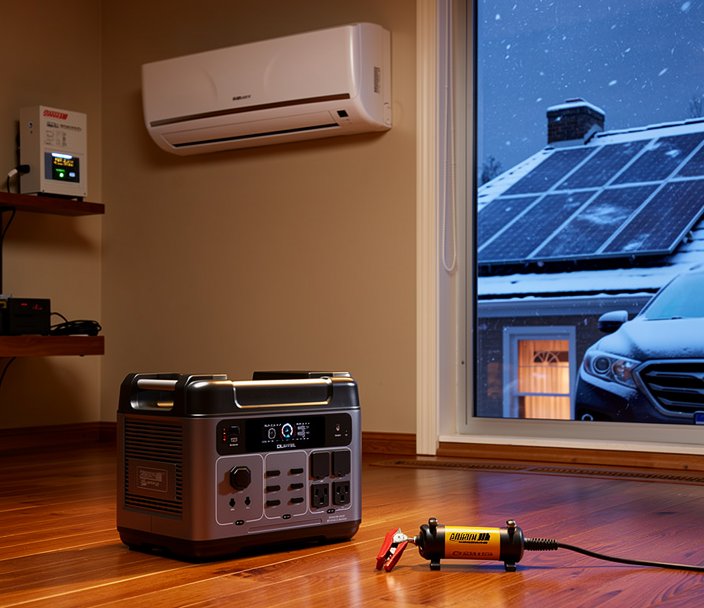
C01
C01


Sizing Solar and Battery for a Winter Heat Pump: A Cold‑Climate Guide for Europe (Germany, Sweden, Ukraine)
The key to powering a heat pump through a European winter isn’t a bigger battery — it’s a cold‑climate‑aware load audit. If you’re sizing a solar and battery system to keep your home warm during weeks of grey skies and sub‑zero nights, a generic online calculator will disappoint you. You need a method that accounts for your heat pump’s real winter appetite, the winter sun’s meager yield, and the way battery chemistry slows down in an unheated garage. We’ll walk through that method, step by step, so you can avoid the most expensive sizing mistake: underestimating the cold.
Before you spend a single euro, understand that what you’re building is not just a backup — it’s a cold‑climate energy system. For a broader look at the economic case, see our European Homeowner’s Blueprint to Slashing Heat Pump Bills with Battery Storage and Smart Tariffs.

Load Audit Methodology: Measuring Your Heat Pump’s True Winter Consumption
Forget nameplate ratings. A 10 kW thermal heat pump might pull 3 kW of electricity on a mild day, but spike to 5 kW during defrost cycles or auxiliary heating. The only way to size a battery correctly is to measure, not guess. Here’s the practitioner’s method:
Step 1 — Meter the unit during a real cold spell. If the heat pump already has a dedicated circuit, clip a plug‑in energy monitor (like a DIN rail meter) onto the supply cable and log consumption every 15 minutes for at least three consecutive cold days (outdoor temperature below −5 °C). If you can’t tap the circuit yet, use the outdoor unit’s spec sheet: record the compressor RLA (rated load amps) and multiply by voltage to get running watts, then add 15 % for the fan and controls.
Step 2 — Log the duty cycle. How many hours per 24 hours does the compressor actually run? In a poorly insulated German Altbau, a 6 kW heat pump might run 8 hours on a cold day; in a new Swedish passive house, perhaps 2 hours. Multiply running watts by run‑hours to get daily Wh.
Step 3 — Don’t ignore defrost. Reverse‑cycle heat pumps can defrost 4–10 times per night, each drawing 2–3 times the normal running current for 5–10 minutes. Add 10–20 % to your daily total to cover it. If your unit has a resistive backup strip, add its full wattage for any hours it runs.
The data plate usually lists the compressor’s full‑load amps, not the total system draw. Add the condenser fan, electronics, and — if the outdoor unit is cold — the defrost cycle can briefly double the current. That’s why a pure sine wave inverter with a healthy surge margin matters; a 3 kW continuous unit may need 6 kW+ peak capacity. For more on surge requirements, read Can a Portable Power Station REALLY Run a Heat Pump?
Calculation Walkthrough: From Real Numbers to Daily Wh
Let’s work a concrete, realistic example — a German detached house in Saxony with a 6 kW thermal heat pump (COP 3 at 7 °C, COP 2 at −7 °C). No electric backup strip.
Measured data (cold January week, average outdoor temp −4 °C):
- Compressor + fan + controls: 2.8 kW electrical draw when running
- Duty cycle: 9 hours compressor‑on per 24 h
- Defrost cycles: 8 per day, each 8 minutes at 5.2 kW → (8 × 0.133 h × 5.2 kW) ≈ 5.5 kWh/day extra
- Daily energy: (9 h × 2.8 kW) + 5.5 kWh = 25.2 + 5.5 ≈ 30.7 kWh.
Now the solar side. A fixed‑tilt 1 kWp array in central Germany generates about 0.6 kWh/kWp on an overcast December day. To simply cover the heat pump’s 30.7 kWh would require a 51 kWp array — unrealistic. Instead, most systems rely on the grid for deficit charging and size the battery for autonomy during short outages or to time‑shift cheap electricity. A practical off‑grid design for Europe’s winter would either pair a very large battery with occasional generator charging, or accept a much smaller continuous load (e.g., just the circulating pump and one room’s fan coil). Our calculation here shows that for a true winter off‑grid scenario, solar alone won’t carry a whole‑house heat pump; you’ll need a hybrid approach.
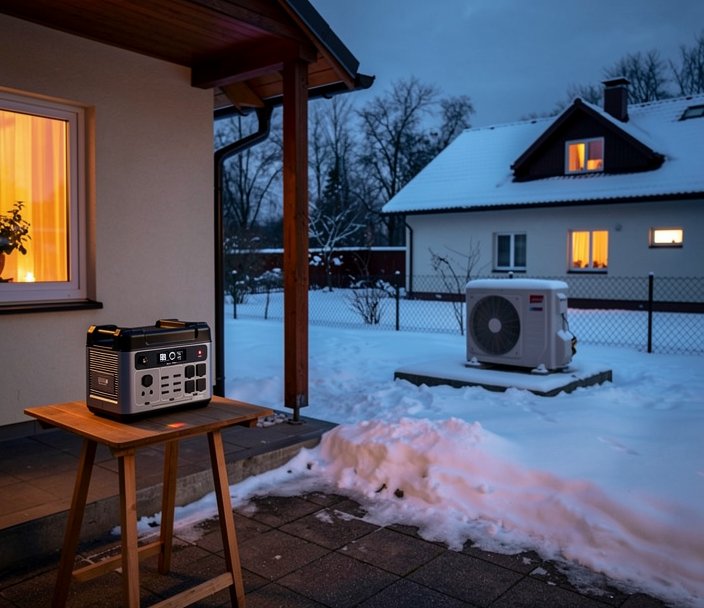
But many users want a backup battery that can run the heat pump for a few hours during a power cut — not indefinitely. That’s the sweet spot for a portable power station. For a 2–3 kW electrical load, a 5 kWh unit can deliver 1–2 hours of heating; add an expansion battery and you stretch it further. In the sizing table below, we’ll map these scenarios to actual battery capacities.
For a deeper dive into calculating daily Wh for all‑electric homes, refer to Heat Pump Battery Sizing: How Much Storage Do All‑Electric Homes Need?
Common Underestimates: Hidden Loads, Inverter Losses, and Cold‑Weather Derating
First‑time system designers routinely ignore three categories, and that’s where the real‑world story goes wrong:
Three culprits usually conspire: (1) defrost cycles you didn’t measure, (2) inverter conversion losses of 5–10 % that silently shave off runtime, and (3) cold‑weather capacity loss — a LiFePO₄ battery stored at −5 °C may deliver only 70–80 % of its rated watt‑hours, and its BMS may block charging altogether below 0 °C. Multiply those effects and a 5 kWh nameplate battery might yield barely 3 kWh usable in a freezing garage.
1. Inverter and conversion losses. Even the best pure sine wave inverter eats 8–15 % of the DC energy when inverting to AC. If you need 30 kWh at the heat pump plug, budget 33–35 kWh from the battery. This loss is extra noticeable when the load is high.
2. Cold‑weather battery derating. Lithium iron phosphate (LiFePO₄) cells, like those in many portable power stations today, are rated at 25 °C. At 0 °C, usable capacity drops roughly 10–15 %; at −10 °C, more than 20 %. More critically, the battery management system (BMS) will prevent charging below 0 °C to avoid plating damage. So if your battery sits in an unheated garage that regularly hits −5 °C, you cannot recharge it from solar or AC until the cell temperature rises above freezing — a detail that has caught many off‑grid enthusiasts by surprise.
3. Failure story. Suppose a family in central Sweden installed a 10 kWh LiFePO₄ battery in an uninsulated outbuilding, expecting it to run a ground‑source heat pump during a 3‑day outage. On the second night, the outdoor temperature dropped to −18 °C and the BMS locked out charging; by morning the remaining capacity was already so low that the system shut down, leaving the house at 8 °C. The fix was costly: relocating the battery to a heated basement and adding insulation. The lesson: count the installation environment as part of your sizing.
Positive counter‑example. A Berlin homeowner, with a similar sized heat pump but a well‑insulated basement that never fell below 5 °C, accounted for a 15 % cold‑capacity derating and an extra 10 % for defrost. She sized her battery 25 % larger than the raw calculation, and over three bitter nights the heat pump ran without interruption. Her upfront “over‑investment” was the cost of not freezing.
Product Sizing Table: Map Your Daily Wh to Battery and Solar Capacity
Below we’ve distilled the cold‑climate math into a practical lookup. All estimates assume a LiFePO₄ battery in a heated or well‑insulated space (5–20 °C) and a 15 % capacity buffer for aging and cold edge cases. Solar sizing assumes an average December insolation for central Germany (0.6 h/d full sun equivalent); adjust for your latitude. For homes in Sweden, consider 0.2–0.4 h/d; in Ukraine, 0.5–0.7 h/d depending on region.
| Scenario | Heat pump electrical load (run) | Daily winter consumption | Recommended solar array | Recommended battery capacity (usable, at 10 °C) | Example OUKITEL system |
|---|---|---|---|---|---|
| Berlin apartment – 800 W balcony solar + 1 kW air‑source heat pump (emergency heating only) | 1 kW | 6 kWh (6 h/day) | 2 × 400 W panels (balcony, grid‑tied) | 2–3 kWh | OUKITEL P2001 Pro (2048 Wh) with one expansion battery |
| German detached home – 6 kW thermal heat pump, COP ~2.5, 160 m² living space | 2.8 kW | 30 kWh | 4 kWp (roof) + optional 800 W balcony | 10–12 kWh (for 8‑h backup) | OUKITEL P5000 Pro (5120 Wh) + 3× OUKITEL BP3000 expansion modules (total 16.4 kWh) |
| Swedish off‑grid cabin – 4 kW inverter‑drive ground‑source heat pump, well‑insulated | 1.8 kW | 18 kWh | 6 kWp (ground mount, high tilt) | 15–18 kWh (1‑day autonomy + winter margin) | P5000 Pro + 6× BP3000 (up to 16.4 kWh) and a 4 kW backup generator for multi‑day overcast periods |
| Ukraine urban home (power‑outage backup) – 2 kW ductless split heat pump for one room | 1.5 kW | 12 kWh (8 h outage) | Grid charging primarily; optional 2 kWp solar for recharging between outages | 5–6 kWh | P5000 Pro or P2001 Pro + 2× BP3000 |
See our full range of portable power stations and compatible solar panels for more configuration options.
Safety Margin Rules: How Much Buffer for Bad Weather, Aging, and Future Expansion
Batteries degrade, winters get darker, and heat pumps sometimes run longer than the design day. A safety margin isn’t a luxury — it’s the difference between a system that works for a decade and one that fails the first severe cold snap. Here’s how to build it in, based on technical specifications rather than guesswork.
1. Capacity degradation. LiFePO₄ cells typically retain 80 % of initial capacity after 4000–5000 full cycles, roughly 10 years of daily cycling. To keep your design capacity available at year 10, start with 25 % more than today’s requirement. If your cold‑day calculation says 8 kWh usable, install at least 10 kWh.
2. Cold‑temperature buffer. If your battery must live in an unheated space where winter lows dip to −5 °C, add a 20 % capacity margin on top of the degradation buffer. Even better: look at the manufacturer’s operating temperature rating. The OUKITEL P2001 Pro specifies operating 0 °C–40 °C and storage −10 °C–40 °C. That means if the environment routinely goes below 0 °C, the BMS will safeguard the cells by blocking charging; discharge may still work but with reduced capacity. Smart move: insulate the battery enclosure and add a small thermostatically controlled heating pad (many LiFePO₄ batteries for cold climates include integrated self‑heating, though OUKITEL’s current lineup relies on environmental control).
3. Inverter surge headroom. A heat pump’s locked‑rotor current can be 4–6 times the running current. If your load audit shows a running draw of 2.8 kW, the startup surge could exceed 11 kW. The P5000 Pro handles 8000 W surge, enough for many split systems up to 3 kW running. For larger units, consider a soft starter or choose a system with a higher surge rating. This is not a paper specification — it’s the instant when your lights dim and the inverter trips. (See our linked article on heat pump surge limits for a detailed walkthrough.)
4. Redundancy for critical loads. If the heat pump is your only heat source, keep at least 20 % of the battery reserved for essential loads (circulator pump, controls, a small fan coil) so you can keep pipes from freezing even if you can’t run full heating. This “resilience reserve” should push your total sizing up by another quarter‑day’s running time.
5. Future expansion. German households, for instance, are increasingly adding heat pumps and EV chargers simultaneously. A battery system that can expand (like the OUKITEL BP3000 stackable solution, which scales from 2 kWh to 16.4 kWh) lets you add capacity later without rewiring — a form of safety margin that pays its way.
Finally, when financial incentives exist, they can offset the cost of extra capacity. Sweden’s 50 % grön teknik tax deduction on battery storage (capped at SEK 50,000 per person) effectively discounts the safety margin you’d prudently add anyway. In Germany, KfW 270 loans and the KfW 442 grant for PV‑plus‑storage‑plus‑wallbox can make the larger system economically sensible. Check current terms on the official kfw.de site before you commit.
Verification Method: Field‑Test Your Estimate Before You Buy
No spreadsheet is a substitute for measuring your actual loads. Before you order thousands of euros in batteries and solar panels, perform a low‑cost reality check:
- Borrow or rent a plug‑in power meter (e.g., a meter that logs kWh). Run it on the heat pump’s circuit during the coldest week you can expect. Log the daily total and any peaks you see. Compare the result to your calculated 30.7 kWh in the walkthrough — if you get 28 kWh or 35 kWh, adjust accordingly.
- Run a scaled test with a small portable power station. Even a 2 kWh unit can tell you a lot. On a cold evening, power the heat pump from the unit while monitoring the battery’s SOC (state of charge) via its app. Measure how long it takes to drop from 100 % to 20 %. If your 2 kWh unit gives you 40 minutes of heating at 3 kW, your real‑world draw is closer to 3 kWh per hour, confirming your math.
- Check temperature at the battery location. Place a data logger in the proposed spot for a week. If it records any temperature below 0 °C, your system will need a heating solution or relocation. If the location is damp, ensure the unit has adequate splash/dust resistance; the P2001 Pro mentions “Splash & Dust Resistant” but IP rating specifics aren’t published — in practice, a dry, insulated cabinet works best.
- If your test reveals a mismatch, don’t assume you need more battery. First, reduce the load: can a smaller, high‑COP heat pump cover your needs? Or can a heat pump water heater be shifted to daytime only? Cutting the demand is always cheaper than adding capacity.
Decision Matrix: Which Winter Heat Pump Setup Is Right for You?
Use this quick‑reference matrix to narrow down your system, based on the climate and your primary goal. All battery suggestions assume LiFePO₄ and include the safety margins discussed above.
| Your situation | What matters most | Recommended battery capacity (usable) | Solar array (winter partial coverage) | Best product path | Key caveat |
|---|---|---|---|---|---|
| German apartment with 800 W balcony solar, want 2‑h emergency heating per blackout | Portability, low cost, grid recharging | 2–3 kWh | 800 W balcony (grid‑tied) | P2001 Pro | Not for whole‑home heating; only one room or an air‑to‑water unit with low flow temperature |
| German detached home, want 8‑h backup during EnBW red‑phase outages | High surge capacity, expandability | 10–12 kWh | 4 kWp roof + solar charger | P5000 Pro + 3× BP3000 | EPS <10 ms switchover works for critical circuits but requires transfer switch; not whole‑house seamless switchover |
| Swedish off‑grid cabin (no grid), full winter heating with ground‑source heat pump | Massive battery, cold‑hardy, generator backup | 15–18 kWh | 6 kWp ground mount, steep tilt | P5000 Pro + 6× BP3000 (16.4 kWh) + diesel/propane generator | Requires heated battery shed; solar alone insufficient in deep winter — generator hybrid mandatory |
| Urban Ukraine, frequent 6‑12 h power cuts, 2 kW split heat pump to heat living room | Grid recharge speed, EPS, portability | 5–6 kWh | Optional 2 kWp for daytime recharging | P5000 Pro (or P2001 Pro + 2× BP3000) | Rapid AC charging (3200 W) is key; solar helps only if grid is off for days |
Frequently Asked Questions
How much does solar panel output drop in winter compared to summer in Germany?
In Germany, a fixed‑tilt solar array typically produces 10–20 % of its rated capacity on an overcast December day, compared to 100 % on a clear June day. A 1 kWp system that yields 4–5 kWh in summer may give as little as 0.4–0.8 kWh in deep winter, mainly due to shorter days, low sun angle, and cloud cover.
Is a self‑heating battery worth the extra cost for a garage that occasionally dips to −5 °C?
If the battery must charge during those cold nights, a self‑heating function or external heating pad is almost mandatory, because the BMS will block charging below 0 °C. If you only discharge (e.g., during an outage when the grid is already down), a standard LiFePO₄ battery will work but with 15–20 % less runtime; you can compensate by oversizing the battery, which is often cheaper than buying a heated model.
Can I rely on a portable power station to heat my home during a Ukrainian winter power outage?
Yes, but manage expectations. A 5 kWh portable station can run a 2 kW heat pump for about 2–2.5 hours. Multiple expandable units can stretch that to 6–8 hours, enough to keep one well‑insulated room warm through a long outage. However, whole‑home heating off battery alone is rarely practical because the energy demand is so high. Pair with a high‑COP unit and only heat essential zones.
How do I calculate the minimum battery capacity for a heat pump in sub‑zero temperatures?
Use this formula: (heat pump electrical draw in kW) × (desired runtime in hours) × 1.25 (cold‑derating + inverter loss) × 1.15 (defrost overlay) = minimum usable kWh. Example: 2.5 kW × 6 h × 1.25 × 1.15 = ~21.6 kWh. Remember to check that the battery can deliver the required continuous power at the expected temperature.
What’s the winter solar panel tilt angle for optimal yield in northern Europe?
A rule of thumb: winter tilt = latitude + 15°. For Stockholm (59 °N), that’s about 74° from horizontal; for Berlin (52 °N), ~67°. A higher tilt helps the panels shed snow and captures more of the low winter sun. If panels are ground‑mounted, you can adjust the angle seasonally; if roof‑mounted, a compromise around latitude +10° often gives a good annual balance.
This article was written using up-to-date sources as of August 2026. Details may change over time — verify current specifics before relying on them.
Latest articles
OUKITEL Power Brings Full-Scenario Energy Storage Solutions to Intersolar Middle East 2026 in Dubai

OUKITEL Showcases Energy Storage Solutions at Intersolar South America 2026, Accelerating Expansion into Latin America
The European Homeowner’s Blueprint to Slashing Heat Pump Bills with Battery Storage and Smart Tariffs
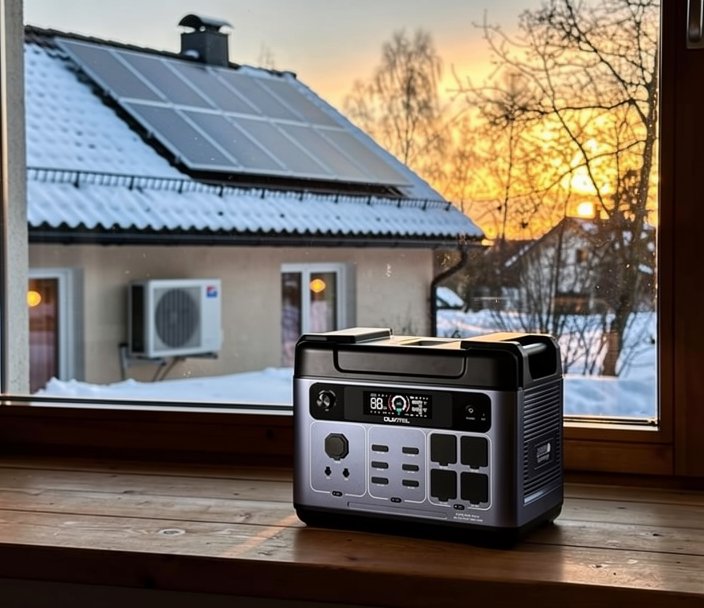
Sizing Solar and Battery for a Winter Heat Pump: A Cold‑Climate Guide for Europe (Germany, Sweden, Ukraine)
Heat Pump Power Outage Survival Guide: Stretching Your Battery Through Multi-Day Winter Outages