C01
C01


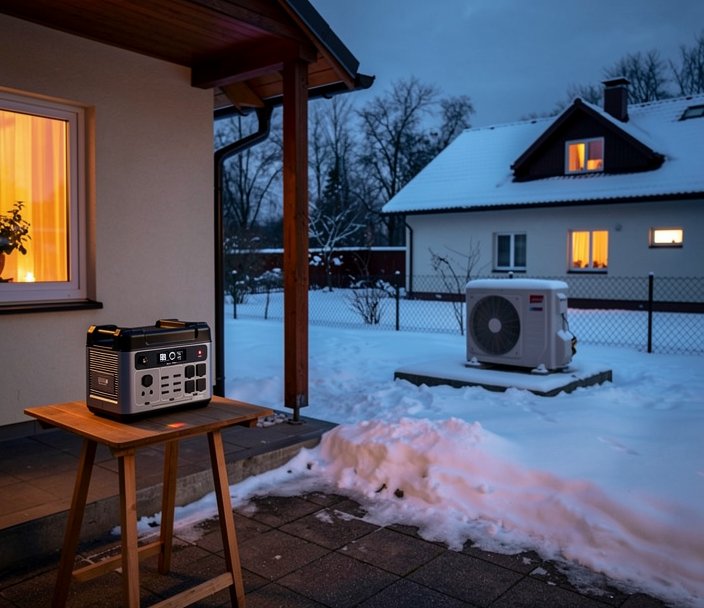
Heat Pump Power Outage Survival Guide: Stretching Your Battery Through Multi-Day Winter Outages
The single most important change you can make to survive a multi day winter power outage with a heat pump is rethinking what “backup” actually means. It’s not just about having a big battery. It’s about slashing your electrical load, keeping the battery warm enough to deliver its promised capacity, and having at least two ways to put energy back in when the grid stays dead for 48 hours or more. The households that ride out a winter blackout comfortably — and safely — are the ones that treat their battery system as a managed energy budget, not a bottomless fuel tank.

Why Most Battery Backup Plans Fail in a Multi Day Winter Outage
The failure pattern is strikingly consistent. A homeowner looks at their heat pump’s nameplate rating — say 2.4 kW — multiplies by the hours they want to run, and buys a battery that matches that math. When the outage hits, the battery is sitting in a freezing garage, the heat pump’s startup surge trips the inverter, and the defrost cycle sends current draw spiking every 45 minutes. By morning, the battery is dead, the house is 9 °C, and the backup plan has evaporated.
Here’s what breaks the plan, in order of impact:
- Startup surge and defrost spikes. A modern inverter heat pump still pulls 3–5 times its running amps for a fraction of a second during compressor start, and defrost cycles can slam the compressor into near full load. If the battery inverter can’t handle that surge, it shuts down — and a “4 kW” inverter may not save you without a soft starter.
- Cold weather capacity loss. Lithium ion cells, including LiFePO₄, lose available capacity when the cell temperature drops below about 5 °C. Below 0 °C, many battery management systems forbid charging entirely, and discharge performance degrades. A 5 kWh pack at –5 °C may deliver only 3 kWh usable — and if the battery was stored in an unheated garage, that’s exactly where it sits.
- Neglected recharge plan. Few outages last just one battery cycle. Without a way to replenish the battery while the grid is down — solar, generator, vehicle to load — the system is a countdown timer, not a sustainable backup.
- Auxiliary heat and parasitic loads. Some heat pump installations include a backup electric resistance strip that can pull 5 kW or more. If that strip engages during defrost or when the setpoint is raised quickly, the battery drain is catastrophic.
Recognise your own setup in any of those? Most households hit at least two. Fixing them changes the survival equation entirely.
Load Prioritization: What to Keep Running and What to Sacrifice During a Heat Pump Outage
Before you size a battery or even think about transfer switches, you need a ruthlessly tiered load list. During a multi day winter outage, not everything deserves a watt hour. The rule is: life safety first, freeze prevention second, comfort a distant third.
The three tier survival load plan
Tier 1 — Critical loads (must run continuously): Refrigerator (120–200 W cycling), any medical equipment, a few LED lights (perhaps 20 W total), internet router if cellular service is unavailable (10 W), and — if you have a gas furnace or a gas water heater — the blower or circulator pump (300–600 W). These loads together rarely exceed 800 W continuous, which a modest portable power station can handle.
Tier 2 — Freeze prevention and minimal heat (intermittent): The heat pump itself. The goal here is not 21 °C; it’s keeping pipes above 5 °C and preventing the indoor temperature from plummeting. Running the heat pump for two 30 ‑minute blocks every three hours can keep a well insulated home in a livable range during a –10 °C night. That intermittent operation dramatically cuts total energy demand.
Tier 3 — Comfort and convenience (shed first): Television, gaming consoles, secondary freezers, dishwasher, electric water heating. If the outage stretches into day three, Tier 3 should already be switched off manually or via a smart panel.
Scenario‑budget matrix: how much battery for what ambition?
The table below maps three outage‑survival profiles to realistic battery capacity and recharging strategies. Costs are ballpark estimates in EUR for a complete backup‑ready configuration (battery, inverter, essential wiring) as of 2027.
| Survival profile | Loads covered | Recommended battery capacity | Recharge source | Typical budget (EUR) |
|---|---|---|---|---|
| Light — essentials only | Tier 1, no heat pump | 2 kWh portable power station | Solar panel (400 W) during daylight; car charger if needed | 1 200 – 1 800 |
| Medium — intermittent heat pump | Tier 1 + heat pump for two 1‑hour runs per day | 5 kWh portable or wall‑mounted unit | 1 000 W solar array + optional 2 kW generator | 4 000 – 6 500 |
| Heavy — sustained heat pump operation | Full‑home, heat pump running 12+ hours/day | 10–16 kWh (expandable system) | Multi‑panel solar (1.5–2 kW) + automatic generator start | 8 000 – 14 000+ |
A 2 048 Wh portable power station slips into the light‑profile slot nicely, running a fridge, lights, and communication gear for a day. For the medium profile, a 5 120 Wh unit can handle intermittent heat pump loads if a soft starter is fitted. Larger, expandable systems — like an expandable base unit that can scale to 16 kWh with additional battery modules — fit the heavy‑use envelope without committing to a permanently installed home battery.
The if‑then decision flow (prose)
If your winter outages rarely exceed 12 hours, a 2‑5 kWh portable station coupled with one 400 W solar panel will likely get you through with smart load management. If outages routinely stretch into two or three days, you must add a generator or a much larger solar array — and you should step up to at least 5 kWh. If your heat pump is your only heat source, you cannot afford to skip a soft starter and may need to supplement with a small electric oil‑filled radiator (which draws steady but lower wattage) during the deepest cold. And if your battery cannot charge below 0 °C, the standard rules flip: you either insulate and pre‑heat the battery enclosure, or you sacrifice capacity by running the heat pump just enough to keep the battery above freezing — a delicate balancing act covered next.
Cold‑Weather Battery Management: Self‑Heating, Insulation, and Garage Location Hacks
Lithium‑iron‑phosphate batteries, the dominant chemistry in portable power stations and home storage today, carry a hard operational constraint: they are not intended to be charged when the cell temperature is below freezing. Many units will also throttle discharge power well below their rated output when cold. The published operating range of a typical portable unit is 0 °C to 40 °C for use and –10 °C to 40 °C for storage — fine on paper, brutal in a detached unheated garage in January in Germany or Sweden.
Field‑proven practices that keep batteries alive when the mercury plunges:
- Move the battery inside the thermal envelope. The simplest fix: place the power station in a utility room, basement, or interior closet that stays above 5 °C even when the furnace is off. If you must keep it in the garage, park it nearest the house‑adjacent wall where heat bleed is greatest.
- Build a ventilated, insulated enclosure. A plywood box lined with 2 cm of rigid foam insulation can hold the heat generated by the inverter’s own losses. Never wrap the battery directly in blankets that could block cooling fans, but an enclosure with a few centimetres of air gap works remarkably well.
- Pre‑heat the battery before charging it. If you’re recharging from a generator or solar after the battery has sat cold overnight, warm it first. Some owners run a small 12 V heating pad (powered by the generator) taped to the battery case for 20 minutes before hooking up the charging cable.
- Temperature monitoring is non‑negotiable. Use a Bluetooth temperature sensor inside the enclosure and set phone alerts at 2 °C. If the battery’s own app reports internal temperature (many OUKITEL units do over Bluetooth/WiFi), check it before initiating a charge.
Do not rely on self‑heating claims unless the manufacturer explicitly documents it in the specification sheet. Many power stations on the European market lack integrated heating, including most portable units. If you are buying new and your garage regularly drops below 0 °C, look for units that advertise a “low‑temperature protection” or heating function — and verify the minimum charging temperature in writing before purchase.
Stretching Every Watt‑Hour: Reducing Heat Pump Demand Without Freezing
Running the heat pump less often and at a lower setpoint is the biggest lever you have. Every 1 °C you lower the thermostat cuts energy consumption by roughly 5–7 %, according to widely accepted building‑science estimates. During an outage, drop the setpoint to 15–16 °C and circulate air with a low‑wattage fan to even out temperatures.
Additional battery‑stretching tactics:
- Zonal heating. Close doors to unused rooms and only condition the core living area. A heat pump working against half the square metreage uses substantially less power.
- Thermal mass and solar gain. Open curtains on south‑facing windows during the day; close them tightly at night. If you have a masonry heater or tile floors, run the heat pump during sunny midday hours to store heat that radiates after the battery is off.
- Avoid the aux heat strip. If your indoor air handler includes electric resistance backup, disable it at the breaker before the outage. A 5 kW strip can empty a 5 kWh battery in under an hour — far worse than simply letting the heat pump struggle for an extra few minutes.
- Soft‑starter installation. A hard‑start kit or electronic soft starter tames the inrush current that otherwise trips smaller inverters. This one upgrade often means a 3 200 W portable station can successfully start and run a heat pump that its nameplate would suggest is out of reach.
If your battery is truly at its limit, consider an electric blanket or a hot water bottle for personal warmth rather than heating the whole room. One 50 W electric throw uses a fraction of the energy of a space heater and keeps a person comfortable through the night.
Recharging When the Grid Is Down: Solar, Generator, and Vehicle‑to‑Load Strategies
A battery without a recharge plan is a disposable commodity during a prolonged outage. In winter, solar is a trickle — but a trickle that adds up. A 400 W portable panel capturing 2 kWh on a decent January day in central Europe can refill a small power station and partially replenish a larger one.
Practical recharge combinations that work in winter:
| Recharge method | Typical winter replenishment | Constraints |
|---|---|---|
| Solar panels (400 W–1 000 W input) | 0.8–2.5 kWh/day depending on panel count, latitude, and snow cover | Must clear snow, angle panels steeply; minimal output on overcast days |
| Inverter generator (2 000 W propane/gas) | ~1 kWh per 0.5 L of fuel; can fully charge a 5 kWh battery in 2‑3 hours | Fuel storage, noise, CO safety; must run outdoors |
| Vehicle AC outlet (V2L, if equipped) | 1.2–2.0 kW continuous; limited by EV battery reserve | Not all EVs support V2L; may require an adapter |
| Dual AC + solar simultaneous charging | Up to 2 800 W combined — 80 % of a 5 kWh unit in roughly 1 hour | Requires a generator AND solar array running at the same time |
Many portable power stations, including mid‑ and large‑capacity models, support dual charging — AC input plus solar simultaneously. That means a small generator running for an hour can inject a massive surge of energy while solar continues to collect whatever light is available. A 2 800 W combined input recharges a 2 048 Wh pack to 80 % in about 40 minutes, and a 5 120 Wh pack in just over an hour. That speed changes the calculus: you can conserve battery during the day, run the heat pump for a warm evening, and then top up the battery with a short generator run before bed.
The one thing that consistently kills a recharge plan: leaving the generator in the shed under 50 cm of snow and assuming it will start. Test your generator monthly during winter, keep the battery‑to‑generator connection cables accessible, and store fuel safely but nearby.
Lessons from European Winter Blackouts: Ukraine, Germany, and Load Shedding Survival
Extended outages in Europe over the last few winters have rewritten what households consider prudent backup. While every country’s grid is different, several lessons have emerged that apply anywhere winter temperatures dip below freezing.
Ukraine winter 2025–2026: Rolling blackouts lasting 8–12 hours forced households to make hard choices. Those who had portable power stations and a single 400 W solar panel kept lights, phones, and the gas boiler circulating pump running. Many discovered that their batteries’ usable capacity shrank noticeably on nights when the indoor temperature fell to 5 °C, and that the combination of a small generator and solar was far more resilient than either alone.
Germany unheated garages: Installers in Germany report that a significant number of home battery backup systems shut down during the first cold snap because the unit was placed in an unheated garage that dipped to –4 °C. In several cases, the battery management system locked the unit out until the temperature inside the enclosure rose above 0 °C, leaving the homeowner without any power until a technician arrived with a portable heater. The fix was simple: move the battery inside the house, or add a thermostatically controlled heating blanket to the battery rack.
Spain summer‑to‑winter contrast: While Spain’s power‑outage risk peaks during summer heatwaves, the increasing number of all‑electric homes with heat pumps has created a similar vulnerability in cold snaps. Homeowners accustomed to using battery storage for time‑of‑use arbitrage in summer found that their 5 kWh system was insufficient for even overnight heating in January — a mismatch between battery‑sizing habits and actual winter heating loads.
Across all these examples, the unifying thread is that a battery alone is not a solution; it’s one component in a system that must be validated under cold weather before an emergency hits.
Common Setup Mistakes That Drain Your Battery in Hours
Use this checklist to audit your own installation. Check every item that describes your current setup, then fix it before the next storm.
- No soft starter, but relying on “surge power” specs. A 6 400 W surge rating doesn’t matter if the inverter can’t deliver it for the milliseconds needed. Install a soft starter or test the real‑world startup with an inductive load meter.
- Battery positioned in a space that drops below 0 °C. Even LiFePO₄ cells that discharge below freezing will deliver less energy. If the battery stays cold, you are losing 20–40 % of the nameplate capacity right when you need it most.
- Auxiliary heat strip still enabled. This single oversight can drain a 5 kWh battery in under an hour. Disable it at the breaker during an outage.
- No temperature sensor or low‑temp alarm. If you don’t know the battery is cold, you’ll try to charge it and the BMS will refuse. A EUR 15 Bluetooth sensor is cheap insurance.
- Relying on solar alone without a snow‑clearing plan. A panel buried under 10 cm of wet snow produces near zero. Have a roof rake or a pole‑mounted squeegee handy, and angle the panels steeply to encourage snow sliding.
- No generator pre‑test. Ethanol fuel goes bad, carburetors gum up, oil thickens in the cold. Run the generator for 10 minutes every month during winter and keep a fresh fuel supply.
- Overestimating battery runtime. Nameplate capacity × 0.85 (usable depth of discharge) × 0.8 (cold derating) ÷ (heat pump average draw + 20 % defrost spikes) gives a far more realistic runtime than the sticker number. Many homeowners are shocked at how little margin remains after the real‑world math.
Pre‑Outage Readiness Checklist
Before the first freeze warning, walk through this checklist. Every “yes” brings you closer to a multi‑day outage where your heat pump stays alive and your family stays safe.
- Audit your essential loads and test which combinations the battery can actually start and run simultaneously — especially the heat pump and fridge compressor starts that may coincide.
- Move the battery inside the habitable part of the house, or build an insulated enclosure with active temperature monitoring.
- Install a soft starter if the heat pump’s locked‑rotor amps exceed 60 % of the inverter’s continuous rating.
- Have at least one 400 W solar panel, a MC4 extension cable, and a clear plan to keep the panel free of snow.
- Keep a small inverter generator fueled and tested, with a transfer cable that matches the power station’s AC input.
- Set a written power‑rationing schedule: e.g., heat pump runs 30 min on, 90 min off overnight, with thermostat at 15 °C.
- Check the manufacturer’s specified minimum charging temperature, and never attempt to charge a frozen battery — warm it first.
No single product or capacity figure guarantees survival. The households that get through a winter blackout with a heat pump are the ones that manage heat, power, and cold simultaneously, on purpose. Build that system, test it on a warm autumn weekend pretending the grid is down, and you’ll know where the weak points are before the temperature drops.
Frequently Asked Questions
Will my battery work in a freezing garage?
It will likely discharge at reduced capacity, but it may refuse to charge if the internal temperature is below 0 °C. To use a battery reliably in a freezing garage, you must add insulation, pre‑heating, or relocate it to a warmer area. Check the manufacturer’s published operating temperature range; most portable lithium batteries list 0 °C as the lower charging bound.
How do I prevent my heat pump from draining the battery in hours?
Disable the electric auxiliary heat strip, install a soft starter to tame the compressor’s inrush current, and run the heat pump intermittently at a reduced setpoint (15–16 °C). Pair those measures with zonal heating — close off unused rooms — and supplement with solar or generator charging during the day.
Can I use solar panels to recharge during a snowstorm?
Solar output drops dramatically under heavy cloud cover and near zero when panels are snow‑covered. However, even diffuse light on an overcast winter day can yield 5–15 % of rated power, so keeping the panels clear of snow with a roof rake or by angling them steeply helps. Pair solar with a generator for guaranteed recharge.
What’s the one thing most people forget that kills their backup plan?
Neglecting cold‑weather battery performance. Most homeowners size their battery based on warm‑room capacity and assume it will deliver the same energy in a freezing garage. The resulting capacity shortfall — often 30–40 % — leaves them with far less runtime than expected, exactly when heating demand is highest.
Is a portable power station enough for a whole‑house heat pump?
A single portable unit is rarely sufficient to run a whole‑house heat pump continuously for multiple days. However, a high‑capacity portable station (4 000 W output, 5+ kWh) used with a soft starter and intermittent operation can provide essential heating cycles, especially when combined with solar and a generator. For sustained whole‑home backup, an expandable system that can reach 10–16 kWh with multiple battery modules is a more realistic foundation.
How do self‑heating batteries help in winter, and are they worth the cost?
Self‑heating batteries use a small internal heater to raise cell temperature above freezing before allowing a charge. This feature lets the battery be placed in unheated spaces without manual pre‑warming and ensures it can accept charge from solar or a generator even at –10 °C ambient. The additional cost is typically a few hundred euros and is justified if your installation cannot be moved indoors; otherwise, a simple insulated enclosure and a heating pad may achieve the same result for less.
This article was written using up-to-date sources as of August 2026. Details may change over time — verify current specifics before relying on them.
Latest articles

OUKITEL Power Brings Full-Scenario Energy Storage Solutions to Intersolar Middle East 2026 in Dubai

OUKITEL Showcases Energy Storage Solutions at Intersolar South America 2026, Accelerating Expansion into Latin America
The European Homeowner’s Blueprint to Slashing Heat Pump Bills with Battery Storage and Smart Tariffs
Sizing Solar and Battery for a Winter Heat Pump: A Cold‑Climate Guide for Europe (Germany, Sweden, Ukraine)
Heat Pump Power Outage Survival Guide: Stretching Your Battery Through Multi-Day Winter Outages