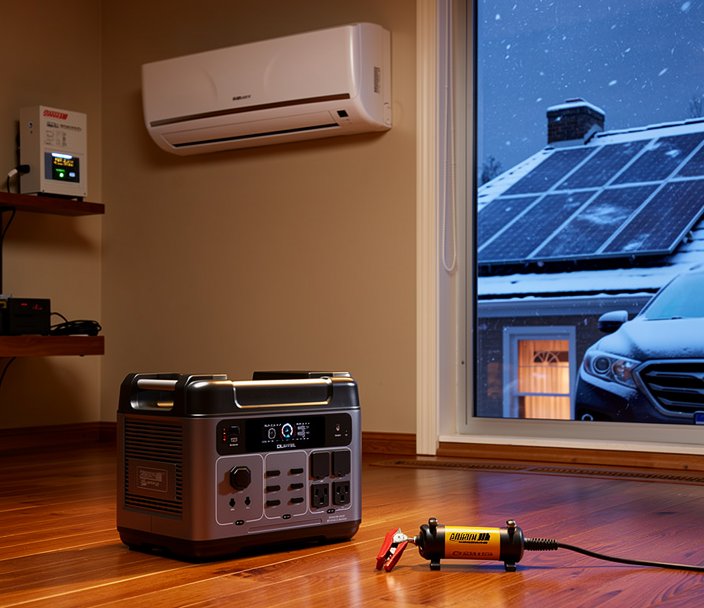
C01
C01


Can a Portable Power Station REALLY Run a Heat Pump? Surge Limits, Soft Starters, and the Right Type
Let's cut through the marketing noise. The short answer is that most portable power stations cannot start a heat pump on their own—even if the running wattage looks comfortably inside the station’s rated output. The catch is the startup surge, often 3 to 5 times higher than the running power, and the ability of the inverter and battery chemistry to deliver that burst without tripping.
However, a practical path exists. The recommended approach for 2027 is to pair a high-surge, pure sine wave portable power station (rated at least 3000 W continuous, with surge capability 6000 W or more) with a properly sized soft starter installed on the heat pump. This combination tames the inrush current enough to make battery-powered operation feasible for small to medium mini‑split systems. Central heat pumps typically remain out of reach for portable units unless you move up to a multi‑module home battery system.

That’s the decision rule in one paragraph. Now we’ll unpack why this is so difficult, what makes some portable power stations suitable while others fail, and how to avoid expensive mistakes.
Why Heat Pumps Need Massive Surge Power (And Why Portable Power Stations Trip)
A heat pump is essentially a compressor motor. When it kicks on, the starting current can spike to 3–5 times the running wattage on older or single‑speed systems. Even a small 12,000 BTU mini‑split that cruises along at 800–1,200 W may momentarily demand 3,500–5,500 W. A 3‑ton central unit might surge past 18,000 W. Portable power stations, however, are protected by a Battery Management System (BMS) and an inverter that shut down within milliseconds if the load exceeds the instantaneous capacity. This is why you can hear the relay click and the screen goes dark—the station hasn’t “broken”; it has done its job protecting the battery.
In contrast, a gasoline generator’s spinning mass provides a reservoir of torque that rides through the surge. A battery inverter must deliver it electronically, and many consumer‑grade units simply can’t. The result: a perfectly healthy 2,000 W portable power station trips on a 1,500 W heat pump because the startup draw jumps to 4,500 W for a fraction of a second.
Before‑and‑after example (negative case): A homeowner tried to back up his 18,000 BTU ductless mini‑split with a generic 2,000 W rated, 4,000 W surge portable station. The station would trip every time the compressor started, even though the running load was only 1,300 W. The before was a dead battery after 10 failed attempts; the after—after adding a soft starter and upgrading to a station with true 6,000 W surge capability—was a reliable three‑hour backup window in mild weather.
Can Your Portable Power Station Handle It? Inverter Type, Battery Chemistry, and Capacity Explained
Three technical specs determine whether a portable power station has a realistic chance of running a heat pump.
Inverter type: pure sine wave is non‑negotiable
Heat pump compressors are induction motors. A modified sine wave inverter may cause overheating, erratic start‑ups, or outright refusal to run. All serious attempts to power a heat pump from a battery must use a pure sine wave inverter. Check the specification sheet; if the manufacturer doesn’t explicitly list “pure sine wave,” assume it isn’t suitable.
Battery chemistry and discharge rate
LiFePO4 (lithium iron phosphate) batteries currently dominate the portable power station market for good reason. They maintain voltage stability under high load better than older NMC packs and far outperform lead‑acid alternatives. A high‑quality LiFePO4 pack can deliver 1C discharge rates or more without significant sag, which matters when the compressor pulls its inrush current. Look for a BMS that explicitly supports surge loads rather than clamping them.
Capacity—not just watt‑hours, but usable cycle life
A 5 kWh battery sounds generous, but if the heat pump draws 1,500 W running, you’ll empty it in about 3 hours—and that’s before accounting for inverter inefficiency, temperature derating, and the fact that you should never repeatedly drain a battery to zero if you want it to last. A station rated for 5000+ cycles to 80% capacity, like those using LiFePO4 cells, will tolerate daily cycling far better than a unit with a 500‑cycle lifespan.
Trade‑off alert: High‑surge portable power stations are heavy. A unit with 4,000 W continuous and 8,000 W surge might weigh 50 kg or more. Portability is relative; this is not a backpack item. You accept a semi‑permanent installation in exchange for heat pump capability.
Soft Starters: How They Tame Inrush Current and Make Battery Operation Possible
A soft starter is a small electronic device wired between the heat pump’s contactor and the compressor. It gradually ramps up voltage during the first few hundred milliseconds, drastically reducing the startup current spike. In field reports, a soft starter can bring the inrush from 45 A down to 18 A on a typical mini‑split—translating to a surge wattage reduction from around 5,000 W to 2,000 W.
When paired with a portable power station that already has robust surge handling, a soft starter often becomes the deciding factor between a silent shutdown and a comfortable heated room. It does not eliminate the surge entirely, but it flattens the peak enough that a station with 6,000–8,000 W surge capability can manage.
Decision rule: If your heat pump’s nameplate lists Locked Rotor Amps (LRA) higher than about 50 A, and your portable station’s peak surge current is below that—divided by 2 for a safety margin—you need a soft starter. For example, a unit with LRA of 55 A at 230 V implies a potential surge of 12,650 W. Even a 8,000 W surge station cannot handle that safely; a soft starter could drop the effective inrush to around 5,000–6,000 W, tipping it into the feasible range.
Real-World Scenarios: When Running a Heat Pump on a Portable Station Actually Makes Sense
Let’s ground this in practical situations. A portable power station is a sensible heat pump backup only under specific conditions.
Core scenario 1: Mild‑climate, short‑duration outages (spring/autumn). A 12,000 BTU inverter mini‑split using 500–800 W in moderate weather, paired with a 4,000 W continuous/8,000 W surge station after a soft starter install. Expected run time: 4–6 hours from a 5 kWh pack. This can keep a living room comfortable during a routine grid failure without burning fuel indoors.
Core scenario 2: Off‑grid tiny home or workshop. The heat pump is the primary heating source but sized for a small space (e.g., 9,000 BTU). Solar panels recharge the battery during the day, and the station handles the heat pump’s starting loads each cycle. A modular system that can accept external battery expansions (up to 16+ kWh) becomes necessary for overnight heating.
Edge case—cold climate deep winter: A heat pump’s capacity and COP drop sharply below freezing. The auxiliary electric resistance strips can add 3–5 kW on their own. Running a portable station in those conditions will quickly deplete the battery, and the cold itself reduces battery efficiency below 0 °C. Most portable power stations have an operating temperature floor of 0 °C. Below that, you need a heated enclosure or an indoor installation. Even with a soft starter, expect usable run time to halve compared to 10 °C outdoor conditions.
Positive case example: An off‑grid cabin owner in northern Sweden installed a 9,000 BTU inverter mini‑split backed by a portable power station rated for 3,200 W continuous and 6,400 W surge, expanded to 12 kWh with extra battery modules. After fitting a soft starter and using the heat pump only during daytime when solar input was high, she maintained 19 °C inside during a three‑day December cold snap (outside -10 °C). The station never tripped, and the battery never dropped below 25%. Key factors: small heat pump, large battery, soft starter, and realistic expectations about run time.
Beyond Heat Pumps: Multi-Functional Portable Power Stations with Jump Starter and Air Compressor Features
While the focus here is on heat pumps, some users look for a “do‑everything” unit that combines a portable power station, a vehicle jump starter, and an air compressor. In 2027, these multi‑function devices do exist—typically as compact, low‑wattage units aimed at roadside emergencies rather than home heating. Their continuous output is rarely above 500 W, and surge ratings are too low for a heat pump. They are useful for inflating tires and jumping a dead car battery, but trying to power a mini‑split from such a unit will trip the protection circuits instantly.
If you need a single device that can back up a heat pump and serve as a vehicle jump starter, you are better off with a dedicated high‑capacity portable power station and a separate jump starter. The technical requirements are too divergent to combine effectively in one box.
| Do’s | Don’ts | Why |
|---|---|---|
| Measure your heat pump’s LRA (locked rotor amps) and multiply by voltage to estimate worst‑case surge watts. | Assume “2000 W peak” on the box is sufficient for a 1500 W heat pump. | Peak ratings are often for resistive loads, not inductive motor starts. Real surge can be 3–5× running watts. |
| Install a soft starter if total surge exceeds 60% of the station’s peak rating. | Try to start the compressor repeatedly after a trip; this can damage both the station and the heat pump. | Repeated high‑current attempts can overheat the inverter or wear relays prematurely. |
| Use a pure sine wave inverter with a LiFePO4 battery that lists surge handling in the spec sheet. | Use a station that only shows “modified sine wave” or omits the inverter type entirely. | Modified sine wave can cause motor overheating and erratic compressor behavior. |
| Place the station in a conditioned space if outdoor temperature is below 0 °C. | Leave the battery exposed to freezing conditions while drawing high load. | LiFePO4 cells lose significant capacity and discharge capability below 0 °C; many BMS will shut down to protect cells. |
Common Mistakes and Voltage Sag Surprises: Lessons from Field Experience
Even with the right hardware on paper, real‑world conditions introduce subtle failure modes.
Mistake 1: Ignoring voltage sag under load. A battery that reads 48 V idle may dip to 43 V during the inrush spike. If the inverter’s low‑voltage cutoff is set too aggressively, it will trip even though the station hasn’t exceeded its wattage rating. Always check the inverter’s input voltage tolerance and whether the BMS allows a momentary dip.
Mistake 2: Counting on “peak power” for more than a few seconds. Many portable power stations quote a surge figure that can only be sustained for milliseconds—long enough for a tool motor, but not for the 500‑ms draw of a compressor. Read the fine print: some units distinguish “peak” (sub‑second) from “surge” (sustained for a few seconds). A heat pump needs at least 2–3 seconds of surge capability.
Mistake 3: Overloading the AC outlets while the heat pump runs. Five AC outlets may tempt you to plug in a refrigerator or lights simultaneously. If the heat pump’s running wattage is 1,200 W and the station’s continuous rating is 3,200 W, you have headroom—but the BMS might still limit total harmonic distortion or derate if multiple inductive loads start close together. Test the system with only the heat pump first.
Gear checklist: beyond the portable power station itself, you will need a soft starter kit (and possibly a professional to install it), a heavy‑gauge extension cord rated for the full amperage, a pure sine wave compatibility sticker on the station, a way to monitor battery state of charge (app or display), and if operating in cold weather, an insulated battery blanket or indoor location. Spare fuses and a digital clamp meter to verify startup current are also worth having.
Maintenance habits that extend battery life when cycling daily with a heat pump
- Keep the depth of discharge moderate: Aim to cycle between 30% and 80% rather than 0–100% to maximize LFP cycle life.
- Balance cell voltages periodically: Use the built‑in BMS equalization charge feature if available; some stations do this automatically after a full charge.
- Store at 50% charge if unused for weeks: Storing at 100% in a warm room accelerates calendar aging. During the heating season, this might not apply, but note it for the off‑season.
- Keep firmware updated: Some modern power stations receive over‑the‑air updates that tweak surge handling algorithms or improve thermal management.
Deciding whether a portable power station can realistically run your heat pump boils down to a matrix of three interlocking values:
| Heat Pump Type | Portable Station Surge ≥ 6 kW + Soft Starter? | Verdict |
|---|---|---|
| Small mini‑split (≤12k BTU, inverter) | Yes | Feasible for 2–6 hour backup in mild weather |
| Small mini‑split, no soft starter | Yes (barely) | Frequent trips likely; a risk that may waste your investment |
| Mid‑size mini‑split (18k BTU) + soft starter | Yes (≥8 kW surge strongly advised) | Feasible but run time limited; dedicate the station to this load |
| Central heat pump (2+ tons) | No (surge too high) | Not realistic; consider a modular home battery system instead |
If your situation falls into the “feasible” column, confirm the surge rating, pure sine wave output, and LiFePO4 chemistry before purchasing. Install a soft starter, test with a meter, and never assume factory labels tell the whole story. For central systems or homes requiring full‑day heating independence, a portable power station is a bridge, not a permanent answer—and it may be wiser to look at fixed home battery storage with proper transfer switching. But for the right small heat pump, the combination of a high‑surge portable unit and a soft starter is a practical, emission‑free backup that works right now.
Frequently Asked Questions
Can a 2000W portable power station run a 1500W heat pump?
Almost never. The startup surge for a 1500W heat pump can exceed 4500W, which trips the station’s overload protection instantly. While the running wattage is within specs, the inrush makes it impossible without a soft starter and a station rated for at least 4000-5000W surge.
Do I need a soft starter for my heat pump to run on battery?
If your heat pump’s LRA indicates a startup current that exceeds 60% of the portable station’s surge amperage, a soft starter is strongly recommended. It can reduce the inrush spike enough to prevent nuisance tripping and protect both the station and the compressor.
What’s the difference between starting watts and running watts for a heat pump?
Running watts is the steady power the heat pump draws after the compressor is spinning, typically 500–1200W for mini-splits. Starting watts is the brief, high inrush needed to overcome the locked rotor condition, often 3–5 times higher. Battery inverters must deliver this peak without tripping.
Is a pure sine wave inverter mandatory for a heat pump?
Yes. Heat pump compressors are sensitive to waveform quality. A modified sine wave can cause overheating, noise, and failure to start. Always verify the inverter type in the specifications; if not listed, assume it is not suitable.
How long will a portable power station run a heat pump?
As a rough estimate, divide the station’s usable watt-hours (e.g., 80% of total capacity) by the heat pump’s running watts. A 5 kWh station might power a 1000W mini-split for about 4 hours. Cold weather, defrost cycles, and auxiliary heat strips will reduce this significantly.
This article was written using up-to-date sources as of August 2026. Details may change over time — verify current specifics before relying on them.
Latest articles
OUKITEL Power Brings Full-Scenario Energy Storage Solutions to Intersolar Middle East 2026 in Dubai

OUKITEL Showcases Energy Storage Solutions at Intersolar South America 2026, Accelerating Expansion into Latin America
The European Homeowner’s Blueprint to Slashing Heat Pump Bills with Battery Storage and Smart Tariffs
Sizing Solar and Battery for a Winter Heat Pump: A Cold‑Climate Guide for Europe (Germany, Sweden, Ukraine)
Heat Pump Power Outage Survival Guide: Stretching Your Battery Through Multi-Day Winter Outages