C01
C01


Heat Pump Battery Sizing: How Much Storage Do All-Electric Homes Need in Any Climate?
For European homeowners who have swapped a gas boiler for a heat pump, the next question is harder than it looks: How much battery storage do I actually need to stay warm through a winter outage—or cool through a summer blackout—without spending thousands on unused capacity? The answer isn’t a single number. It’s a year‑round decision that weighs your local climate, where the battery will live, regional incentive programmes, and the safety demands of a household that can’t afford to be caught powerless.
This guide walks you through the sizing logic for an all‑electric home with a heat pump, using real European conditions and constraints. It is not a product catalogue. Instead, you’ll find a methodology, a worked example, the common mistakes that leave families in the dark, and a climate‑by‑climate cheat sheet that turns the arithmetic into a clear decision.

How to Calculate Your Heat Pump’s Daily Energy Need — Winter, Summer, and Reality
The starting point is not your heat pump’s nameplate power. It’s your daily energy consumption in kilowatt‑hours (kWh), which changes dramatically with outdoor temperature because the coefficient of performance (COP) falls as the mercury drops. A unit that sips 1.5 kW in spring might pull 4 kW on a freezing January night.
To get a real number, list every appliance that must stay on during an outage—heat pump, circulation pump, fridge, freezer, lights, router, medical devices—and estimate their daily kWh. The most reliable method is a plug‑in energy monitor logged over a full week in both a cold spell and a heat wave. If that data isn’t available, start from your electricity bill’s monthly kWh, divide by 30, then subtract everything you could turn off in a crisis (tumble dryer, dishwasher, electric oven). That stripped‑down daily figure is your essential load.
For a well‑insulated 130 m² house in northern Germany, a typical winter essential load with a 7 kW air‑source heat pump might be 25–35 kWh/day. In a summer heat wave, the same home might need only 8–12 kWh/day for cooling. This seasonal spread is why sizing for winter alone often doubles the battery cost compared with a summer‑only backup—and why the decision must be year‑round from the start.
One mistake people make: they size for the heat pump’s average draw but forget the surge when the compressor starts. A 3 kW heat pump can momentarily pull 12 kW or more. If your battery inverter can’t handle that peak, the system faults out just when you need it. Link this constraint to the inverter sizing discussion later in the article.
Sizing for Autonomy: How Many Days of Backup Do You Really Need?
One day of capacity may seem enough for a short outage, but real‑world blackouts in Europe last longer. A 2024 survey by the German Federal Network Agency found that the average interruption duration in low‑voltage grids was over 10 minutes, but extreme weather events can knock out power for 24–72 hours. In rural Scandinavia, a snowstorm can isolate a home for three days; in Mediterranean Spain, a heat‑wave grid collapse might last 6–12 hours but recur several times a summer.
Pick an autonomy target based on your region’s worst‑case scenario, not its average. A practical rule:
- 1‑day autonomy – suitable for urban dwellers with a reliable grid who can retreat to a friend’s house if needed.
- 2‑day autonomy – the sweet spot for most suburban and rural European homes. Covers the typical storm or maintenance outage.
- 3‑day autonomy – recommended for off‑grid or end‑of‑line rural properties, especially in Nordic and Alpine regions where repair crews may be delayed by weather.
Multiply your daily essential load by the autonomy days. For the German example above (30 kWh/day), a 2‑day target means a usable battery capacity of 60 kWh. That’s a large system, and it’s why solar + battery sizing must be integrated: if you have rooftop solar, you can recharge during the day and reduce the battery size needed to carry the night. We’ll return to that in the integration section.
Climate Modifiers: When Your Garage or Outdoor Shed Slashes Battery Capacity
Most home battery specifications assume an ambient temperature of 25°C. Place the same unit in an unheated garage that drops to −10°C in a Berlin winter, and the usable capacity can fall by 20–30% because lithium‑ion chemistry slows down. Some battery management systems (BMS) will even block charging below 0°C to prevent permanent damage. The cold‑climate specifics are detailed in our winter sizing companion article, but the take‑away for year‑round planning is clear: if your storage location isn’t frost‑free, derate the battery’s stated capacity by at least 25% for winter months, and confirm the manufacturer’s low‑temperature charge cut‑off before buying.
On the flip side, a Spanish garage that hits 45°C in July will accelerate battery ageing and may force the BMS to throttle charging to protect the cells. The battery’s heat‑dissipation design and cooling fans become critical. Look for units with active cooling (smart fans) and a storage temperature rating of at least −10°C to 40°C, which is typical for LiFePO4 chemistry. If the only available space is a hot shed, consider a shaded outdoor enclosure or a dedicated indoor shelf in a utility room.
How can I protect my battery from extreme heat in summer? For a Spanish or Italian summer, position the battery against an interior wall, away from direct sunlight, and ensure at least 15 cm of clearance around the unit for ventilation. If the garage temperature regularly exceeds 40°C, a small exhaust fan or a louvred door can make the difference between a 10‑year life and a 5‑year life. Some models, such as the OUKITEL P5000 Pro, include a 4‑fan cooling system and allow remote temperature monitoring via an app, which helps you verify conditions without opening the garage.
Incentives That Change the Sizing Math: The Finland Tax Deduction Example
In several European countries, financial support can reduce the cost of a larger battery, effectively lowering the penalty for oversizing. Finland’s kotitalousvähennys (household expense tax credit) is a case in point. While the credit does not directly subsidise battery purchase, it allows homeowners to deduct a portion of the eligible installation work from their taxes, subject to annual caps and eligibility criteria that are updated regularly. The exact deduction percentage and maximum amounts vary by year; check the official Finnish Tax Administration website (www.vero.fi) for the current conditions. This can meaningfully reduce the after‑tax cost of installing a larger battery, making it easier to invest in additional capacity.
Other countries have their own programmes: Spain’s MITECO runs regional self‑consumption and storage aid lines, though the exact amounts vary by autonomous community. When drafting your budget, check the home battery backup solutions that qualify under your local scheme; many grants require that the equipment be installed by a certified electrician and carry specific certifications (CE, UN38.3). The incentive effectively shifts the “sweet spot” upward, because the marginal cost of an extra 2 kWh may be partly subsidised, while the comfort of an extra day of autonomy is priceless in a winter storm.
Safety, Placement, and Peace of Mind: Sizing with Family Emergencies in Mind
For a single mother or an eco‑conscious family, the battery isn’t just a box of kilowatt‑hours—it’s the guarantee that the heat pump keeps running when the grid fails. That means safety is inseparable from sizing. A battery that is technically large enough but lacks robust protection can become a liability.
At the component level, LiFePO4 (lithium iron phosphate) chemistry has become the standard for residential storage because it is inherently more thermally stable than older NMC chemistries. Look for a Battery Management System (BMS) that monitors cell voltage, temperature, and current in real time and can isolate the pack within milliseconds if a fault is detected. Certifications such as CE, FCC, PSE, UN38.3, EMC, LVD, and RoHS indicate that the unit has passed rigorous safety testing for both normal operation and transport. Models like the OUKITEL P2001 Pro list all seven of those certifications; others may carry only a subset.
Equally important is the EPS (Emergency Power Supply) switchover time. A battery with a sub‑10 ms switchover, like the OUKITEL P5000 Pro, can bridge the gap fast enough that computers don’t reboot and the heat pump’s electronics don’t lose their set points. For a household with a baby or a medical device, that seamless transition is not a luxury—it’s a requirement. The battery must also be sized to handle the repetitive surge of the heat pump compressor. An inverter rated at 4 000 W continuous but with 8 000 W surge capacity, like the P5000 Pro’s, gives headroom for those hard starts.
Physically, the unit should be installed on a non‑combustible surface at least 30 cm from walls, and never in a bedroom or a child’s play area. Modern LiFePO4 batteries do not off‑gas hydrogen like lead‑acid, so they are safe for indoor use, but a smoke detector in the same room adds a layer of defence. For a single parent, an app that reports state‑of‑charge and any alarm conditions to a smartphone is practical peace of mind.
Solar Inverters and Battery Integration: Avoiding the Undersized Inverter Trap
When a battery is paired with rooftop solar, the inverter becomes the bottleneck. The solar inverter must be able to charge the battery while simultaneously supplying the house loads, and the battery inverter must be able to feed the entire home—including the heat pump’s inrush—when the grid goes down.
The classic mistake is to match the battery’s continuous output to the heat pump’s running watts, ignoring the startup surge. A 3 kW heat pump with a locked‑rotor current of 40 A at 230 V momentarily demands over 9 kW. If the battery inverter can only sustain 4 kW and surge to 5 kW, the system trips. The deep dive on surge limits and soft starters explains how to handle this, but the sizing principle is simple: pick an integrated solution where the inverter’s surge rating is at least 2× the heat pump’s nameplate power, or install a soft starter that reduces inrush current by 50–70%.
Year‑round, the solar‑plus‑battery combination reduces the days of autonomy you need, because even in winter you’ll usually get some solar generation. A south‑facing 4 kWp array in Germany produces roughly 2–5 kWh/day in December and 15–20 kWh/day in July. If you size the battery for 2‑day autonomy on a 30 kWh load, a 4 kWp array might shave that requirement to a 1.5‑day battery because daytime generation covers part of the load. Run the numbers with a tool like PVGIS, and plug them into your decision matrix.
Common Sizing Mistakes That Leave You Powerless When You Need It Most
Over years of field experience, a handful of errors repeat themselves across Europe. Avoiding them is more valuable than any single calculation.
1. Ignoring auxiliary heat strips. Many air‑source heat pumps have a backup resistive heater that switches on when the outdoor unit can’t keep up. These strips can add 3–6 kW of load. If your battery was sized only for the compressor, you’ll overload the inverter the first time the temperature plummets.
2. Forgetting the inverter’s own consumption. A large inverter burns 50–150 W just sitting there. Over 24 h, that’s 1.2–3.6 kWh of “parasitic” drain that eats into your battery reserve before you’ve even turned on a light.
3. Treating the battery’s advertised capacity as usable. A 5 kWh battery may only deliver 4.5 kWh after inverter losses and BMS headroom. Derate by at least 10% for usable AC‑coupled capacity.
4. Sizing for the “average” day rather than the peak day. Suppose a family in Normandy based their battery on the annual average heat‑pump consumption of 12 kWh/day. During the “Beast from the East” cold snap, their actual draw jumped to 35 kWh/day, and their 15 kWh battery ran dry in 4 hours. A negative case to learn from: the system worked flawlessly in mild weather but failed exactly when it was needed. The fix would have been to use the coldest‑day load, not the average, as the basis.
5. Omitting the future load expansion. Many households add an electric car, a second heat pump, or a home office after the battery is installed. Leave a 20% capacity buffer or choose a modular system that accepts expansion, like the OUKITEL BP3000 which can stack up to 16 kWh from a 2 kWh base, so you don’t have to rip out the whole system when your needs grow.
Your Climate-by-Climate Sizing Cheat Sheet
Below is a decision matrix that translates the principles of this article into a recommended battery capacity range. All figures assume a well‑insulated all‑electric home with a modern inverter‑driven heat pump and a two‑day autonomy target. Adjust up or down based on your own load audit.
| Climate zone | Typical winter daily essential load (kWh) | Recommended usable battery capacity (kWh) | Example portable power station that fits (expandable) |
|---|---|---|---|
| Nordic / Alpine (regular −10°C) | 35–45 | 70–90 | 2–3× P5000 Pro (10–15 kWh) or BP3000 stack (up to 16 kWh) + solar |
| Central Europe (0°C to −5°C winter) | 25–35 | 50–70 | P5000 Pro (5 kWh) + expansion, or 2× P2001 Pro (4 kWh) if load is at the low end |
| Mediterranean / mild coastal (rarely below 5°C) | 8–15 | 16–30 | P2001 Plus (2 kWh) or BP3000 paired with solar |
When comparing options, remember that a battery that operates only in summer can be smaller; a battery expected to power heating through a February outage must be larger. The cheat sheet is a starting point, not a substitute for your own load audit. Use it alongside the European homeowner’s blueprint to slashing heat‑pump bills with battery storage to see how the right tariff can offset the cost of a bigger system.
The real decision matrix comes down to two axes: cold‑weather reliability and budget after incentives. If your household includes small children, elderly relatives, or medical equipment, err on the side of a larger battery with a strong surge rating and sub‑10 ms EPS. If your outages are rare and short, a smaller LiFePO4 unit in a climate‑controlled space will keep the essentials running without overcapitalising. In every case, verify the specifications against the real environment where the battery will live—and test the system with an actual outage simulation before you need it.
Frequently Asked Questions
How do I calculate how much battery storage I need for a heat pump?
Start with your essential daily kWh (measure for at least a week in winter and summer), multiply by your desired days of autonomy (2 is typical for most European homes), then add a 20–25% buffer for inverter losses, temperature derating, and future load growth. Ensure the battery inverter’s surge rating is at least twice the heat pump’s nameplate wattage to handle compressor start‑up.
Does battery capacity change if I store it in an unheated garage in winter?
Yes. Lithium iron phosphate batteries can lose 20–30% of their usable capacity at −10°C, and many BMS units block charging below 0°C. Always derate the battery’s specified capacity by at least 25% for winter use if the storage space isn’t frost‑free, and check the manufacturer’s temperature limits.
How can I protect my battery from extreme heat in summer?
Place the battery against an interior wall away from direct sun, ensure ventilation clearance, and shade the storage area if possible. If the ambient temperature regularly exceeds 40°C, consider an air‑conditioned indoor location or a unit with active cooling fans and app‑based temperature monitoring.
Are there tax deductions for home battery storage in Finland?
Finland’s kotitalousvähennys provides a tax credit for a portion of the installation work of a home battery system. The exact deduction percentage and annual caps are set annually; check the Finnish Tax Administration’s official website for current rates and limits. The battery purchase itself is not directly subsidised, so the credit can effectively reduce the cost of going larger if you plan the installation carefully.
What battery safety features are important for a single mother preparing for emergencies?
Look for LiFePO4 chemistry (inherently stable), a BMS with cell‑level monitoring, certifications like CE and UN38.3, and an EPS switchover time under 10 ms so medical devices or baby monitors don’t lose power. A smartphone app that alerts you to faults and state‑of‑charge adds an extra layer of reassurance.
How do solar inverters and battery storage work together for whole‑house backup with a heat pump?
The battery inverter must be sized to handle the heat pump’s running watts and its surge, while the solar inverter feeds the battery and the home. A common mistake is underestimating the surge; either choose an inverter with a surge rating 2× the heat pump’s nameplate, or install a soft starter. An integrated system with a fast EPS switchover ensures the heat pump’s electronics stay alive during grid‑to‑battery transition.
Is battery backup worth it during summer heat wave power outages in Spain?
Yes, especially if your heat pump provides cooling. Spanish summer outages can be short but frequent, and a battery sized for one day of cooling (typically 10–15 kWh) can pay for itself in avoided food spoilage, hotel stays, and lost work. Check regional self‑consumption grants that may subsidise part of the installation cost.
Can I keep a portable power station in my car for emergency use in Italy’s summer heat?
It is not recommended. Even LiFePO4 units are rated for storage up to about 40°C, and a car parked in Italian summer sun can easily exceed 50°C, which accelerates battery degradation. If you must carry a power station in a vehicle, choose a model with a robust cooling system and monitor the internal temperature via an app; better yet, keep it in a cool bag and move it to the garage at home.
References
- Finnish Tax Administration — Tax credit for household expenses (kotitalousvähennys), https://www.vero.fi/en/individuals/deductions/Tax-credit-for-household-expenses/
Information in this article was fact-checked against current sources in August 2026. Policies, incentive programs, and regulations change frequently — always confirm current terms with official sources before making financial or legal decisions.
Latest articles
OUKITEL Power Brings Full-Scenario Energy Storage Solutions to Intersolar Middle East 2026 in Dubai

OUKITEL Showcases Energy Storage Solutions at Intersolar South America 2026, Accelerating Expansion into Latin America
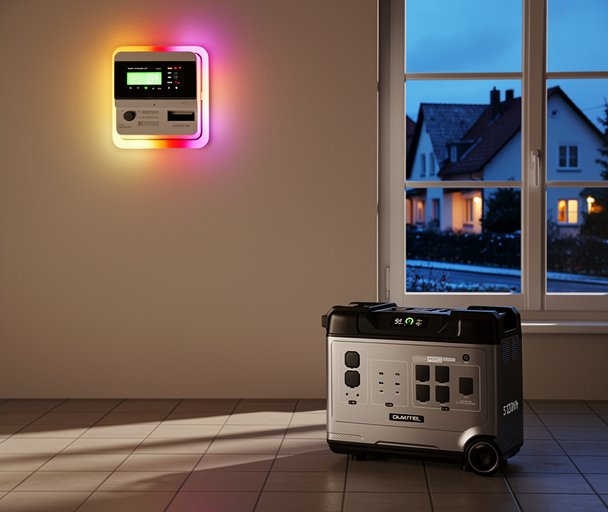
The European Homeowner’s Blueprint to Slashing Heat Pump Bills with Battery Storage and Smart Tariffs
Sizing Solar and Battery for a Winter Heat Pump: A Cold‑Climate Guide for Europe (Germany, Sweden, Ukraine)
Heat Pump Power Outage Survival Guide: Stretching Your Battery Through Multi-Day Winter Outages