C01
C01


Portable Power for Audiovisual Professionals: Keeping DJs, Photographers & Livestreams Running at Events
Silent, reliable power is no longer a luxury for audiovisual professionals—it is a show‑stopper when it fails. An outdoor wedding reception suddenly plunged into darkness, a livestream dropping mid‑keynote because of inverter noise, or a camera battery dying minutes before the first look: every working DJ, photographer, and broadcast engineer knows that mains power is a gamble at remote venues, parks, and beachfronts. The solution? A properly chosen portable power station that delivers clean, sustained electricity without the roar of a gasoline generator.
But not all battery packs are built for professional AV gear. The wrong unit can introduce audible hum into a PA system, cause camera monitors to flicker, or simply run dry an hour before the gig ends. This guide walks you through sizing, inverter types, environmental protection, and redundancy strategies, using real‑world load profiles and trade‑offs that production technicians actually face. By the end, you will have a decision framework that prevents the most common portable‑power failures at events.

Understanding the Power Demands of AV Gear (DJs, Cameras, Lights & Streams)
Audiovisual equipment spans a wide wattage range, and the first mistake many event pros make is trusting the nameplate rating without measuring actual draw. A powered 10-inch speaker might list 400W RMS, but in a typical DJ set playing compressed dance music at moderate volume, it pulls closer to 150-200W continuous. Similarly, a cinema camera body draws 20-40W, but adding an external monitor, wireless follow focus, and a teradek transmitter can push total camera‑side consumption past 100W.
To avoid guesswork, use a plug‑in watt meter or a clamp meter during a rehearsal to record real‑world consumption of your full rig. Below is a conservative planning table based on common event gear. All values include some headroom for transient peaks.
| Device | Typical Continuous Draw (W) | Notes |
|---|---|---|
| 2× Active 10″ tops + 12″ sub | 600-900 | Full-range club volume |
| DJ controller + laptop | 50-90 | Backlit controllers draw more |
| Wireless mic receiver (rack) | 20-40 | Often overlooked in tally |
| Moving head light (60W LED) | 90-110 | Includes pan/tilt motors |
| 4× LED PAR uplights | 100-140 | 12-15W per fixture actual |
| Livestream switcher + encoder | 70-120 | ATEM Mini Pro ISO + laptop |
| DSLR / mirrorless camera rig | 40-80 | With monitor, recorder, focus motor |
For a compact wedding DJ setup (two active tops, controller, laptop, four uplights), a realistic continuous load often falls between 500W and 750W. A full‑scale band livestream with multiple PTZ cameras, audio interface, and a lighting console can easily cross 1200W. Note that many digital amplifiers and switch‑mode power supplies have an inrush current roughly 2‑3× their running watts at power‑on, so an inverter’s surge rating matters.
Negative case example: Suppose a mobile DJ arrives at a vineyard wedding with a single 500Wh unit rated for 300W continuous output, expecting to power a 1200W PA. The inverter overload trips the moment the first kick drum hits, and the battery’s capacity is irrelevant—the rig never gets off the ground. The couple loses the first dance music, and the DJ loses the night’s review. The error: not checking the inverter’s continuous and surge rating against the actual gear, and not sizing the battery for runtime even if the inverter had been enough.
Positive case example: A seasoned videographer covering a 5‑hour outdoor product launch uses a 2048Wh power station with a 2400W pure sine wave inverter to feed a 6K cinema camera, a 7‑inch production monitor, an external SSD recorder, and a wireless lav system, totaling 320W continuous. With a 20% buffer, the math gave about 5.4 hours of runtime (2048Wh ÷ 384W). The shoot finished with 18% charge remaining, and the footage was delivered without a single battery swap. The discipline here was measuring actual load in advance, not assuming.
Pure Sine Wave vs Modified Sine Wave: Why Clean Power Is Critical for Audio & Video
Cheap inverters produce a modified sine wave—a stepped square wave that deviates from the smooth curve of grid AC. For resistive loads like a kettle it barely matters, but for professional audio and video, the difference is audible and visible. An amplifier fed modified sine wave can inject a 50/60 Hz buzz into the signal chain, even if the mixer and playback device run from battery power. The hum is often induced in the power supply transformers of outboard gear or active speakers, and ground‑loop isolators rarely fix it completely.
Cameras, field monitors, and capture cards can exhibit rolling horizontal bars in the image due to power line frequency mismatch when the inverter’s waveform is dirty. Some gear, particularly switching power supplies in digital consoles and LED drivers, may overheat or trigger protection circuits prematurely on modified sine wave, leading to intermittent shutdowns during an event.
The industry‑standard solution is a pure sine wave inverter, which outputs AC virtually identical to the mains. Every reputable portable power station aimed at AV professionals uses pure sine wave technology, including the OUKITEL P1000E Plus and its larger siblings. When shopping, verify the specification explicitly states "pure sine wave," not just "sine wave" or "clean power."
Failure scenario: A photographer at a remote elopement powered a wireless audio recorder and mixer off a modified sine wave car‑jumper pack because it was “only 50 watts.” The recorder’s input stage picked up a low‑frequency buzz that was barely noticeable during the ceremony but rendered the vows audio unusable for the highlight film. The client refused to pay for the audio package, costing the photographer a four‑figure upsell. The root cause: assuming low‑wattage gear is immune to waveform distortion.
How to Right‑Size a Portable Power Station for Uninterrupted Event Coverage
Sizing a battery station for an event isn’t just about capacity—it’s the intersection of three numbers: continuous inverter rating (W), surge headroom (W), and usable energy (Wh). Follow this four‑step workflow, and you will rarely run short.
- Build a real‑world load list. As above, measure or estimate continuous wattage for every device that will run simultaneously. Add a 25% safety factor to cover inverter efficiency losses (typical pure sine wave units run 85–93% efficient) and unexpected peaks. If your measured total is 900W, budget 1125W of inverter capacity.
- Check surge capability. When you power on a rack of amplifiers or switch on LED moving heads, the momentary inrush can be double the continuous draw. A 2400W peak load needs an inverter rated for at least that surge, not just continuous. Units like the OUKITEL P2001 Plus with 2400W continuous and 4800W surge offer ample headroom for most small‑venue AV setups.
- Calculate runtime. Divide the battery’s rated watt‑hours by the continuous load (after safety factor). A 2048Wh unit feeding 750W net load runs roughly 2.7 hours. For a 6‑hour reception, you’d need ~4500Wh, which suggests either a larger station (like the 5120Wh OUKITEL P5000 Pro) or a pair of mid‑capacity units swapped or used in parallel if supported.
- Factor in usable capacity. Lithium‑based batteries shouldn’t be regularly run to 0%—many BMS units cut off at 5‑10% to protect cell health. LiFePO₄ (LFP) cells have a flat discharge curve, so you get nearly full capacity, but a conservative estimate is 90% of rated Wh actually usable. Adjust your math accordingly.
Below is a quick trade‑off reference for three power stations that span the needs of event pros, using manufacturer data. Note that weight climbs significantly with capacity—a constraint for solo operators who carry their own gear.
| Model | Capacity (Wh) | Inverter (W cont. / surge) | Weight | AC full‑charge time | Approx. runtime at 700W load* |
|---|---|---|---|---|---|
| P1000E Plus | 1024 | 1800 / 3600 | 12 kg | 1 hour | 1.3 hours |
| P2001 Plus | 2048 | 2400 / 4800 | 22 kg | ~1 hour to 80% | 2.6 hours |
| P5000 Pro | 5120 | 4000 / 8000 | 53 kg | 1.5 hours to 80% | 6.6 hours |
*Runtime estimated as (capacity × 0.9) ÷ 700W, without solar input. Actual runtime varies with temperature and load pattern.
A common mistake is buying the largest affordable unit and then discovering it’s too heavy to lift out of a van solo. The P5000 Pro at 53 kg is a two‑person lift for most users, which makes it better suited for fixed outdoor stages or multi‑day festivals with crew support, while the 12‑kg P1000E Plus can be moved by one person between ceremony and reception locations. Choose the model that fits your load and your back.
Quiet, Weather‑Ready Power: Portability and Environmental Protection for On‑Location Gigs
Noise regulations and venue policies increasingly ban gasoline generators. In the EU, outdoor power equipment is regulated under Directive 2000/14/EC, which sets sound power limits by equipment category, while US cities enforce their own local noise ordinances. Battery‑based power stations produce zero engine noise and zero emissions, making them the only acceptable option for ceremony sound, film dialogue recording, and livestreams where even a quiet inverter generator’s 52 dB hum can be picked up by shotgun mics.
The silent operation comes with a trade‑off: most compact stations are not designed for direct rain exposure. Look for enclosures with ingress protection (IP) ratings; some models achieve IP65, meaning they are dust‑tight and protected against low‑pressure water jets, but many popular units lack an official IP rating. A pragmatic approach for unpredictable weather is a folding waterproof canopy over the power station and a battery‑powered fan for ventilation if the unit gets warm. The official operating temperature range for many units is 0°C to 40°C, so in freezing conditions, an insulated cover or hand‑warmer pack can prevent the BMS from entering a cold‑temperature protection lockout.
Example: A documentary crew filming in coastal drizzle placed their power station on a 10‑cm riser inside an open‑sided event tent. They ran the camera and audio recorder through a weather‑sealed cable pass‑through rated for outdoor use. The kit survived a 45‑minute shower that would have flooded a station set on the ground.
Constraint to plan for: If you work at high‑temperature summer festivals where ambient air exceeds 35°C, keep the power station out of direct sunlight. LiFePO₄ batteries can throttle charging above 40°C; fast AC charging may be automatically reduced by the BMS, slowing your turnaround between events. Storing units in a vehicle trunk on a 38°C day can put the battery above its maximum storage temperature of 40°C, accelerating degradation.
When One Battery Isn’t Enough: Redundancy, Generator Integration & Solar Backup
Critical events call for layered power. A single point of failure is a liability, whether it’s a drained battery or a tripped inverter. Three redundancy strategies work in practice for AV crews:
1. Two independent power stations. Instead of one 4000Wh box, carry two 2000Wh units. If one fails or runs low, the other takes over. This also halves the weight per trip and allows simultaneous charging from two wall outlets during setup. For a DJ running a 700W rig, a pair of P2001 Plus units provides over 5 hours of combined runtime and a spare should a unit overheat.
2. Hybrid battery + generator. Use a battery station for silent portions (vows, speeches, acoustic sets) and a small inverter generator for high‑draw moments like full band soundcheck or audience lighting. This reduces generator runtime to perhaps 20% of the event, lowering fuel costs and noise complaints while still having the surge capacity to handle everything. A generator can also recharge the battery station via AC input during set breaks if the station supports pass‑through charging.
3. Solar assist for daytime events. Outdoor daytime gigs offer free recharge. A station with a 500W solar input, like the P2001 Plus, can add roughly 2.5–3 kWh over 6 hours of good sun—enough to run a 300W camera‑and‑streaming setup all day while slowly increasing remaining charge. Solar alone shouldn’t be counted as primary; treat it as a range extender. In overcast conditions, yield drops to 30% of rated panel output, so your battery must still cover the full event duration without solar.
Failure scenario: A festival videographer relied on a single 1.5 kWh station with a 200W solar blanket for a 10‑hour shoot. The day turned overcast, and by hour 6 the station shut down, missing the headline act’s entrance. The solar input added only 400Wh over the whole day—nowhere near compensating. The lesson: solar is a booster, not a backup.
A well‑designed power plan includes a walk‑by check every hour. Read remaining charge percentage, verify no warning LEDs, and keep a 15‑minute reserve for the critical final segment. Redundancy doesn’t have to mean carrying a generator; it means having a second source of power that can be activated without breaking down the stage.
Frequently Asked Questions
How do I calculate the total wattage and runtime I need for a DJ rig with speakers, mixer, and lighting?
Add the measured continuous wattage of each device that will be powered simultaneously, then multiply by 1.25 to cover inverter losses and headroom. Divide the battery’s usable watt‑hours (roughly 90% of its rated capacity for LiFePO₄) by this total to get estimated runtime in hours. For example, a 900W load on a 2048Wh station yields about 2.0 hours of real usable time.
Can I run a full PA system and LED light bar on a single portable power station?
Yes, if the station’s continuous inverter rating exceeds the combined load’s peak draw and its capacity covers the event duration. A 1200W PA with a 300W LED bar totals 1500W; a station with a 2400W inverter (like the OUKITEL P2001 Plus) can handle it, but the 2048Wh battery will last roughly 1.2 hours at that load. For a full 4‑hour gig, you’d need at least 6000Wh of usable capacity or a second station.
What actually happens if I use a modified sine wave power station with pro audio or video gear?
Pro audio equipment often produces an audible 50/60 Hz hum, and video gear may show rolling bands or flickering in the image. Sensitive electronics can overheat or shut down because the stepped waveform creates harmonic distortion that power supplies aren’t designed to filter. In worst cases, prolonged use damages the input capacitors of powered speakers or mixers, leading to costly repairs.
How do I protect my portable power station from rain during an outdoor wedding?
Use a waterproof canopy or pop‑up tent positioned to cover the station while keeping airflow free. Elevate the unit on a dry riser (a plastic pedalboard case works) to avoid ground water. If the station has no official IP rating, add a transparent rain cover with rear ventilation slits, but never wrap it in a sealed plastic bag—the inverter needs air circulation. Check the manual for operating temperature limits, as cooling fans can pull moisture inside.
Is solar charging reliable enough to power a DJ set at an afternoon event?
Solar can meaningfully extend runtime but should not be your sole energy source. A 500W solar panel in full sun adds roughly 300‑400Wh per hour of charging—enough to cover a small 300W rig in real time. However, cloud cover, panel angle, and shadows easily halve that production. Treat solar as a range extender, and bring a battery sized to run the full event without sun.
Conclusion
A silent, clean‑power battery station is the most reliable way to keep pro AV gear running at events where grid power is absent or unpredictable. The decision comes down to three numbers: continuous inverter rating (must exceed your real load with a 25% safety buffer), usable watt‑hours (must last your event with a finishing reserve), and weight you can actually transport. Pure sine wave is non‑negotiable for audio and video; any unit lacking it will eventually compromise a recording or a PA. Redundancy is the insurance—two smaller units beat one big one, and solar or a small generator can fill the gaps without disturbing the event.
For most mobile DJs and videographers, a 2000Wh-class pure sine wave power station weighing under 25 kg strikes the optimum balance between runtime and portability. Browse portable power stations that match AV load profiles, and always test your own rig with a watt meter before the gig. The gear you trust your reputation to deserves power that never becomes the story.
References
This article was written using up-to-date sources as of July 2026. Details may change over time — verify current specifics before relying on them.
Latest articles
OUKITEL Power Brings Full-Scenario Energy Storage Solutions to Intersolar Middle East 2026 in Dubai

OUKITEL Showcases Energy Storage Solutions at Intersolar South America 2026, Accelerating Expansion into Latin America
The European Homeowner’s Blueprint to Slashing Heat Pump Bills with Battery Storage and Smart Tariffs
Sizing Solar and Battery for a Winter Heat Pump: A Cold‑Climate Guide for Europe (Germany, Sweden, Ukraine)
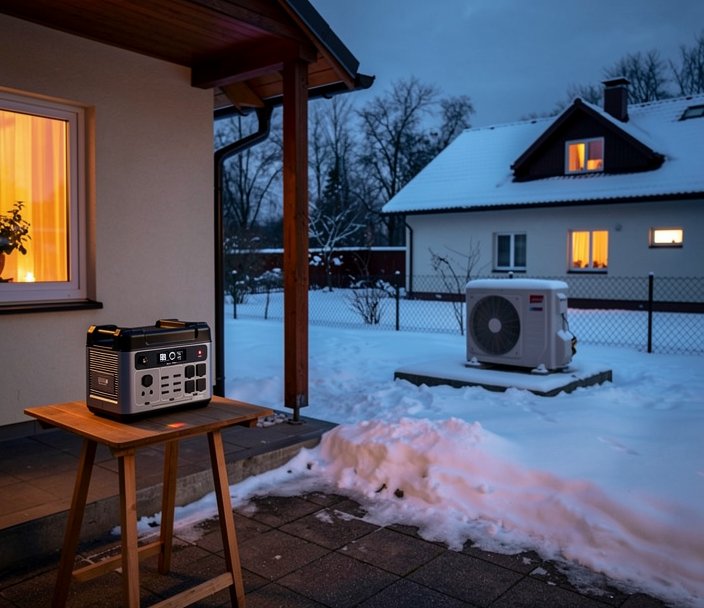
Heat Pump Power Outage Survival Guide: Stretching Your Battery Through Multi-Day Winter Outages