C01


What Is a Portable Power Station? A Home Backup Guide to Wattage, Capacity and Battery Chemistry
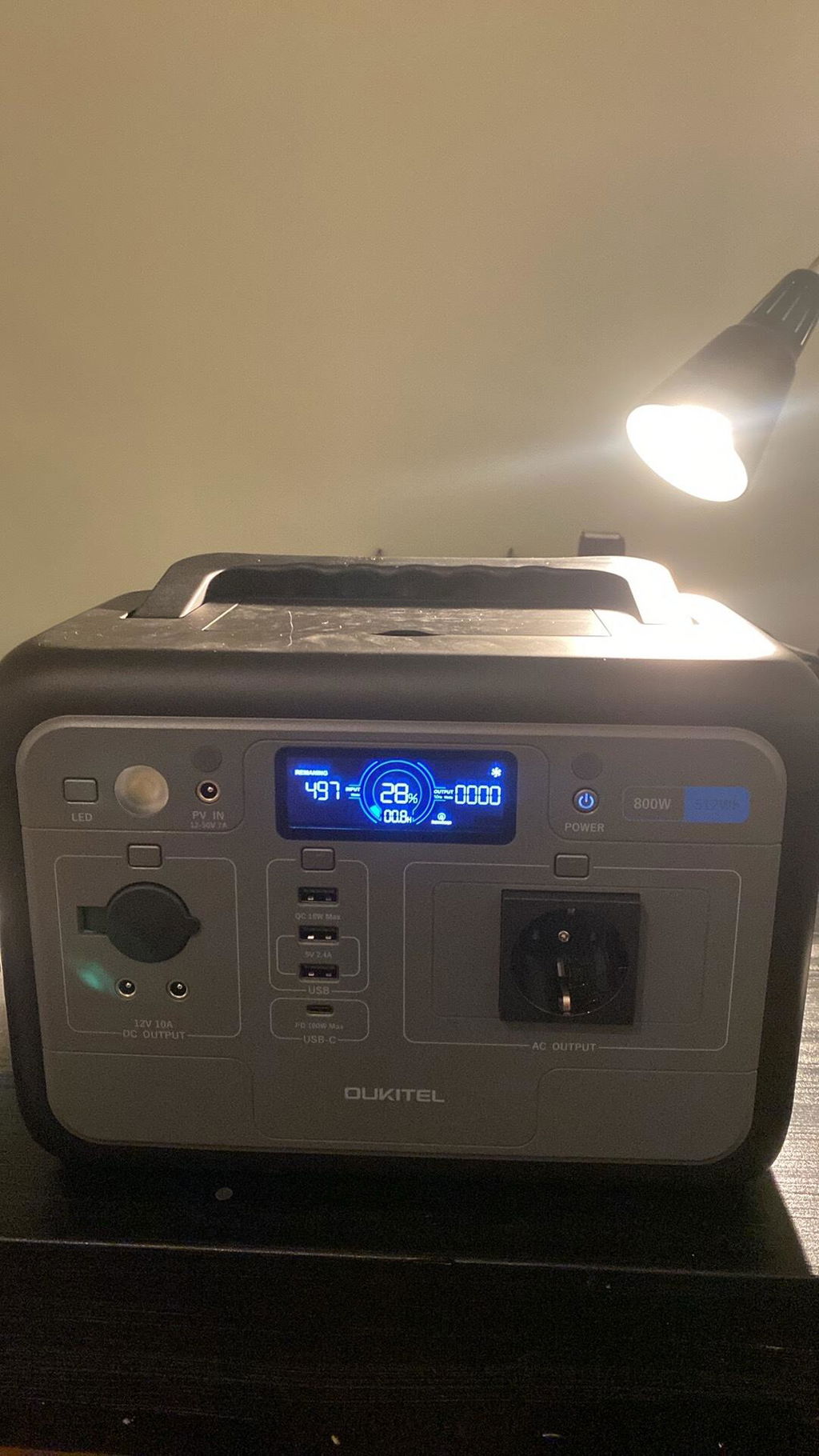
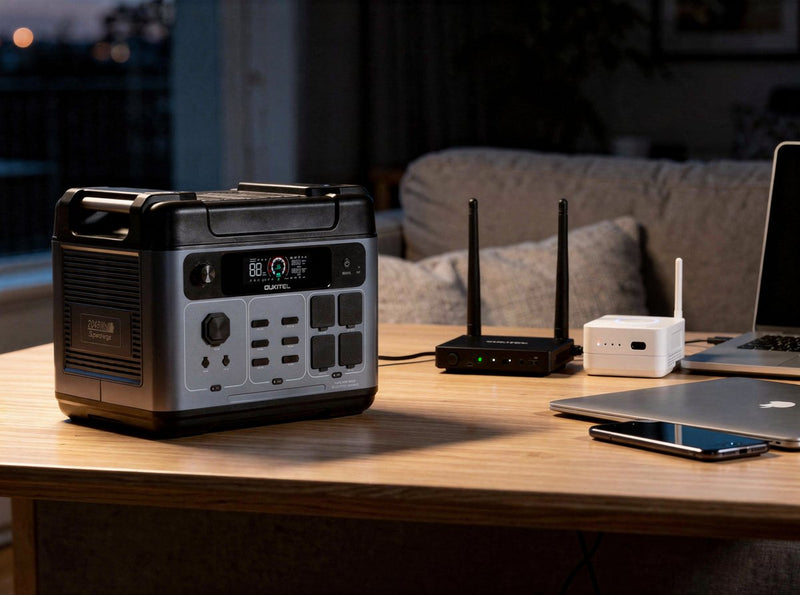
A portable power station is a battery, a battery management system and a mains inverter in one case: it stores DC energy and releases it as 230 V AC through ordinary sockets. That definition sets the boundary of what the device can do in a home. It will carry a fridge, a router, a boiler's controls, lights, a CPAP machine and a fan through an outage. It will not carry a heat pump, an immersion heater, an electric shower or a whole consumer unit for days on end, and no amount of marketing copy changes that.
Two terms get in the way of a straight answer. Power bank and charging bank describe 5 V USB batteries rated in mAh; they charge phones and laptops and cannot start a compressor. A power station is rated in Wh and gives you mains sockets and a pure sine wave inverter. If that distinction is still fuzzy, the comparison of a power bank vs a portable power station settles it. Solar generator is the other label — it means the same battery box, usually bundled with a panel. The panel is optional and contributes nothing after dark, which is precisely when most outages begin.

The Short Answer: Match the Backup Type to the Outage Before You Look at Wattage
Start with the shape of the outage, not the spec sheet. Three different products get sold as "home backup" and they solve different problems.
| Portable power station | Petrol or diesel generator | UPS | |
|---|---|---|---|
| What it is | Battery plus inverter, movable, no fuel | Engine plus alternator, outdoor siting | Battery plus inverter, fixed, sized for minutes |
| Indoor use | Yes — no exhaust, no CO | No. Carbon monoxide risk makes indoor running genuinely dangerous | Yes, sealed units |
| Noise | Low; the P1000 Plus is rated under 29 dB | High, and worse under load | Silent in normal operation |
| Runtime | Fixed by capacity in Wh, then recharged | Unlimited while fuel lasts | Minutes — enough to shut down safely |
| Starting motors | Within the surge rating, one at a time | Usually yes, with headroom | No |
| Routine upkeep | Charge discipline and occasional load tests | Fuel rotation, oil, servicing, carburettor care | Battery replacement every few years |
| Main weakness | Finite stored energy; high cost per kWh stored | Fuel storage, exhaust, noise, maintenance | Cannot ride out a long outage |
The decision rules that follow from that table are blunt:
- Outages measured in hours, loads under roughly 2 kW: a power station wins outright. No fuel to store, no exhaust, safe in a hallway, and quiet enough to sleep beside.
- Outages measured in days, especially in a heatwave or with a medical device in the house: you need a power station plus a recharge path. Capacity on its own is a one-shot resource.
- Whole-home coverage including a heat pump or EV charging: none of these three. That is a fixed home battery, a transfer switch and an electrician.
- Protecting a desktop, NAS or router from flicker and short dips: a small UPS does more per euro than a power station — unless the power station has a fast EPS switchover, in which case it does that job and runs the fridge as well.
There is an honest trade-off buried here. A power station is expensive per kilowatt-hour of stored energy compared with a generator burning fuel, and it cannot be refuelled from a can. What you buy instead is indoor safety, silence, zero maintenance and instant readiness. Buy it as a very good UPS with a generous battery, not as a small generator. Households that buy it as a generator end up disappointed; households that buy it as a resilience appliance tend to keep it for a decade.
The Four Specs That Decide Whether a Power Station Can Carry Your Home Backup
Four numbers do almost all the work. Marketing headlines tend to lead with capacity because it is the biggest number on the box, but capacity is the third most important of the four for backup duty.
1. Continuous AC output (W) — the ceiling you live under
This is the load the inverter can sustain for hours without shutting down. The P1000 Plus is rated 1800 W, the P2001 Plus 2400 W, the BP3000 3200 W and the P5000 Pro 4000 W. Add up everything you want running at the same time — not sequentially — and stay meaningfully below the rating. A fridge, a router, six LED lamps and a TV is a modest simultaneous load. Add a 2 kW kettle and the arithmetic changes completely.
2. Surge or peak output — the number that stops the fridge tripping
Anything with a motor or a compressor draws a spike for a fraction of a second on startup. That spike is what trips undersized units, not the running load. Surge ratings here are double the continuous figure: 3600 W on the P1000 Plus, 4800 W on the P2001 Plus, 8000 W on the P5000 Pro. The practical rule is to start high-draw motor loads one at a time, with everything else already running or switched off.
3. Usable capacity (Wh) — a ceiling, not a promise
Nameplate watt-hours are measured at the battery, before conversion losses and before the reserve you should never drain. Treat the figure as an upper bound. A 1024 Wh unit holds roughly half the stored energy of a 2048 Wh unit, so the same appliance runs for roughly half as long. OUKITEL quotes 41 hours for a 50 W fridge on the P2001 Plus — a useful reference point, but a real fridge cycles its compressor, defrosts and loses cold every time the door opens, so plan on less.
4. Battery chemistry — the spec that decides how long the box stays useful
Every unit discussed in this guide uses LiFePO4 (lithium iron phosphate), rated at 4000 cycles on the P1000 Plus and P2001 Plus, 4000+ on the BP3000, and 5000+ on the P5000 Pro, with a 10-year life figure across the range. That matters more below.
Capacity Tiers Explained: What 1000 Wh, 2000 Wh and 5000 Wh Really Cover
A power station 1000 watt buyers look at, a powerstation 2000 watt unit and a powerstation 5000 watt class machine are not three sizes of the same thing — they are three different products serving three different houses.
| Tier | Nameplate capacity | Realistic backup coverage | Will not cover | Reference unit |
|---|---|---|---|---|
| 1000 Wh class | P1000 Plus: 1024 Wh | Router, mesh nodes, laptops, phones, CPAP, TV, lamps, a small fridge run in blocks | Kettle and microwave together; any heating appliance; a full-size fridge for a full day | P1000 Plus — 1800 W continuous, 12 kg |
| 2000 Wh class | P2001 Plus: 2048 Wh; BP3000 base: 2048 Wh | Full-size fridge, boiler controls, lights, fans, laptops, battery chargers, light power tools | Anything with a heating element running alongside the fridge | P2001 Plus — 2400 W continuous, 22 kg |
| 5000 Wh class | P5000 Pro: 5120 Wh; BP3000 expandable to 16,384 Wh | Fridge, freezer, lights, microwave, well pump, workshop tools, short bursts of high draw | Multi-day air conditioning; whole-home electric heating | P5000 Pro — 4000 W continuous, 53 kg |
The working method is straightforward: list the appliances you genuinely need, note the running watts of each, decide which ones run simultaneously, multiply by the hours you want to cover, and then buy the tier above the answer. The gap between the calculation and reality is duty cycling, conversion losses and the fact that nobody drains a battery to zero during an outage because you may need it again tomorrow.
The most common tiering error is buying on total capacity while ignoring which tier of appliance the house actually depends on. A flat with gas heating, gas hob and a router needs a fraction of what a rural house with a well pump and an oil boiler's ignition controls needs — even though both owners describe their requirement as "backup for the essentials".
LiFePO4 vs NMC: Why Battery Chemistry Is a Backup Decision, Not a Spec-Sheet Detail
For a device that sits in a cupboard for 51 weeks and then works hard for two days, chemistry determines three things: how long it lasts in calendar terms, how it behaves if it is abused, and how much it weighs when you have to carry it up a flight of stairs.
LiFePO4 (LFP) is the more thermally forgiving of the two common lithium chemistries and is the one used across this category's serious backup products. It is heavier per unit of energy than NMC, which is why a 5120 Wh unit weighs 53 kg. The P1000 Plus carries 1024 Wh in 12 kg; the P2001 Plus carries 2048 Wh in 22 kg.
NMC packs are lighter and smaller for the same energy, which is why they dominate e-bikes and some consumer electronics. For a stationary home-backup box that gets carried twice a year, that weight advantage buys you very little, and manufacturers' cycle ratings for NMC packs are generally lower. Treat any cycle number — including the 4000 and 5000+ figures quoted for these units — as a laboratory figure produced under controlled charging and temperature conditions. Real-world life is decided by storage temperature and depth of discharge far more than by the label.
One practical consequence deserves emphasis: if you cycle the unit four times a year, calendar ageing will retire it long before cycle count does. A 4000-cycle rating is meaningless for a household that never uses it. That is why the maintenance habits below focus on storage conditions and periodic exercise rather than on counting cycles.
Three Outage Scenarios and What Each One Demands
The same product question looks different depending on which outage you are actually preparing for.
Scenario 1: The six-to-eighteen-hour storm outage in a suburban house
Constraints: a full fridge, children, no warning, and a need to keep working from home if the outage lands on a weekday. The fridge is non-negotiable; laptops and the router are close behind. A 2000 Wh class unit covers this comfortably, and placement matters more than capacity — hallways and kitchens are convenient, sealed cupboards and cupboards next to radiators are not. Because these outages are short, the recharge path barely matters. Buy for output headroom instead.
Scenario 2: The multi-day wildfire or PSPS shutdown in heat
Constraints invert here: the fridge matters less than keeping insulin cold, running fans and charging a phone, and the ambient temperature is working against the battery. Every unit listed operates between 0 °C and 40 °C and can be stored between −10 °C and 40 °C. A sun-baked garage in a heatwave can sit outside that window, so the unit needs a cool interior room. This is the scenario where a 5000 Wh class machine plus solar is not overkill — and where recharge planning matters more than output.
Scenario 3: The renter in a flat with no balcony and no generator option
Constraints: noise rules, no fuel storage, no permission to modify wiring, limited floor space, and stairs. A 12 kg unit that recharges from a wall socket in one hour is worth more here than a 53 kg unit that needs two people to move. Fast wall recharge also handles the flickering-grid pattern — power returns for 40 minutes, then drops again — better than sheer capacity does.
One case that worked: suppose a household in a storm-prone coastal town measured their fridge with a plug-in energy monitor before buying, discovered that the running draw was modest but the startup spike was the real constraint, and bought into the 2048 Wh tier rather than the cheapest unit on the shelf. They parked it in a hallway, ran the fridge in blocks rather than continuously, and topped it up from a 400 W folding panel and a car outlet. The outage lasted two and a half days and no food was lost — the win came from measuring first, not from buying the biggest box.
Recharging Through a Multi-Day Outage: Wall, Solar and the Solar-Input Trap
A backup power station is a bucket, and a bucket has to be refilled. The recharge strategy is where most buyers under-plan and where the honest limits of the format show up.
Wall charging is the fastest and the least useful during an outage, because the wall is what failed. It still matters: if the grid flickers back for an hour, a fast charger turns that hour into a full battery. The P1000 Plus accepts 1200 W and charges fully in about one hour; the P2001 Plus accepts 1800 W and reaches 80% in about one hour, with four adjustable charging speeds; the P5000 Pro takes 3200 W and reaches 80% in about 1.5 hours. Note the caveat: a 3200 W draw needs a circuit that can actually carry it, so on an ordinary domestic socket you use a reduced rate rather than tripping the breaker.
Solar is the only recharge route that survives a wide-area outage, and the input ceiling is the number to read carefully. The P1000 Plus and P2001 Plus each accept up to 500 W of solar; the P5000 Pro accepts up to 1000 W. The 400 W portable panel is listed as compatible with one unit on the P1000 Plus and P2001 Plus, and up to three panels on the P5000 Pro — but with a 1000 W input cap, the third panel is largely wasted on that model. That is the solar-input trap in one sentence: panels beyond the input ceiling add cost and packing weight without adding charge. If you are new to panel matching, the solar charger buying guide covers voltage and connector matching in detail.
Car charging is the slow fallback — the units accept 12 V/8 A or 24 V/10 A inputs. It is enough to keep a phone-and-lights load alive while driving, and nowhere near enough to refill a 5 kWh bank.
Combined AC plus solar charging is genuinely useful in the flickering-grid scenario: the P1000 Plus accepts up to 1700 W combined and reaches full in roughly 36 minutes, the P2001 Plus up to 2300 W with 80% in about 50 minutes, and the P5000 Pro up to 4200 W with 80% in about 1 hour 10 minutes. In a rotating-outage schedule, that is the difference between a battery that recovers between events and one that slowly drains.
Where the Gear Hits Its Limits
Every one of these limits is easier to plan around than to discover at 22:00 on the second night.
- Ambient temperature. The declared operating window is 0 °C to 40 °C across the range, with storage from −10 °C to 40 °C. Below freezing the unit is outside its rated operating conditions — capacity available to you drops and charging a cold pack is not something the specification endorses. Above 40 °C, expect fans at full tilt and possible throttling. In cold weather, the practical move is to keep the unit in a heated room and accept a shorter outdoor working window.
- Continuous draw at the rating. Running an inverter near its ceiling for hours generates heat and noise. This is audible: the P1000 Plus is specified under 29 dB, the P2001 Plus under 50 dB. If the unit is going in a bedroom, that difference decides the placement. If it is going in a garage, it does not.
- Surge stacking. A unit with 8000 W of surge will still shut down if two compressor loads start in the same second. Sequence your startups: fridge first, then everything else.
- Altitude. No altitude rating is published for these models, so high-elevation use sits outside the declared parameters and should be treated as unverified rather than approved.
- Water and dust. The P2001 Plus is specified as splash and dust resistant; the 400 W solar panel is rated IP68. No ingress rating is listed for the other models, which means they should not be run on a damp basement floor or left out in rain.
- Weight as a limit, not a detail. A 53 kg unit is a fixture, not a portable appliance. Plan a permanent ground-floor position for the P5000 Pro; the P1000 Plus at 12 kg is the one you can genuinely move between rooms.
Five Home-Backup Mistakes That Quietly Cut Runtime and Battery Life
Negative case first, because it is the expensive one. Suppose a household bought the 1000 W class unit because the number looked large enough for a fridge, and never tested it under load. On the first night of an outage they ran the fridge and, twenty minutes later, boiled a 2 kW kettle on the same unit. The combined load sat above the 1800 W continuous rating, the inverter shut down, and because they had assumed the battery was faulty they kept retrying rather than shedding load. The fridge warmed overnight. The purchased capacity was never the problem; the load plan was.
| Task | Right way | Common wrong way | Why it matters |
|---|---|---|---|
| Sizing | Measure the real running draw and startup spike of your fridge with a plug-in monitor | Adding up nameplate labels and buying on capacity alone | Startup spikes, not running watts, are what trip inverters |
| Placement | Hard, non-flammable surface, vents clear, ambient inside 0–40 °C | Sealed cupboard, next to a radiator, or a sun-baked shed | Heat throttles output and accelerates cell ageing |
| Load sequencing | Start one motor load at a time, then add electronics | Everything plugged in and switched on at once | Stacked surges exceed the peak rating even on large units |
| Extension leads | One correctly rated heavy-duty lead per high-draw appliance | Daisy-chaining domestic power strips | Cable heating and voltage drop waste energy and create a fire risk |
| Testing | Quarterly 20-minute run under a real load | Checking it by charging a phone once a year | A unit that has never carried a compressor has never been tested |
| Storage charge | Sit around half charge for long idle periods, top up periodically | Left at 100% in a warm garage, or flat at 0% for months | Both extremes shorten service life; heat makes it worse |
The fifth mistake is the quietest: buying capacity without buying a recharge plan. A powerstation 5000 watt class unit with no panel and no generator behind it is a very good two-day battery and nothing more.
The Gear Checklist: What You Need Beyond the Box
The unit is roughly two-thirds of a working backup setup. The rest is small, cheap and easy to forget until the night it matters.
- A plug-in energy monitor. The single highest-value purchase in this list. It converts guesswork about your fridge and boiler into real numbers.
- Correctly rated extension leads. Heavy-duty, short, one per high-draw appliance. Not a decorative household strip.
- The car charging cable matching the unit's 12 V/8 A or 24 V/10 A input, kept in the same box so it can be found in the dark.
- MC4 extension leads and a parallel adapter if you plan to run more than one solar panel, plus a way to angle the panel toward the sun — the 400 W panel unfolds to 2362 × 990 mm and needs a stable, tilted position, not a flat one.
- A transfer switch or a labelled essentials plan. Decide in advance whether you are running extension leads to specific appliances or feeding selected circuits properly. Back-feeding a consumer unit through a socket is dangerous and must not be done.
- Labelling and a printed load list. Whoever is home during the outage may not be the person who bought the equipment.
- A cart or trolley for anything 22 kg and above, and a permanent ground-floor home for a 53 kg unit.
- Torches, a printed contact list and a first-aid kit stored beside the unit, so the backup isn't in a cupboard behind the thing you can't find.
Maintenance Habits That Genuinely Extend Battery Life
These are the routines that change outcomes. They take about twenty minutes a quarter.
- Exercise it under a real load every three months. Run the fridge or a fan heater for twenty minutes. This flushes out the failure modes that only appear under current draw and confirms the inverter still behaves.
- Store it at mid-charge, not full and not flat. For a unit that idles most of the year, half charge in a cool, dry room is the setting that ages slowest. Top it up on the same calendar reminder each quarter.
- Keep the vents and fans clear. Dust build-up on the intake is the most common self-inflicted cause of overheating. The BP3000 uses six cooling fans, and all six need airflow.
- Log capacity drift once a year. Run the same known load for the same duration and note how far the state of charge falls. A gradual decline is normal; a sudden step change usually means a cell problem worth investigating while the warranty is live.
- Look after the panel separately. Wipe the ETFE surface with a damp cloth, never fold it wet, and store it flat rather than leaning on a corner. A scratched or dirty panel loses output quietly and permanently.
- Check the app occasionally. The P1000 Plus, P2001 Plus and P5000 Pro connect over WiFi and Bluetooth; the BP3000 pairs over Bluetooth. A firmware notification is easy to miss when the unit lives in a cupboard.
- Keep it above freezing in storage. The declared storage floor is −10 °C, but a garage that swings below zero for weeks is not where a lithium pack should spend winter.
Matching Output and Capacity to Real Roles: Five Units and Where They Fit
Read these as illustrations of fit rather than recommendations in the abstract. Each describes the situation a unit suits, and the situation it does not.
P1000 Plus — the flat, the renter, the short outage
The OUKITEL P1000 Plus pairs 1024 Wh with 1800 W continuous and 3600 W surge, four AC outlets, one 100 W and one 20 W USB-C port and two 18 W USB-A ports. At 12 kg and 34.6 × 22.8 × 23.8 cm it is genuinely movable, and at under 29 dB it can sit in a hallway overnight. EPS switchover is specified under 10 ms, so it also behaves like a UPS for a router or desktop. Recharge is the standout: 1200 W AC input gives a full charge in about an hour, 500 W solar gives a full charge in about 2.05 hours, and combined input of 1700 W fills it in roughly 36 minutes. It suits lights, connectivity, CPAP, laptops and a fridge run in blocks. It does not suit a kettle and a microwave at the same time.
P2001 Plus — the family house that wants the fridge running normally
The OUKITEL P2001 Plus doubles capacity to 2048 Wh and lifts continuous output to 2400 W with 4800 W of surge — the tier where a full-size fridge, boiler controls, lights, fans and chargers coexist. It is specified as splash and dust resistant, which matters if the unit lives in a garage or utility room, and it carries a 1+2 year warranty with subscription. Charging runs to 1800 W AC input with 80% in about an hour, 500 W solar with 80% in about 2.75 hours, and 2300 W combined with 80% in about 50 minutes, plus four adjustable charging speeds for weaker circuits. At 22 kg it stays portable for one adult. It is specified under 50 dB, so it is a garage or hallway unit rather than a bedside one.
P5000 Pro — the multi-day, whole-home-lite reserve
The OUKITEL P5000 Pro is the tier for people who have decided that a two-day outage is the realistic worst case and want margin. 5120 Wh, 4000 W continuous, 8000 W surge, five AC outlets, two 100 W USB-C ports, a 48 V/15 A DC output and a 12 V car outlet. Charging is correspondingly serious: 3200 W AC input for 80% in about 1.5 hours, 1000 W solar, and 4200 W combined for 80% in about 1 hour 10 minutes, with EPS switchover under 10 ms. It carries FCC, CE, PSE, RoHS, UN38.3 and MSDS listings. The honest constraint is 53 kg and 550 × 299 × 487 mm: this is a fixed installation with a handle, not something you carry up stairs, and it wants a ground-floor position with ventilation.
BP3000 — the buy-small-then-scale route
The OUKITEL BP3000 starts at 2048 Wh with 3200 W continuous output and four AC outlets, but its real argument is expansion: it accepts up to seven B2000L units for a maximum of 16,384 Wh. If your instinct is "I don't know how much I need yet", this is the structure that lets you answer the question with money over time rather than guessing up front. It charges at 1800 W AC for 80% in about 1 hour 5 minutes, takes 1000 W of solar for 80% in about 1 hour 30 minutes, and reaches 80% in about 45 minutes on 2800 W combined input, with EPS switchover under 10 ms. At 24 kg it is manageable, and it carries CE, FCC, PSE, UN38.3, EMC, LVD, RoHS and MSDS listings. Bluetooth-only app control is worth knowing if you expected remote WiFi monitoring.
400 W Portable Solar Panel — the recharge path, with one caveat
The OUKITEL 400 W Portable Solar Panel uses monocrystalline cells at a stated 24.8% efficiency, an ETFE laminate rated IP68, a 48 V open-circuit voltage and MC4 connectors on a 3 m cable. Folded it is 640 × 990 × 60 mm at 17.5 kg; unfolded it is 2362 × 990 mm. It is listed as compatible with one panel on the P1000 Plus and P2001 Plus, and up to three on the P5000 Pro. Read the input ceilings before buying a second panel: the smaller units cap solar input at 500 W and the P5000 Pro at 1000 W, so extra panels beyond those limits add packing weight and nothing else. Rated output also assumes good sun at a favourable angle — flat, shaded or overcast deployment delivers substantially less, which is why the recharge plan should assume a poor solar day, not a perfect one.
A Practical Buying Checklist for Your First Home Backup Power Station
- Measure before you shop. Use a plug-in monitor on the fridge, the boiler and anything medical. Record running watts and the startup spike.
- Write your must-run list and the hours you need. Be honest about whether heating is gas, oil or electric — it changes the tier entirely.
- Choose the outage you are buying for. Hours means capacity; days means capacity plus recharge; a week means a different product class altogether.
- Check the continuous and surge ratings against your simultaneous load, not against your sequential list.
- Confirm the recharge path is real in your home. Which socket can carry the AC input? Where would a panel actually sit, and for how many hours of sun?
- Decide where the unit will live — permanently, with ventilation, inside the 0 °C to 40 °C operating window, and reachable without moving furniture.
- Then compare models in the portable power station collection, with your numbers in hand rather than the marketing headline.
Conclusion: A Decision Matrix Rather Than a Summary
Use the row that matches your situation. If two rows apply, buy for the harder one.
| Your situation | What to buy | Reference point |
|---|---|---|
| Flat or rental, outages under six hours, work-from-home, no outdoor space | 1000 Wh class with fast wall recharge and sub-10 ms EPS; keep it in a hallway | P1000 Plus |
| Detached house, storm outages of half a day to a day, fridge and boiler controls must run | 2000 Wh class with 2400 W+ continuous and one 400 W panel for top-ups | P2001 Plus |
| Wildfire or PSPS zone, multi-day outages in heat, medical equipment in the house | 5000 Wh class plus solar, sited in a cool interior room, with a rehearsed load plan | P5000 Pro |
| Unsure of your real requirement and likely to grow into it | A modular base unit with a published expansion path | BP3000, expanded with B2000L later |
| Heat pump, electric water heating or whole-home coverage for a week | Not a portable unit. A fixed home battery with a transfer switch and an electrician; the power station becomes the bridge | None of the above |
The rule in one line: buy a power station for the loads you can carry in one hand, plan the recharge before you need it, and stop expecting a battery box to substitute for a generator or a wired-in home battery. If your measured must-run load exceeds what the 2000 Wh tier can hold for the hours you actually fear, the answer is not a bigger portable unit — it is a change of product class.
Frequently Asked Questions
Is it safe to run a portable power station indoors during a power outage, and what placement limits apply?
Yes — there is no combustion and no exhaust, so the carbon monoxide risk that makes indoor generator use dangerous simply does not apply. The placement limits are thermal and electrical instead: a hard, non-flammable surface, unobstructed vents, ambient temperature inside the declared 0 °C to 40 °C operating window, and no damp basement floor for models without a listed ingress rating. Avoid sealed cupboards and anything next to a radiator or in direct sun, because heat throttles output and shortens cell life.
Can a portable power station be wired into my home's breaker panel or run through a transfer switch?
Not by back-feeding a socket — that is dangerous and should never be attempted. Selected circuits can be supplied properly through a transfer switch or a dedicated inlet installed by an electrician, and some large units are explicitly listed as compatible with a dual power automatic transfer switch for whole-home backup. For most households, extension leads to specific appliances are the sensible and legal route.
Why does my fridge trip the power station even when the running wattage looks well within range?
Because a compressor draws a short inrush spike several times its running wattage for a fraction of a second, and that spike — not the steady draw — is what the inverter sees. If other loads are already running, the spike lands on top of them. Start the fridge first with everything else off, and check the unit's surge rating rather than its continuous rating.
How many years should I expect a home-backup power station to last before capacity fades noticeably?
The units discussed here are rated at 4000 to 5000+ cycles with a 10-year life figure, but those numbers assume controlled conditions. A backup unit that cycles a handful of times a year will age by calendar and storage temperature rather than by cycle count, so mid-charge storage in a cool room matters more than any label. Expect noticeable fade to be driven by heat exposure and by being left full or flat for long periods.
Do I need pure sine wave output for a furnace blower, CPAP, or other sensitive electronics?
Yes. Motors run cooler and quieter on a pure sine wave, and electronics with motors or sensitive power supplies can misbehave or overheat on modified sine output. Every unit referenced in this guide uses a pure sine wave inverter, which is the specification to confirm before buying anything for a boiler, a CPAP machine or a desktop computer.
This article was written using up-to-date sources as of November 2026. Details may change over time — verify current specifics before relying on them.
Latest articles
Battery Charger Buying Guide: How to Match Chargers to Your Batteries and Devices
Solar Charger Buying Guide: How to Match Panel Wattage to Your Portable Power Station
Charging Bank vs Power Bank: How to Tell If You're Getting AC Power or Just USB
Power Bank vs Portable Power Station: How to Choose by Device Load and Real Runtime

What Is a Portable Power Station? A Home Backup Guide to Wattage, Capacity and Battery Chemistry