C01


Solar Charger Buying Guide: How to Match Panel Wattage to Your Portable Power Station
Most searches for a 'solar charger' land on one of two very different products: a pocket-sized USB panel for topping up a phone, or a folding solar panel built to refill a portable power station. This guide covers the second type — the panels you pair with a station in the 1kWh to 2kWh class — because that is where buying mistakes get expensive.
One correction on terminology first. What you are buying is a photovoltaic module, not a charger. The charger — an MPPT controller — already sits inside your power station. Nothing here is about charging loose AA cells; if that is your task, the battery charger buying guide covers it properly. This article is strictly about the portable power station and solar charger pairing: which panel, how many, and how to tell whether a marketplace listing is telling the truth. If you are still deciding whether you need a station at all, start with What Is a Portable Power Station? A Complete Guide for Home Backup and come back once the category is settled.
The short answer, before the reasoning:
- Buy panels whose combined nameplate wattage lands at or just below your station's published solar input ceiling. Above it you gain nothing; far below it you spend the day waiting.
- Check the panel's open-circuit voltage against the station's input window before anything else. Wattage is the second question, never the first.
- Weigh the panels before you pay. A 400W folding panel weighs 17.5kg. If it never leaves the boot, its real-world output is zero.

Start With Your Power Station's Solar Input Spec, Not the Panel's Wattage
Panel listings are written to sell watts. Station spec sheets are written to describe limits. The purchase only works when the second document governs the first, so read in this order.
| Spec field | What it actually means | What it decides |
|---|---|---|
| Solar input maximum (W) | The most the built-in MPPT controller will draw from a DC source. | The total nameplate wattage you should buy. |
| Open-circuit voltage, Voc (V) | The panel's highest voltage, measured unloaded, rising further in cold weather. | Whether the panel sits inside the station's input window. |
| Max power voltage and current, Vmp/Imp | The operating point where the panel does its rated work. | Whether the panel spends its day inside the controller's efficient band. |
| Connector type | The physical housing at the cable end. | Whether an adapter is needed — and adapters are where field failures start. |
| Cable length | The fixed cable supplied with the panel. | Whether you also need an extension run. |
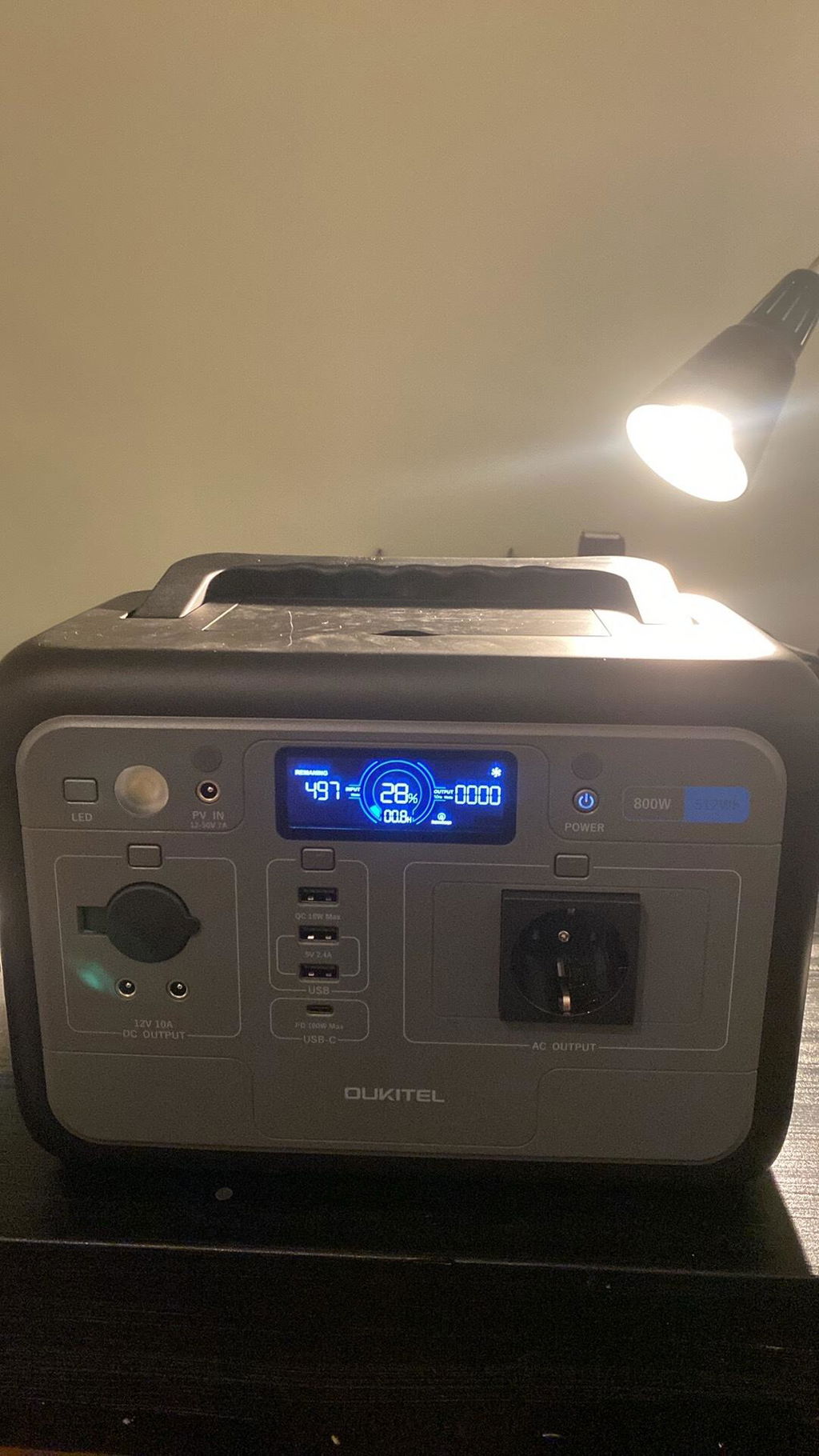
Applied to the two stations in this class: the OUKITEL P1000 PLUS publishes a 500W solar input maximum against a 1,024Wh battery and a 2.05-hour full solar recharge. The OUKITEL P2001 Plus publishes the same 500W solar ceiling against 2,048Wh, with an 80% solar recharge quoted at 2.75 hours. Both rely on a built-in MPPT controller and BMS.
Neither published specification list states a maximum solar input voltage or a maximum solar input current. That gap matters. If you intend to pair a third-party panel — especially a 48V-Voc module — get those two numbers from the manufacturer before you buy. In this category, over-voltage is the failure that is both entirely avoidable and expensive to recover from.
The panel side is better documented. All three OUKITEL folding panels use MC4 connectors and a 3m cable. The OUKITEL 400W Portable Solar Panel lists 48V open-circuit, 36V at maximum power, 12A short-circuit and 11.1A at maximum power. The OUKITEL 200W Portable Solar Panel lists 25V open-circuit, 18V at maximum power, 12.8A short-circuit and 11.1A at maximum power. The OUKITEL 100W Portable Solar Panel publishes its wattage, cell type, efficiency and IP rating, but not its open-circuit voltage or current — confirm those with the manufacturer rather than assuming it behaves like a scaled-down 200W.
Rated vs Real Output: Why a 200W Panel Rarely Delivers 200W
A 200W panel is rated at 200W under standard test conditions: a laboratory flash at fixed irradiance and a cell temperature of 25°C. The nameplate is a comparison tool, not a forecast.
Two standards sit behind the numbers on the box. IEC 61215 covers design qualification and type approval for terrestrial PV modules — in plain terms, whether the design survives and keeps performing. IEC 61730 covers safety qualification, including protection against electric shock, fire and mechanical or environmental stress. A panel can hold both and still deliver well under its nameplate on a hot afternoon, because neither standard promises a field yield.
The more realistic figure is the NMOT/NOCT-style rating, which assumes a warmer cell and a modest breeze. On portable folding panels it is often missing from the listing entirely. What you get instead is a best working temperature — 25°C on all three OUKITEL panels — inside an operating range of -10°C to 65°C. A dark ETFE laminate lying flat on warm ground will sit well above 25°C for most of a sunny day, and output falls as cell temperature climbs.
No single verified derating percentage applies across panels, climates and mounting styles, so treat any listing that quotes one as marketing rather than data. The decision rule is simpler: size for the worst hour you are willing to accept, not the best hour you can imagine. If the trip depends on a full battery by evening, buy enough nameplate wattage that a mediocre day still covers consumption.
Voltage Matching and Connectors: Where Most Panel-Station Pairings Fail
Most buying guides stop at wattage. Voltage is where the pairing actually succeeds or fails, and it is the number buyers skip.
A panel has two voltage figures. Vmp is where it does its work under load; Voc is what it reads with nothing connected, in full sun, and it climbs further as cells get colder. A station's input window is a ceiling on the second number, not the first. So a panel that 'runs at 36V' may present close to 48V to the controller on a cold, bright morning before the MPPT settles.
That is why the 400W panel's 48V Voc deserves a check even when the arithmetic looks comfortable against a 500W ceiling. Wattage tells you how fast you can refill; voltage tells you whether you are allowed to connect at all.
Series and parallel change the arithmetic, and the two options fail in opposite directions:
- Two 200W panels in series: voltages add. Roughly 50V open-circuit, 36V at maximum power, current unchanged at about 12.8A short-circuit. You gain a higher, more controller-friendly voltage but push Voc closer to any input ceiling.
- Two 200W panels in parallel: currents add. Roughly 25V open-circuit, 22.2A at maximum power and 25.6A short-circuit. Voltage stays low, but you roughly double the current the input has to handle.
- One 400W panel: 48V open-circuit, 36V at maximum power, 11.1A. One connector pair, one cable run, 17.5kg.
Because OUKITEL does not publish a solar input voltage or current ceiling for either station, the honest recommendation is to stay inside the configurations the manufacturer lists as supported: one 400W panel or up to two 200W panels into the P1000 PLUS, and the same on the P2001 Plus. Two 200W panels weigh 14kg in total against 17.5kg for the single 400W, pack into two smaller bags, and give you redundancy when one is shaded — at the cost of an extra connector pair and a second cable to manage.
Connectors earn their own warning. IEC 62852 sets safety requirements and tests for PV DC connectors, covering rated voltages up to 1,500V DC and rated currents up to 125A per contact. It exists because a mated pair carrying real current is a small, hot, weather-exposed electrical joint. Mixing incompatible MC4-style connectors, or stacking clone adapters to bridge two different housings, can produce unsafe mating, arcing, local heating and a loss of compliance — the joint may still 'work' while quietly degrading. If a panel does not terminate in a genuine MC4 pair that mates cleanly with your cable, budget for replacing the connector instead of adding another adapter.
Folding, Rigid, or Briefcase: Choosing for How You Actually Travel
Folding panels win on storage volume and setup speed; they lose on cost per watt and weight per watt against rigid glass modules of similar output. Rigid panels are the better buy when the module lives on a roof rack or a balcony and never moves — but they need mounting hardware and they do not fold into a bag.
The three OUKITEL panels make the trade-off concrete:
| Panel | Rated power | Folded size | Weight | Electrical headline | Notes |
|---|---|---|---|---|---|
| OUKITEL 400W | 400W | 640 × 990 × 60 mm | 17.5kg | 48V Voc, 36V Vmp, 11.1A Imp | ETFE laminate, IP68 splashproof, 24.8% cell efficiency, MC4, 3m cable |
| OUKITEL 200W | 200W | 576.5 × 606 × 60 mm | 7kg | 25V Voc, 18V Vmp, 11.1A Imp | Same laminate and efficiency, carryable by one person |
| OUKITEL 100W | 100W | Not published | 7kg | Voc not published | Smallest output, same listed weight as the 200W |
Two observations that change decisions. First, the 400W panel folds to 640 × 990mm but weighs 17.5kg — that is a two-trip or two-person item on anything other than a vehicle-based journey. Second, the 100W panel's published weight matches the 200W panel's 7kg, so on paper it offers no carrying advantage; if weight is your reason for choosing it, verify the shipping weight and folded dimensions first, because the published specification does not include them.
Cell efficiency is identical across all three at 24.8%, with the same ETFE laminate and IP68 splashproof claim — so the specification block lists no open-circuit voltage for the 100W, and you should not assume one. The choice between these panels is not about cell quality. It is about how many watts you can physically carry and how many panels the station will accept.
How Many Watts Do You Need? A Sizing Walkthrough for a Weekend vs a Multi-Day Trip
Work outward from the station, not inward from the panel. Three profiles cover most buyers, and each fails against a different constraint.
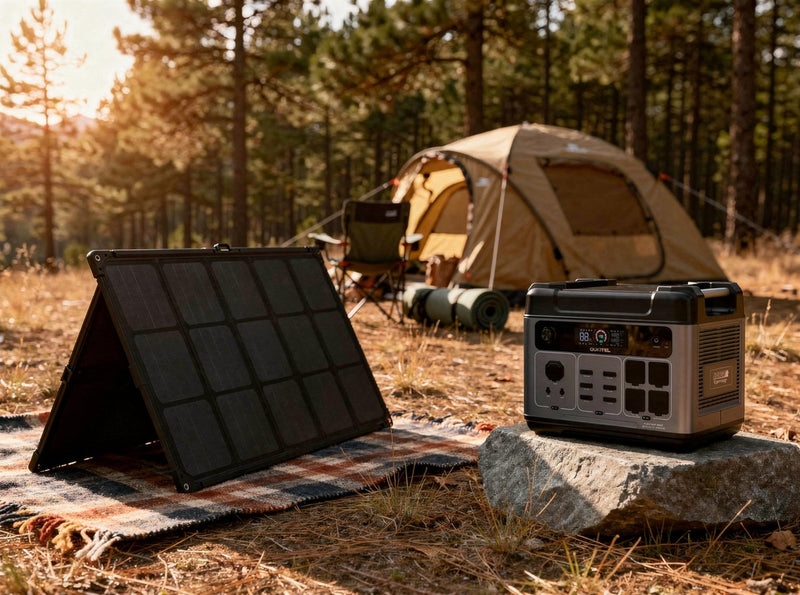
Scenario 1 — weekend car camping, short daylight, space not a constraint. Suppose you run a P1000 PLUS at 1,024Wh and leave Friday evening, returning Sunday. The car carries the weight, so portability is irrelevant, but you only get two charging windows. At 400W of panel — the maximum the compatibility list supports — a full recharge from empty is about 2.6 hours of genuinely good sun at nameplate output. In practice that means most of Saturday's middle hours rather than a quick top-up. This is the profile where buying the 400W panel is straightforwardly correct.
Scenario 2 — multi-day van or overland travel, mixed weather, weight matters. A P2001 Plus at 2,048Wh with 400W of panel needs roughly 5.1 hours of nameplate output to go from empty to full. That is a full sunny day, not an afternoon, which means the realistic strategy is daily charging rather than deep-cycling and recovering. If consumption is high — a compressor fridge is the usual culprit — two 200W panels give the same 400W ceiling while letting you move one module out of shade, which is often worth more than the weight saving.
Scenario 3 — home backup top-up in poor light. Here the panel is not the primary charger; mains is. The panel's job is to hold a charged station at charge through a long outage. Because winter output is the binding constraint, the useful purchase is the largest panel you can leave permanently positioned, not the most portable one. A 400W panel angled at the sun for six hours will out-collect a 200W panel moved twice a day in most conditions.
One caution about published recharge times. The P1000 PLUS's 2.05-hour full solar recharge reconciles neatly with its 500W input ceiling: 500W for just over two hours is about 1,024Wh. That is a statement about what happens if your panels genuinely deliver 500W, which is a laboratory-grade assumption. The P2001 Plus figures are harder to reconcile — 80% of 2,048Wh is roughly 1,638Wh, while 2.75 hours at the 500W ceiling is about 1,375Wh — which is the clearest available argument for treating any solar recharge time as a best case rather than a schedule. Note also that with OUKITEL's own panels the practical ceiling on either station is 400W, not 500W, because that is the largest single module the compatibility list supports.
Reading Marketplace Listings: What 'Compatible With' Really Means
'Compatible with most solar generators' is a claim about the connector, not about the electronics. Five checks separate a working bundle from a return:
- Open-circuit voltage, stated as a number. If the listing gives watts and nothing else, you cannot check the match. Skip it.
- Wattage per panel versus wattage per bundle. A '400W' bag containing two 200W panels joined by a Y-branch is a different product from a single 400W module, with twice the connectors.
- Connector type, and whether the supplied cable matches. MC4 on both ends is the clean case. If an adapter is needed, ask which one and whether it is rated for the current.
- Whether the station's input window is published at all. No voltage ceiling published means no verification is possible.
- Who honours the warranty when the bundle is assembled from three brands. Usually nobody.
Buyers searching for an 'OMRC portable power station solar charger' bundle are usually looking at exactly this situation: a marketplace listing where station, panel and cable come from different suppliers, and the compatibility claim is written by whoever assembled the listing. Treat that claim as a hypothesis to test, not a specification.
Two before-and-after comparisons show how the same budget produces different outcomes. Both are hypothetical, but neither is unusual.
| Setup | Before | After | What actually changed |
|---|---|---|---|
| Van owner, P2001 Plus, one 400W panel | Panel laid flat on the roof rack, shadowed by a roof box from mid-afternoon; the station rarely reached full despite long days parked in sun. | Same panel, raised to face the sun and shifted clear of the roof box, with charging concentrated between mid-morning and mid-afternoon; daily consumption covered without adding a single watt. | Aim and placement, not hardware. |
| Festival camper, marketplace '400W solar charger' bundle | Bought on the headline wattage; the bundle arrived as two 200W panels joined by a Y-branch with clone connectors that mated loosely. | Intermittent charging, a warm connector and a flat battery by the final day; later rebuilt around a single module with the open-circuit voltage verified before first use. | Connector integrity and a two-minute multimeter check. |
The lesson from both is the same and slightly uncomfortable: the cheapest upgrade is rarely a bigger panel. It is usually a correct connection and a better angle.
Field Reality: Shading, Heat, Dust and Cable Management
Field practice, not datasheet practice, decides whether panels earn their cost. Four conditions matter more than anything printed on the box.
Shading
Partial shading is not proportional. Shade one section of a module and the bypass diodes route around it, dropping a larger share of output than the shaded area suggests. On a folding panel this compounds, because the sections are wired internally — shading the lower third while the upper two-thirds sit in sun can cost far more than a third of the yield. Move the panel rather than accepting 40cm of shadow across the corner of a 400W module.
Heat
Lay a black ETFE panel on warm ground and the cells climb well past the 25°C best-working temperature the specification quotes. Airflow behind the panel and a slight tilt both help. Do not store a panel folded in direct sun; the laminate heats faster than it can shed.
Dust and water
All three OUKITEL panels carry an IP68 splashproof rating, which is a statement about the enclosure, not about the connector joint. IEC 60529 defines how ingress protection is graded, and on real installations the junction box, connectors and cable glands are usually what let you down. The P2001 Plus is described as splash and dust resistant, but its published specification list carries no IP number, so do not treat it as weatherproof beyond that wording.
Cables
Cable runs are where field users lose power and create hazards. A cable lying across a walkway is a trip hazard and a pull-force risk on the connector; a tightly coiled cable carrying current concentrates heat. Run the cable once, along the ground, out of foot traffic, with a little slack at each end.
| Right way | Common wrong way | Why it matters |
|---|---|---|
| Read open-circuit voltage with a multimeter before first connection | Plug in and see what happens | A cold-morning Voc above the input ceiling is the one mistake that can end both the trip and the equipment. |
| Keep MC4 pairs mated or capped | Leave connectors open in sand and dust | Contaminated contacts arc and heat; IEC 62852 exists because this joint is the weak point. |
| Re-aim the panel two or three times a day | Lay it flat and leave it | Flat mounting in a European summer gives up a meaningful share of the day's harvest to angle alone. |
| Match panel count to the published compatibility list | Assume more panels always means faster charging | Beyond the input ceiling the controller clips, so extra wattage buys weight and nothing else. |
| Run one continuous cable with slack at both ends | Daisy-chain three short adapters | Every extra joint is a resistance point and a water trap. |
| Weight or stake the panel against wind | Lean it against the van | A folding panel is a sail; a gust turns it into a falling object. |
| Fold and store panels dry | Fold a wet panel and leave it closed for days | Trapped moisture sits against the laminate and inside the connector housing. |
Where the Gear Hits Its Limits
Every specification in this class has a boundary, and most boundaries are environmental rather than electrical.
- Cold. Both stations list an operating temperature of 0°C to 40°C and a storage range of -10°C to 40°C. Charging below freezing sits outside the operating specification, while the panels themselves are rated from -10°C to 65°C. A bright, freezing morning is precisely when panel Voc is highest and the battery is least willing to accept charge.
- Heat under load. The P1000 PLUS delivers 1,800W continuous with a 3,600W surge; the P2001 Plus delivers 2,400W continuous with a 4,800W surge. Sustained high draw in a hot, enclosed space pushes the inverter toward thermal protection, and the first sign is usually the fan — quoted below 29dB on the P1000 PLUS and below 50dB on the P2001 Plus.
- Altitude. No altitude rating is published for either unit. If you work above typical European hillwalking heights, treat cooling performance as unverified and keep loads modest.
- Continuous solar draw at the ceiling. Running a controller at its input maximum for hours is not the same as a short burst. If the charge rate visibly steps down after an hour of strong sun, that is thermal management doing its job, not a fault.
How to tell a limit from a fault: charge wattage plateauing well below the panel's nameplate while the panel is cool and unshaded points to the station's ceiling or the cable; charge wattage falling through the afternoon while the panel is hot points to temperature; and a station refusing charge in sub-zero conditions is the BMS protecting itself.
Gear Checklist: What You Need Beyond the Panel
- An MC4 extension cable sized for the current, if your run exceeds the supplied 3m that ships with all three OUKITEL panels.
- A multimeter. The cheapest insurance in this category: it verifies Voc before first connection and diagnoses a bad joint later.
- One correct adapter, chosen deliberately. MC4 to XT60, MC4 to Anderson or MC4 to barrel — whichever your station's input uses. One adapter rated for the current, never three stacked.
- Connector caps or a spare mated MC4 pair to keep exposed contacts clean in transit.
- A padded bag or sleeve. Folding panels fail at the hinge and at the cable exit, both of which are abrasion points.
- A ground sheet or clean flat surface. Grit against a laminate is a slow scratch.
- Something to prop and angle the panel — a stuff sack, a rock or a purpose-made stand.
- A written note of your station's solar input ceiling and voltage window, kept with the panel. It is the one number you will not remember at the campsite.
- Optional and separate: a USB-C PD 3.1 source. The specification allows up to 240W over USB-C at fixed voltages of 28V, 36V and 48V, but that is a mains or power-bank route for topping up small loads, not a substitute for a solar input.
Maintenance Habits That Actually Extend Life
Routines beat products here. These are specific, and most take under five minutes.
- Monthly: unfold the panel in daylight and read Voc with a multimeter. A reading noticeably below nameplate on a cool, bright day means a failing section or a corroded joint — better discovered at home than at a campsite.
- Before every trip: inspect the MC4 contacts for discolouration or pitting. Brown marks mean heat, and heat means a joint on its way out. Replace the connector pair rather than cleaning it.
- After every trip: wipe the laminate with lukewarm water and a soft cloth, dry it fully, and store it dry. Never store a panel folded wet.
- Seasonally: check the cable jacket along its full length for abrasion, particularly where it exits the panel frame.
- For the station: if it will sit unused for months, store it part-charged rather than full, well inside the -10°C to 40°C storage range, and top it up every few months. The LiFePO4 cells in both units are rated at 4,000 cycles or better over a quoted 10-year life, but that rating assumes sensible storage rather than a summer in a hot shed.
- Firmware: both stations support app control over WiFi and Bluetooth. Check for updates before a long trip rather than during one, because charge and input behaviour occasionally changes with firmware.
If Your Budget Only Covers One Upgrade, Buy This First
Decision rules, in the order most buyers should apply them.
- If you already own the station and have no panel: buy panels totalling close to its solar input ceiling, using the manufacturer's compatibility list as the cap. For a 500W-ceiling station that means 400W — one 400W module or two 200W modules. Do not buy a second battery before you own a way to charge the first one off-grid.
- If you carry everything by hand: cap total panel weight at around 7kg and accept fewer watts. A 200W panel you actually deploy beats a 400W panel left in the vehicle every time.
- If you are buying the panel before the station: stop and reverse the order. The station's input window is the constraint, and buying the panel first locks you into a station that matches it.
- If a listing will not state open-circuit voltage: do not buy it, at any price.
- If your daily consumption exceeds what 400W can harvest in your climate: the answer is lower consumption or a larger station, not more panel — the input ceiling caps what extra wattage can achieve.
The one trade-off worth naming plainly: a bigger panel is almost always cheaper per watt than a bigger battery, but only up to your station's input ceiling. Past that ceiling, additional panel capacity is weight you carry for nothing. If you are still comparing device categories rather than panels, Power Bank vs Portable Power Station: Which Do You Need? covers that fork, and the full portable power station range is the place to check input ceilings before you spend anything on solar.
Frequently Asked Questions
Can I use a solar panel with a higher wattage than my power station recommends, or does that damage it?
A higher-wattage panel does not force current into the station; the MPPT controller draws only what it can use, so surplus wattage is largely wasted rather than damaging. The genuine risk is voltage, not wattage — check the panel's open-circuit voltage against the station's input window before connecting anything. Extra wattage above the ceiling mainly buys you weight and cost.
What happens if the panel's open-circuit voltage exceeds the station's input limit — is it a fuse, a shutdown, or permanent damage?
The outcome depends on how the input stage is designed, and OUKITEL does not publish a solar input voltage ceiling for these models, so it is not something worth testing. Some controllers clamp the input and refuse to charge; others rely on component ratings that can be permanently damaged by an over-voltage event. Verify the window with the manufacturer before pairing a third-party panel.
Can I run two panels in series or parallel into a single solar input, and which one should I pick?
Series adds voltage — two 200W panels present roughly 50V open-circuit — while parallel adds current, reaching about 25.6A short-circuit. Without a published voltage window or current limit for the station, stay inside the configurations the manufacturer supports: up to two 200W panels per station, or a single 400W module. Series suits controllers with a high voltage window; parallel suits low-voltage, high-current inputs.
Do I need a separate charge controller if my power station already accepts solar input?
No. Both the P1000 PLUS and the P2001 Plus have a built-in MPPT controller, and inserting a second controller in line creates two regulation stages that fight each other and reduce yield. A separate controller only makes sense when you are charging a bare battery rather than a station with its own input electronics.
Why does my panel only output a fraction of its rating on a clear day?
The nameplate is a standard-test-condition figure measured at a 25°C cell temperature, and a panel in real sun runs far hotter than that. Flat angle, dust, cable losses and any partial shading all subtract further. Check cell temperature and aim first, then inspect the connectors and cable before blaming the panel.
Is a folding panel worth the premium over a rigid panel of the same wattage?
Only if the panel actually moves. Rigid modules are cheaper per watt and better suited to permanent mounting on a roof rack or balcony, where folding brings no benefit. Folding panels earn their premium through storage volume and setup speed, so the decision follows how the panel travels, not how it performs.
This article was written using up-to-date sources as of November 2026. Details may change over time — verify current specifics before relying on them.
Latest articles
Battery Charger Buying Guide: How to Match Chargers to Your Batteries and Devices
Solar Charger Buying Guide: How to Match Panel Wattage to Your Portable Power Station
Charging Bank vs Power Bank: How to Tell If You're Getting AC Power or Just USB
Power Bank vs Portable Power Station: How to Choose by Device Load and Real Runtime

What Is a Portable Power Station? A Home Backup Guide to Wattage, Capacity and Battery Chemistry