C01
C01


RV Portable Power Stations: How to Choose the Right Battery & Solar System for Your Camper
If you've been spending nights at a campground listening to the drone of a neighbor's generator, you've probably wondered whether there is a quieter, cleaner, and less temperamental way to power your RV. The answer increasingly involves portable power stations paired with solar panels. Unlike the fuel-based generators that dominated RV travel for decades, today's lithium battery systems offer near-silent operation, zero fumes, and a drastic reduction in maintenance—making them an attractive alternative for everyone from weekend campers to full-time boondockers.

But switching to battery and solar isn't as simple as buying the biggest power station you can afford. Undersizing your system for high-surge appliances, misestimating daily energy consumption, or expecting solar panels to perform at their lab-rated output in every condition are common and expensive mistakes. This guide will walk you through a practical, step-by-step decision process—from calculating your true power needs to choosing the right battery capacity and solar input—so you can build a system that fits your travel style without overpaying for capacity you'll never use.
Before we dive in, a quick terminology note: the industry often calls a portable power station paired with solar panels a "solar generator," but it's important to understand that these are not generators in the traditional sense. They don't create power; they store it and can be recharged via solar panels, an AC wall outlet, or a car's 12V socket. Throughout this article, we'll use the terms "portable power station" and "solar generator" interchangeably, but always with the understanding that we're talking about a battery inverter system, not a combustion-engine device.
Why RVers Are Swapping Generators for Portable Power Stations
The shift isn't just about noise, though that's a compelling reason. The deeper advantages touch on convenience, maintenance, and the freedom to camp without generator-hour restrictions.
Consider a scenario where you're boondocking in a national forest. Traditional gasoline or propane generators often have designated quiet hours, and even the quietest inverter generators produce a constant hum that can disturb wildlife and other campers. A portable power station, by contrast, delivers power silently. The OUKITEL P1000 Plus, for instance, operates at less than 29dB—about the volume of a whisper—so you can run your devices overnight without any noise violation.
Maintenance is another differentiator. Portable power stations have zero moving parts in the battery and inverter system, meaning no oil changes, no spark plug replacements, and no fuel stabilization. For RVers who use their rig seasonally, the ability to store the power station for months without degradation or stale fuel is a significant practical advantage. And when you combine it with solar, you eliminate the need to carry fuel cans or hunt for propane refill stations.
However, there is a trade-off. A generator can run indefinitely as long as you feed it fuel, while a power station has a finite capacity. If you need sustained high power for days without access to shore power or sufficient solar recharge, a generator might still be the better choice. The decision comes down to your energy consumption profile and how you recharge.
Understanding Your RV's True Power Consumption: From Lights to Air Conditioners
The root cause of most RV power system failures is not the equipment, but the owner's energy audit—or lack thereof. You can't size a system until you know how many watt-hours (Wh) you consume in a typical day.
Common mistake: Adding up the rated wattage of all your appliances and multiplying by 24 hours. That gives you a wildly inflated number because most devices don't run continuously. A 12V compressor fridge, for example, draws 60-80W when running but cycles on and off, consuming roughly 500-800Wh over 24 hours. A 13,500 BTU air conditioner, on the other hand, can pull 1,500-2,000W when the compressor is on, plus a significant startup surge—but you might only run it for a few hours in the evening. You need a realistic estimate of daily energy consumption, not peak instantaneous numbers.
A better method is to list each appliance, its running watts, approximate daily hours of use, and calculate watt-hours. Here's a sample table for a moderate-use RV scenario:
| Appliance | Running Watts (approx.) | Hours/Day | Daily Wh |
|---|---|---|---|
| 12V Compressor Fridge | 60 | 10 (cycling) | 600 |
| LED Lights (6x5W) | 30 | 4 | 120 |
| Water Pump | 50 | 0.5 | 25 |
| Laptop Charging | 60 | 3 | 180 |
| Phone/Tablet Charging | 20 | 3 | 60 |
| Vent Fan | 30 | 8 | 240 |
| Total | ~1,225 Wh |
If you add a few hours of air conditioning, you could easily push that number over 3,000Wh. The key is to do this calculation for your specific usage pattern. One full-time RV couple we spoke with during research—who boondock in the southwestern US—discovered their real consumption was nearly double their original estimate because they didn't account for a Starlink system (which draws about 75W continuously) and a 12V entertainment system. Their first 2,000Wh power station couldn't get them through a single day without solar. They upgraded to a 5,120Wh system and a larger solar array, which solved the problem.
Once you have your daily Wh estimate, add a 20-30% buffer. This buffer accounts for inverter efficiency losses (typically 10-15%), battery self-discharge, and cloudy days. If your calculated daily consumption is 1,500Wh, plan for a battery bank of at least 1,800-2,000Wh.
Sizing Your Battery Bank: Amp-Hours, Watt-Hours, and Why You Need a Buffer
The battery capacity of portable power stations is usually given in watt-hours (Wh), which is more intuitive than amp-hours (Ah) because it's voltage-agnostic. However, understanding both can be helpful when comparing with traditional deep-cycle battery systems.
For example, a 2,000Wh power station can theoretically power a 1,000W appliance for two hours. But in practice, you should rarely discharge a lithium battery to zero; LiFePO4 chemistry can handle deep cycles well, but for longevity, many experts recommend keeping above 20% state of charge. So a 2,000Wh unit realistically gives you about 1,600Wh of usable energy.
Surge power capacity is another critical factor. Appliances with motors or compressors—air conditioners, microwave ovens, some power tools—require a surge of 2-3 times their running wattage for a few seconds at startup. If your power station can't deliver that surge, it will shut down even if it has enough total capacity. For instance, a 13,500 BTU RV AC might be rated at 1,500W running but need a startup surge of 3,000W or more. A 2,048Wh station with a 3,200W rated output and 6,400W surge, like the OUKITEL P2001 Pro, can handle that comfortably. A smaller unit with a 1,800W rating and 3,600W surge might trip protection on particularly hot days.
Decision rule: If you plan to run an air conditioner or a microwave regularly, look for a power station with a rated output of at least 2,000W and surge capacity above 4,500W. For lighter loads, a 1,000-1,500W unit is sufficient.
Now consider a negative example: Suppose an overlander bought a 1,024Wh power station thinking it could run a small portable fridge, charge devices, and occasionally run a 700W microwave. They calculated their daily usage at 900Wh, so it seemed fine. But they didn't account for the microwave's 1,200W surge, which caused the inverter to shut down repeatedly, and their actual fridge consumption in hot weather was 25% higher than advertised. After two days of cloudy weather, they had to shut everything down and drive to a town to recharge. The lesson: the buffer is non-negotiable, and surge compatibility must be verified with the actual appliances you own.
Solar Panels for RVs: Rigid vs Flexible, Wattage Targets, and Realistic Harvest
Pairing your power station with solar panels turns it into a true off-grid system, but only if you set realistic expectations about solar harvest. A 200W solar panel doesn't deliver 200W continuously; its output depends on sun angle, temperature, shading, and time of year.
In practice, a high-quality monocrystalline panel with an MPPT charge controller can yield 4-6 times its rated wattage in watt-hours per day under good conditions. For example, a 200W panel might produce 800-1,200Wh on a sunny summer day. In winter or cloudy conditions, that could drop to 200-400Wh. So if your daily consumption is 1,500Wh, you'd want at least 400W of solar panels—ideally 500W or more—to keep up on average.
There are two main panel types: rigid and flexible. Rigid panels are typically glass-covered and framed, offering better durability and often slightly higher efficiency but adding weight and requiring a mounting system. Flexible panels are lightweight, can conform to a curved RV roof, and are easier to install, but they generally have a shorter lifespan and can overheat if not properly ventilated. For an RV that moves frequently, the ETFE-laminated flexible panels like the OUKITEL 200W Portable Solar Panel (which is IP68 splashproof and 24.8% efficient) offer a good balance of portability and robustness. You can set them up at the campsite, angling them toward the sun for optimal harvest, rather than relying solely on fixed roof panels.
Common mistake: Connecting solar panels in series without checking the voltage limits of your power station's charge controller. If the total open-circuit voltage exceeds the input limit, you can damage the unit. Most portable power stations have a maximum solar input voltage, and it's crucial to stay under that. For example, if your station has a 500W solar input with a maximum voltage of 50V, and you use two 200W panels each with a Voc of 25V, you'd connect them in parallel (keeping voltage at 25V but amperage higher) rather than series (which would push voltage to 50V and may be too close to the limit).
Trade-off: A large rooftop solar array is convenient because it charges while you drive, but it adds weight and wind resistance. Portable panels require setup and takedown but allow you to park in the shade and place panels in the sun. Most serious RV boondockers use a combination: a modest roof system for trickle charging and a portable array that can be positioned for maximum yield.
Wind Turbines for RVs: Are They Worth It? A Reality Check
Wind turbines sound appealing—free energy while you sleep—but for RV use, they rarely deliver meaningful power. Small wind turbines marketed for RVs are typically rated at 100-400W, but those ratings are achieved at wind speeds of 12-15 m/s, which you're unlikely to encounter at a typical camp spot. At the more common 5-6 m/s, output is often a fraction of the rating, sometimes as low as 10-20W.
Practical constraints include the need for a mounting pole sturdy enough to handle gusts, noise from the blades, and the fact that many campgrounds have rules against permanent installations. Additionally, the electronics for regulating wind turbine output can be more complex than a simple solar MPPT controller, and pairing them with a battery system designed primarily for solar input is not always straightforward.
The verdict: For the vast majority of RV travelers, wind turbines are not worth the cost, weight, and complexity. Invest that budget in additional solar capacity or a higher-capacity battery instead.
Installation and Integration: How to Pair Everything Safely and Effectively
Even the best components won't work well if they're integrated poorly. Here are the key considerations:
- Inverter type: Always ensure your battery-to-power-station system uses a pure sine wave inverter. Modified sine wave inverters can damage sensitive electronics like laptops and variable-speed motors. All OUKITEL stations use pure sine wave inverters.
- Charge controller: For solar, an MPPT (Maximum Power Point Tracking) controller is vastly superior to a PWM controller, extracting up to 30% more power from the same panels. The built-in MPPT in the station should match your panel array's voltage and current.
- Charging while driving: You can use a car's 12V outlet to trickle-charge the power station while en route, but the charging rate is slow—typically 100-150W. A better approach is to use an integrated DC-DC charger or a portable power station with a direct alternator charging input. The OUKITEL P5000 Pro supports car charging at 12V/8A or 24V/10A, which is adequate for top-ups.
- Safety: Ensure your portable power station has the necessary certifications for your region (CE, FCC, UN38.3 for battery transport). And always secure the unit so it doesn't become a projectile in a sudden stop.
Positive case example: A van-lifer equipped a Sprinter with a 5,120Wh power station, two 200W portable solar panels, and a 30A DC-DC charger connected to the alternator. The DC-DC charger provided 360W while driving, which could refill a significant portion of the battery during a day's transit. The portable panels were set up at camp, and the combination allowed indefinite off-grid stays in sunny weather, with the alternator providing a safety net on cloudy days. The system cost about EUR 4,500, but eliminated fuel generator costs and gave them silence and freedom.
For more detailed guidance on van life power systems, see our Van Life Power: Complete Guide to Solar and Battery Systems article.
Top Portable Power Station Recommendations for Different RV Setups
Your choice hinges on your daily energy consumption, surge requirements, and recharge strategy. Here's a decision matrix based on typical user profiles.
| RV Setup | Typical Daily Wh | Recommended Capacity | Example Model |
|---|---|---|---|
| Weekend camper, no AC, lights/fridge only | 500-1,000Wh | 1,000-1,500Wh | OUKITEL P1000 Plus (1,024Wh, 1,800W) |
| Regular boondocker, occasional microwave, 12V fridge | 1,000-2,000Wh | 2,000-2,500Wh | OUKITEL P2001 Pro (2,048Wh, 3,200W) |
| Full-time/off-grid with occasional AC use | 2,000-4,000Wh | 4,000-5,500Wh | OUKITEL P5000 Pro (5,120Wh, 4,000W) |
| Whole-home battery for large RV, heavy AC use | 4,000Wh+ | 5,120Wh+ (expandable) | P5000 Pro with extra battery (if supported) |
Note: The above are examples using OUKITEL products because they match common RV capacity steps, but the sizing logic applies to any brand. What matters is that the power station's rated and surge output match your loads, and the capacity covers your daily energy use with a buffer.
If you're considering a solar generator kit, the OUKITEL solar generator collection offers bundles with portable solar panels that simplify the matching of components. But always verify the solar input limits and cable system.
For those who travel by car and need power for devices, our Car Power Solutions guide offers additional portable options.
Frequently Asked Questions
Can a portable power station run my RV air conditioner?
Yes, but only if the station's inverter can handle the surge current. A 13,500 BTU RV AC typically draws 1,500W running and may surge to 3,000W at startup. Look for a station with at least 2,000W rated output and 4,500W surge capacity, and enough battery capacity to run the AC for your desired duration (e.g., a 5,120Wh unit could run it for 2-3 hours).
What size portable power station do I need for my RV?
Start with a daily energy audit. For a typical weekend RV with a 12V fridge, lights, and device charging, a 1,000-2,000Wh station is sufficient. If you plan to run a microwave or AC regularly, size up to 2,000-5,120Wh or more. Always include a 20-30% buffer.
How many solar panels do I need to keep my RV batteries charged?
A rough rule: plan for 200-400W of solar for every 1,000Wh of daily consumption. So if you use 2,000Wh per day, aim for 400-800W of solar panels. The actual number depends on your location, season, and panel orientation. In sunny areas, 400W may sustain a 1,500Wh daily load.
Are wind turbines worth installing on an RV?
For most RVers, no. Small wind turbines are noisy, require high wind speeds to produce meaningful power, and are difficult to mount stably on an RV. Their cost and complexity outweigh the minimal energy gain. Solar is a far more reliable and silent investment.
What's the difference between a solar generator and a portable power station?
The terms are often used interchangeably, but strictly speaking, a portable power station is the battery-inverter unit, while a solar generator is that unit plus solar panels. A better term is "portable power station with solar charging capability." Unlike a traditional generator, it stores energy rather than producing it from fuel.
How long will a 2000Wh power station run my RV fridge?
A modern 12V compressor fridge typically consumes 500-800Wh per day. A 2,000Wh power station can run it for about 2.5 to 4 days without recharging, assuming no other loads. Always monitor actual consumption, as ambient temperature can increase fridge cycling.
Can I use a portable power station while driving to charge my RV house battery?
Yes, many power stations can be charged via a 12V car outlet or a dedicated alternator charger while driving. However, the standard 12V outlet may only deliver 100-150W, so a full recharge of a large battery could take many hours. A higher-current DC-DC charger connected to the vehicle's electrical system is a more efficient solution.
Choosing the right battery and solar system for your RV is ultimately about matching capacity and input to your specific travel rhythm. The biggest mistake is to focus on the large numbers—like how many watt-hours a unit can store—while ignoring the real-world constraints of surge power, solar harvest variability, and daily consumption patterns. The ideal system is never the one with the highest capacity; it's the one that reliably covers your energy needs with a comfortable buffer, without forcing you to carry unnecessary weight or spend money on unused capacity.
Start with a pencil-and-paper energy audit. Identify your must-run appliances and their consumption over a 24-hour period. Then find a power station that provides that amount of usable energy plus 30%, and verify it can handle the starting surge of any motor-driven devices. Pair it with enough solar wattage to replace your daily consumption under average conditions, and have a backup charging plan for cloudy stretches—whether that's a portable panel you can angle perfectly, a DC-DC charger from your vehicle, or occasionally plugging in at a campground hookup.
This approach will get you a system that works in the real world, not just on a spec sheet.
This article was written using up-to-date sources as of July 2026. Details may change over time — verify current specifics before relying on them.
Latest articles
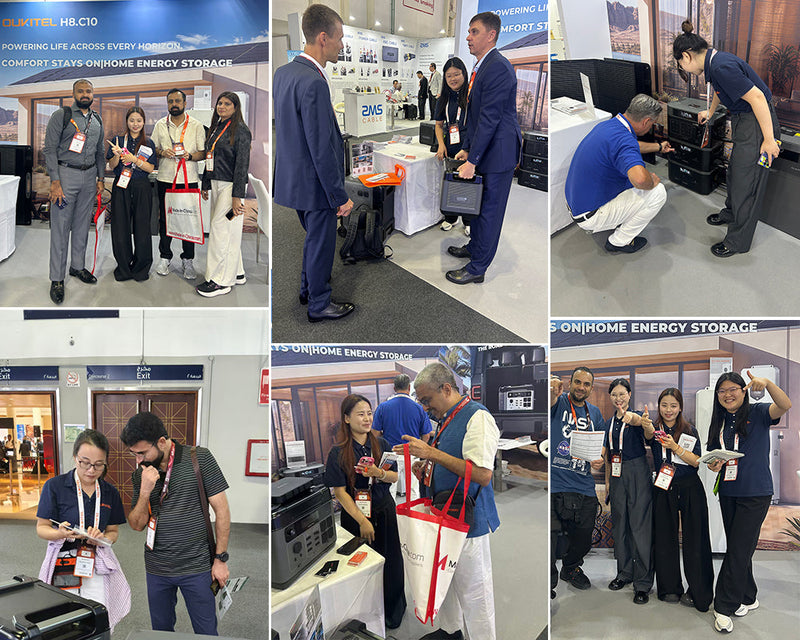
OUKITEL Power Brings Full-Scenario Energy Storage Solutions to Intersolar Middle East 2026 in Dubai

OUKITEL Showcases Energy Storage Solutions at Intersolar South America 2026, Accelerating Expansion into Latin America
The European Homeowner’s Blueprint to Slashing Heat Pump Bills with Battery Storage and Smart Tariffs
Sizing Solar and Battery for a Winter Heat Pump: A Cold‑Climate Guide for Europe (Germany, Sweden, Ukraine)
Heat Pump Power Outage Survival Guide: Stretching Your Battery Through Multi-Day Winter Outages