C01


Charging Bank vs Power Bank: How to Tell If You're Getting AC Power or Just USB
Search for a charging bank and the results page will show you two genuinely different products: a pocket-sized battery that tops up a phone over USB, and a box with a mains socket on the front that can run a laptop, a lamp or a small kitchen appliance. The labels do almost nothing to separate them. Retailers use “charging bank”, “power bank” and “portable charger” interchangeably, and none of those terms has a definition you can check against a published standard.
So the first correction is a terminology one. A charging bank and a power bank are the same object — a sealed lithium-ion pack with DC outputs only. The device that behaves differently is a portable power station: a larger pack with a built-in inverter and one or more AC outlets. The distinction that matters when you spend money is not the words on the listing; it is whether the product contains an inverter, and how much AC power that inverter can deliver continuously.
This guide gives you a way to tell the two apart in under a minute, a framework for reading capacity claims honestly, and a decision matrix you can apply to your own kit list. It also covers the regulatory layer most buying guides skip — because the safety standard a device is tested to, the watt-hour figure that decides whether it can fly, and the labelling rules now phasing in across the EU all follow from which category you are actually buying.

What “Charging Bank” Actually Means — And Why the Label Is Misleading
The phrase has no technical standing. It entered marketplaces as a search-friendly synonym for power bank and then spread to listings for products that are not power banks at all. That is why you can find a “27,000mAh portable charging bank with AC outlet” sitting next to a 10,000mAh USB pack and a 512Wh power station, all described in similar language, at wildly different prices.
Three product classes are hiding behind the same words:
- USB power bank. DC outputs only — USB-A, USB-C, sometimes a 12V barrel or car socket. No inverter. Cannot run anything that expects mains power.
- Pocket unit with an AC outlet. A power bank with a very small inverter bolted on. The outlet is real but the sustained output is modest, and it is often the least efficient way to move energy from a battery into a device.
- Portable power station. A battery, an inverter and a management system in one enclosure, rated in continuous AC watts and watt-hours. Designed to run mains devices.
The misleading part is not the word “charging”; it is the absence of a watt figure next to the outlet. A mains socket is a promise, and on a pocket unit that promise is usually much smaller than the photo suggests.
There is a quieter clue too: the safety standard the product is tested against. As a general rule, a device sold primarily as a battery bank for charging portable electronics is tested to UL 2056, while a device with a built-in AC outlet is treated as a portable power station under UL 2743. That split is useful because it follows function rather than marketing — the moment a product has an inverter and a socket, it is in the power-station family whether or not the listing admits it.
The AC Outlet Test: The One Spec That Separates Power Banks from Power Stations
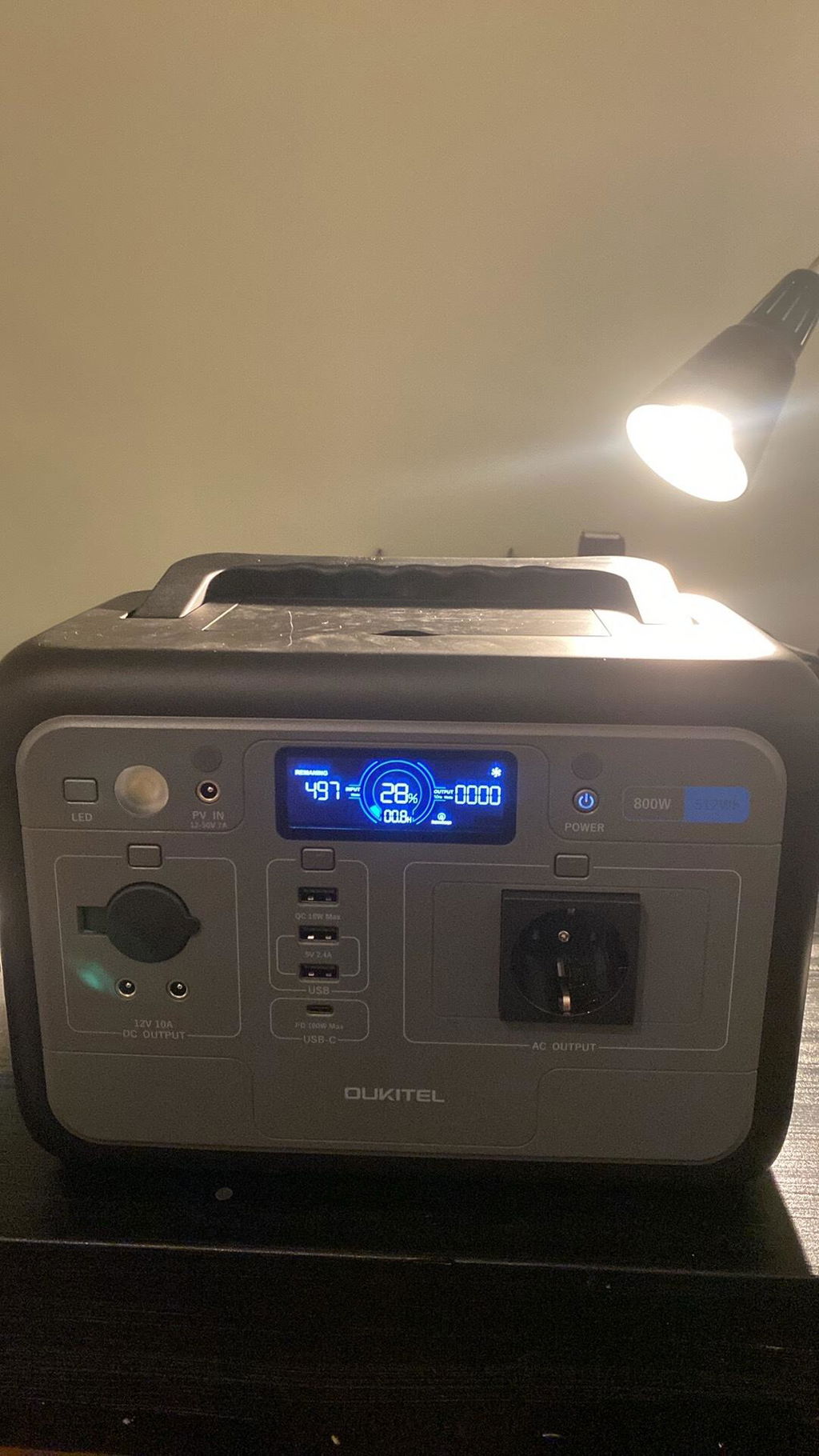
Here is the test. Look at the product photographs. If the device has a mains socket, find the number that follows “AC” on the specification sheet. It should read something like 800W or 300W. If the listing shows an AC outlet but never states a continuous wattage, treat that outlet as decorative and keep looking.
Continuous AC watts is the most informative number on any of these products because it describes what the inverter can sustain — not briefly survive, but run for an hour without tripping. A surge rating (the OUKITEL P800, for instance, is rated 800W continuous with a 1600W surge) tells you how it copes with motor start-up and heating elements. It is not a licence to run a 1600W appliance for twenty minutes.
Five criteria do almost all the work when you compare the classes:
- Continuous AC output in watts. Rules out anything that needs a heating element, a compressor or a motor if the figure is low or missing.
- Waveform. Pure sine wave behaves like mains electricity. Modified sine is cheaper to build and can make motors run hot, transformers buzz and some sensitive electronics behave erratically.
- Energy in watt-hours. The only figure that lets you compare products fairly. More on this below.
- Recharge input and time to full. A large pack with a slow charger is a heavy object that is empty when you need it.
- Carry weight. The spec that decides whether the device actually leaves the house.
Apply these five in order and the marketing language stops mattering. A product that states its AC watts, its waveform, its watt-hours, its recharge time and its weight is telling you what it is. A product that states only milliamp-hours is telling you what it wants you to think.
Why 27,000mAh Doesn’t Tell You What You Can Run: Capacity vs. Output
Milliamp-hours describe charge, not energy, and the number depends entirely on the voltage it is quoted at. A pack rated 27,000mAh at a nominal cell voltage of about 3.7V works out at roughly 100Wh — treat that as an estimate, because vendors quote at different voltages. The same physical battery expressed at 5V would be around 20,000mAh. Only watt-hours let you compare two products honestly, and only watt-hours tell you what a device is legally allowed to do on an aircraft.
That 100Wh mark is not arbitrary. It is also the threshold at which aviation rules start requiring airline approval, which means a 27,000mAh pack sits just underneath a regulatory line most buyers have never heard of.
Capacity is half the story. The other half is output, and the two are independent. A pack can hold 100Wh and deliver it only through a USB-C port at Power Delivery rates; a power station can hold 512Wh and deliver 800W of AC. USB Power Delivery 3.1 with Extended Power Range is now capable of up to 240W, but support is partial across chargers, banks and laptops — so a USB-C laptop that charges at 100W today may not accept more from a newer bank. Check the laptop’s accepted input, not just the bank’s output claim.
Once you move to AC, a second deduction applies. Inverters lose energy as heat, and the station consumes a little to run its own electronics. A 512Wh pack running a 100W load gives roughly five hours on paper; plan for something closer to four to four and a half hours in practice. Always treat single-number runtime claims as estimates and size on the actual draw of your devices, measured or read off the label.
Real-World Use Cases: When You Need a Charging Bank with AC Outlets
Suppose a freelance videographer works weekend shoots out of a van and needs to charge two camera batteries, run a 14-inch laptop for rough cuts, power a small LED panel and keep two phones alive across a two-day trip. Every one of those loads is either USB-C or a low-draw mains brick. A compact station in the 500Wh class covers the whole list, and the numbers that matter are not the capacity but the 800W AC output (headroom for the laptop brick), the pure sine wave (camera chargers dislike modified sine), the 6kg weight (carryable from van to location in one hand) and the one-hour recharge from a 500W AC input when they stop somewhere with a socket. Solar input of up to 200W gives a 2.75-hour top-up in good sun. That is a fit, not a splurge.
Now the opposite case. Suppose a household buys a pocket “charging bank with AC outlet” because the listing shows a laptop next to a mains plug and quotes a large mAh figure. It works for the laptop on a low-draw charge, then trips the moment someone plugs in a travel kettle or a hairdryer, and the laptop’s power supply hums audibly because the waveform is not a clean sine wave. Nothing was broken and nothing was falsely advertised — the buyer simply read capacity and assumed output. The listing never stated a continuous AC wattage, and that silence was the answer.
A third scenario worth planning for is standby power for a router, a cordless phone base and a small light during an outage. These are low-draw, long-duration loads, and the deciding features are pure sine wave output and a fast automatic switchover — the P800 specifies EPS switching in under 10ms, which is the difference between a router that rides through a brief cut and one that reboots. Capacity sizing here is simple arithmetic: add the standby draw of everything you want to keep alive, multiply by the hours you want to cover, and add headroom.
Trade-Offs: Size, Weight, Cost and Recharge Time
No class wins on all four. The honest comparison looks like this:
| Attribute | USB power bank | Pocket unit with AC outlet | Portable power station |
|---|---|---|---|
| Typical energy | Under 100Wh | Around 100Wh | 500Wh and upwards |
| AC output | None | Low, often unstated | Stated in watts, plus surge |
| Waveform | Not applicable | Frequently modified sine | Pure sine on better units |
| Weight | Pocketable | Small but heavy for its capacity | 6kg and up |
| Recharge | Hours on USB-C | Hours on USB-C | Mains, solar and car input |
| Cost per usable Wh | Lowest | Usually the highest | Middle |
The pocket AC unit is the weakest value in the table, and it is worth being blunt about why. You pay for a battery, an inverter and safety certification in the smallest possible enclosure, and then you accept an inverter that wastes a meaningful share of a small energy budget. Its one genuine advantage is that it fits in a bag you were already carrying.
Recharge time is the trade-off buyers underestimate most. A station that takes all night to refill from a wall socket is fine at home and useless on a road trip with short stops. Compare input wattage, not just capacity: 500W of AC input on a 512Wh pack gets you to full in about an hour, and combining AC and solar input shortens that further. On the power-bank side, the same logic applies in miniature — a 20W input on a large bank means an overnight charge whether you like it or not.
The other long-run trade-off is chemistry. Lithium iron phosphate packs, like the LiFePO4 cell in the P800, are specified for 4000 cycles and a ten-year service life, which matters if the device will be cycled weekly for years. Conventional lithium-ion packs in thin power banks are typically rated for fewer cycles — capacity fades gradually, and a three-year-old pocket bank that used to give two phone charges may give one.
Safety and Regulation: What the Label Legally Has to Tell You
This is the part that separates a considered purchase from a gamble, and it is almost entirely about which category the product falls into.
Product safety standards. UL 2056 is the standard generally associated with power banks; UL 2743 applies to portable power packs and stations, and a device with a built-in AC outlet is generally treated as a portable power station under UL 2743. If a seller cannot say which standard applies to their product, that is a question worth pressing before you buy — and if a specification sheet lists no certifications at all, ask for the test documentation rather than assuming compliance or assuming the worst.
Transport testing. UN 38.3 governs the transport testing of lithium batteries by air, sea, road and rail, and IEC 62133-2 is the core safety standard for portable sealed lithium cells and batteries. Both remain the reference standards in practice; revision status should be confirmed with the certification body rather than taken from a retailer’s summary.
Aviation rules. Spare lithium-ion batteries and power banks must travel in carry-on, not checked baggage. Units up to 100Wh are generally allowed; 101–160Wh requires airline approval, typically limited to two spare batteries; and anything over 160Wh is prohibited on passenger aircraft[1]. The practical consequence is severe for power stations: a 512Wh unit cannot fly in the cabin at all, no matter how carefully it is packed. Beyond carriage, several Asia-based carriers introduced in-flight bans on using or charging power banks during 2025, and some jurisdictions now require such devices to be kept within reach rather than in overhead bins. These rules vary by airline and change quickly — check your carrier’s dangerous goods page before you travel rather than relying on last year’s guidance.
EU labelling and design obligations. Regulation (EU) 2023/1542 is in force, with phased obligations running across 2025–2027 covering labelling, removability and replaceability of portable batteries among other requirements. The exact milestone dates for portable-battery labelling should be checked against the official text, because summaries circulating online are frequently out of date. What matters for a buyer is direction of travel: capacity disclosure and replaceability are becoming regulatory expectations rather than marketing choices.
How to Read Specs and Avoid the “Charging Bank” Trap
Most bad purchases in this category follow one of six patterns. Each has a simple counter-move.
- Buying on milliamp-hours alone. Counter: convert to watt-hours, or demand the Wh figure from the seller. If it is not published, that is information in itself.
- Reading “AC outlet” as “mains power”. Counter: find the continuous wattage. No number, no purchase.
- Ignoring waveform. Counter: if the specification does not say pure sine wave, assume it is not. Motors, audio kit, medical devices and some laptop bricks are the usual casualties.
- Ignoring recharge time. Counter: compare input watts and stated time to full, then ask whether that fits the sockets you actually have access to.
- Ignoring cycle life and chemistry. Counter: for anything you will cycle weekly, LiFePO4 with a stated cycle count is usually the better long-run buy.
- Ignoring operating temperature. Counter: check the range. The P800 specifies 0℃–40℃ for operation and −10℃–40℃ for storage; charging a lithium pack below freezing damages it, so a winter camping plan needs a strategy beyond a bigger battery.
The unifying rule: buy the output, then buy the capacity. Output determines what will run; capacity determines for how long. Reverse that order and you end up with a large battery that cannot start the device you bought it for.
Matching Scenario to Budget: Light, Medium and Heavy Use
Budget tiers below are relative rather than fixed, because prices move. The reliable comparison metric is euros per usable watt-hour — divide the price by the usable capacity, then discount the result for AC use to account for inverter losses. That single number exposes overpriced products faster than any feature list.
| Use profile | Typical loads | Right class | Spec that decides it | Budget tier |
|---|---|---|---|---|
| Light — commuting, day hikes, festivals | Phone, earbuds, watch, one tablet | USB power bank | Watt-hours and USB-C PD wattage | Lowest |
| Light-medium — travel with one mains-only device | Laptop brick, camera charger, phone | Pocket unit with a stated AC rating | Continuous AC watts and waveform | Mid, poor value |
| Medium — weekend camping, van trips, outdoor work | Laptop, LED panels, camera batteries, small cooking appliances | Compact power station around 500Wh | Continuous W, Wh, recharge time, weight | Mid to high |
| Heavy — outage backup, off-grid working, medical equipment | Router, modem, lights, CPAP, fridge cycling | Power station with pure sine wave and fast switchover | Waveform, EPS behaviour, multi-hour capacity | Highest |
Two notes on this table. First, the light-medium row is the one to think hardest about: a pocket AC unit costs noticeably more than a good USB bank for a capability it delivers poorly. If your only mains-only device is a laptop, check whether a USB-C PD trigger cable or a DC input for the laptop solves the problem for a fraction of the cost. Second, the heavy row is where capacity matters least and waveform matters most — a cheap modified-sine unit that reboots your router or makes a CPAP motor run hot is not a bargain at any price.
Decision Flow: From “I Need a Charging Bank” to the Right Device
Work through these in order and stop at the first one that applies.
- Everything you carry charges from USB. Buy a USB power bank. Nothing else in this article applies to you.
- You have one mains-only device, it draws little, and weight is critical. A pocket unit with a stated continuous AC rating can work — but verify waveform and accept the efficiency penalty.
- You need to run a laptop, lights, cameras or a router for a weekend. A compact station in the 500Wh class. Check continuous watts against your highest-draw device and check that the recharge time fits your routine.
- Any load involves a motor, a compressor or a heating element. Move up to a station whose continuous rating comfortably exceeds the appliance’s running draw and whose surge rating covers start-up.
- You need unattended overnight operation or automatic switchover. Require pure sine wave and a stated EPS switchover time. No waveform statement, no purchase.
- You plan to fly with it. Only sub-100Wh units travel without friction, and 101–160Wh needs airline approval. Anything above 160Wh stays on the ground.
If you are still torn between the two main classes, the wider comparison of power banks versus portable power stations walks through the same decision from the other direction, and the guide to what a portable power station is and how it behaves in home backup covers the standby case in more depth.
Edge Cases: When the Standard Rules Don’t Apply
Air travel flips the answer entirely. The best device for a two-week road trip is often illegal in the cabin. If a trip involves flights at both ends, plan around a sub-100Wh bank plus a station rented or bought at the destination.
Cold weather changes usable capacity, not just comfort. Lithium packs deliver less energy in the cold, and charging below freezing causes permanent damage. A winter plan needs the pack kept warm before charging, or a chemistry and specification that tolerates your actual conditions.
Medical equipment deserves a different standard of evidence. If the load is a CPAP or any device with a health function, get the manufacturer’s own statement on acceptable power sources and waveform, and treat a consumer station as a convenience rather than a medical backup. No consumer product should be a single point of failure for health equipment.
Very large loads are a different category again. Somewhere above the small-appliance range you are into whole-home backup territory, where capacity is measured in kilowatt-hours, installation and transfer switching become relevant, and a portable unit is the wrong tool. If that is your actual requirement, start from home backup rather than portable power.
Shared or multi-user kit rewards simplicity. A station that requires an app, a mode switch or a specific outlet sequence will be used wrongly by the second person who touches it. For household emergency kits, choose the unit whose operation can be explained in one sentence.
Conclusion: The Decision Matrix
The rule underneath every section above is short: find the watt figure first, then the watt-hours. Output decides whether the device can do the job; capacity decides for how long. Everything else — the label, the milliamp-hour hero number, the photograph of a laptop next to a socket — is noise until those two figures are on the page.
| Your situation | Right class | Gate spec to verify | Walk away if… |
|---|---|---|---|
| Only phones, earbuds and a tablet | USB power bank | Watt-hours, USB-C PD wattage | It advertises an AC outlet with no watt figure |
| One low-draw mains device, light travel | Pocket unit with a stated AC rating | Continuous AC watts, waveform | Waveform is unstated |
| Laptop, lights and cameras for a weekend | Compact station, 500Wh class | Continuous W, Wh, recharge time, weight | It is heavier than you will realistically carry |
| Kettle, blender, induction hob or power tools | Station rated above the appliance’s running draw | Surge rating versus start-up current | You are relying on a pocket unit’s socket |
| Overnight router, CPAP or outage backup | Station with pure sine wave and EPS | Waveform, switchover time, whole-night capacity | No waveform or switchover statement exists |
| Any trip involving a flight | Sub-100Wh bank only | Wh printed on the case, not mAh | The unit exceeds 160Wh |
Your next step is a five-minute exercise: write down every device you want to power, note the wattage from its label or charger, add them up for the worst case, and multiply your longest expected run by that total. If the answer is under 100Wh and every device charges from USB, buy a power bank and stop reading. If it is larger, or if a single device in the list has a mains-only plug, you are buying a power station — and you now know exactly which two numbers to check before you pay. You can browse the range of portable power stations with that arithmetic already done.
Frequently Asked Questions
Is a charging bank the same as a power bank?
Yes — both terms describe a sealed battery pack with DC outputs only. The label tells you nothing about capability, because some listings use “charging bank” for products that contain a small inverter. Judge by the published watt-hours and, where an AC socket exists, the continuous AC wattage.
Can a charging bank with an AC outlet run a laptop or small appliance?
A laptop usually yes, provided the outlet’s continuous rating exceeds the laptop brick’s draw and the waveform is a clean sine wave. Appliances with motors, compressors or heating elements generally no — those need a power station whose continuous and surge ratings comfortably exceed the appliance’s demands.
What does 27000mAh mean in real-world runtime for AC devices?
At a nominal cell voltage of about 3.7V, 27,000mAh works out at roughly 100Wh — an estimate, since vendors quote at different voltages. Fed through an inverter into a laptop drawing around 60W, expect something in the region of an hour and a half once conversion losses and the inverter’s own consumption are counted. That is a short working session, not a day of editing.
Do I need a charging bank or a power station for camping?
It depends on whether any of your kit is mains-only and how long you are away. Phones, head torches and a tablet are a power-bank job. A laptop, camera chargers, an LED panel or a small cooking appliance push you into a 500Wh-class station — and if the site has no power and the trip is longer than a weekend, recharge options matter as much as capacity.
How do I know if a charging bank has pure sine wave output?
Only from the specification sheet. If the phrase “pure sine wave” is absent, assume the output is modified sine — manufacturers who have paid for the better inverter say so prominently. If you already own a unit and are unsure, listen: a mains transformer or motor that hums or runs hot on it is behaving as it would on a modified sine supply.
References
- Federal Aviation Administration — Airline Passengers and Batteries, https://www.faa.gov/hazmat/packsafe/resources/airline-passengers-batteries
This article was written using up-to-date sources as of November 2026. Details may change over time — verify current specifics before relying on them.
Latest articles
Battery Charger Buying Guide: How to Match Chargers to Your Batteries and Devices

Solar Charger Buying Guide: How to Match Panel Wattage to Your Portable Power Station
Charging Bank vs Power Bank: How to Tell If You're Getting AC Power or Just USB
Power Bank vs Portable Power Station: How to Choose by Device Load and Real Runtime

What Is a Portable Power Station? A Home Backup Guide to Wattage, Capacity and Battery Chemistry