C01


Whole-House Solar Battery Backup: How to Choose the Right Battery for Your Home
Choosing a battery for a solar system looks like a specification exercise. In practice it is a sequencing exercise. The right unit depends far less on which model has the largest headline kWh figure than on the order in which you settle four things: what the battery is for, how much usable energy you actually need, what it has to start, and what it has to talk to.
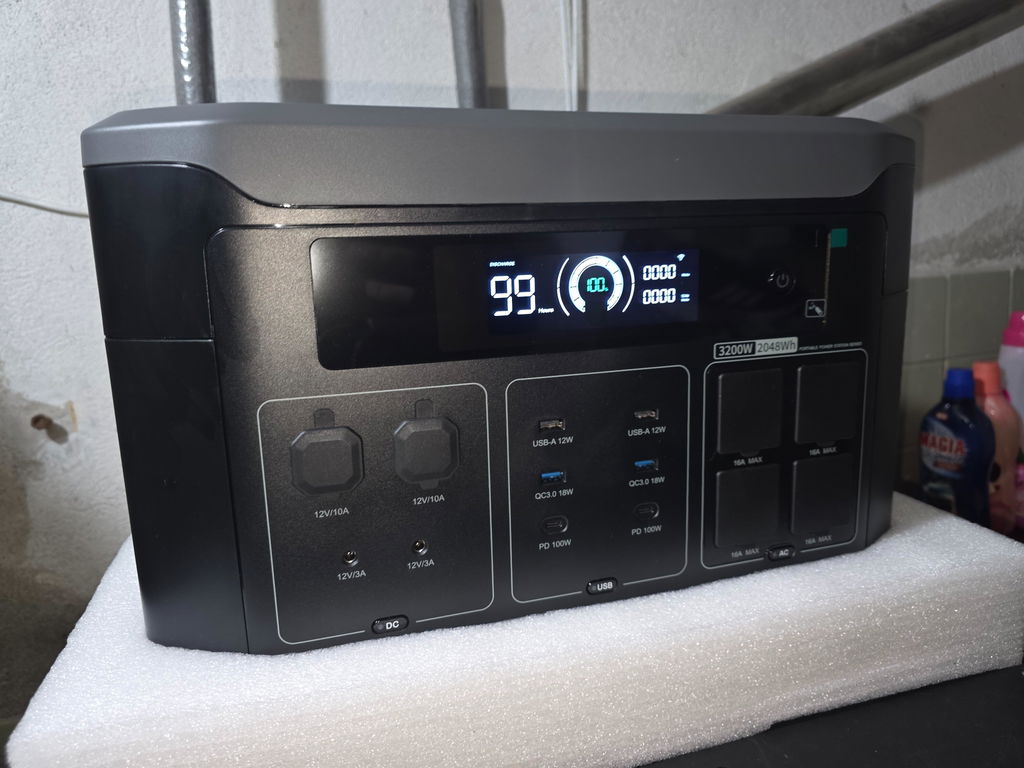
Terminology matters before you compare prices. A whole-house solar battery is a fixed, hardwired energy storage system: an inverter plus one or more battery modules, installed by a qualified electrician, certified to a recognised energy-storage safety standard, and connected to the consumer unit through a backup or transfer interface. That is a different product class from a portable power station, even when the two share LiFePO4 cells and similar nameplate capacities. A middle category has emerged — modular LiFePO4 systems that accept add-on batteries and can be wired through a transfer switch for whole-home backup — and it is the category many homeowners end up comparing against fixed rack systems on price.
Two adjacent questions are deliberately out of scope here. Whether to back up the whole house or a set of critical circuits, and how to size essential loads for a multi-day outage, both have their own arithmetic and their own failure modes. This guide assumes you have decided to buy storage and now need to pick the right one, and it concentrates on the criteria that decide whether the installation still works two winters from now.

Whole-House Backup vs. Daily Solar Storage: What's Your Battery Actually For?
A home battery does two jobs that pull in opposite directions. Backup duty is infrequent and harsh: the pack sits at high state of charge for months, then has to deliver high power for a few hours with no warning. Daily cycling duty is the reverse — shallow, frequent and throughput-hungry, judged on round-trip efficiency, cycle count, and how much of your own solar you can shift into the evening.
Most grid-tied systems do both, and that is exactly where the design decision hides. You have to choose a reserve floor: the state of charge the system will not fall below while the grid is up, so that something is left when the grid goes down. Suppose you hold 30% back on a 10 kWh usable pack. That leaves 7 kWh for daily cycling, and in December — heat pump running, solar yield low — the reserve is the part most likely to have been eaten by morning. A battery optimised for arbitrage and a battery optimised for resilience are not the same purchase, even when they are the same box.
Can I use a whole-house solar battery for both daily solar self-consumption and backup power?
Yes, and dual use is the normal operating mode for grid-tied residential storage. The practical catch is that dual use forces you to manage two numbers rather than one: a cycling target that sets how much evening demand you cover, and a reserve floor the system must protect. Systems that let you schedule a winter reserve separately from a summer reserve handle dual use far better than systems with a single fixed "backup percentage" setting, because the honest reserve requirement in January is not the same as in June.
Five criteria decide the shortlist, and all of them are quantifiable:
- Usable energy at your reserve floor — nameplate capacity minus the reserve, minus the depth-of-discharge limit, minus conversion losses.
- Continuous and surge power — the real ceiling on what can run at once, regardless of how many kWh sit behind it.
- Throughput warranty — years, cycles or megawatt-hours, whichever limit arrives first.
- Compatibility — with your existing inverter, your grid code, and the electrician who signs the commissioning sheet.
- Headroom — physical space, expansion capacity, and the paperwork that allows either to be used later.
If you cannot state in writing how many hours of outage you want to cover and which loads must be running during it, you are not yet in a position to compare batteries. That statement is the input to every calculation that follows.
Sizing Your Battery: Balancing Backup Capacity and Daily Cycling Needs
Size twice and take the larger answer. Calculation one is the cycling need: how much of your daily consumption falls outside solar production hours, typically the evening and early-morning block. Calculation two is the backup need: the running load of the circuits you insist on keeping alive, multiplied by the hours you want to cover.
A worked example makes the arithmetic concrete. Suppose a household uses about 8 kWh a day, of which 3.5 kWh lands after sunset. Its essential backup set — fridge, broadband, lights, boiler pump — draws roughly 0.4 kW, and the household wants eight hours of cover, which is 3.2 kWh. The cycling figure is the larger one, so the design figure is 3.5 kWh. Dividing by the usable share of nameplate after a 30% reserve leaves a target of about 5 kWh of usable capacity, before the round-trip losses quoted on the datasheet are applied. Note what did not happen: nobody divided the annual bill by 365 and bought that number.
Array-side sizing is a separate discipline. If you are still choosing panels or matching an array to a planned battery, the guide to choosing solar panels for a home battery system in Europe covers the generation side of the equation.
With both figures in hand, the capacity bands below are a reasonable starting point for home solar system battery storage. They assume LiFePO4 modules with a usable share of nameplate in the region of 80–90% and a reserve floor between 20% and 30%; change those assumptions and the bands move.
| Usage profile | What the day looks like | Cycling target (usable) | Backup target | Sensible capacity band | Hardware tier | Prioritise |
|---|---|---|---|---|---|---|
| Light | Flat or small house, two occupants, no electric heating | 2–3 kWh evening shift | 1–2 kWh | 3–5 kWh | Entry: one module, basic hybrid inverter | Scheduling flexibility and standby losses |
| Medium | Three-bedroom house, heat pump on critical circuits only, home office | 4–6 kWh | 3–5 kWh | 8–12 kWh | Mid: two to three modules, hybrid inverter | Surge headroom and a credible expansion path |
| Heavy | All-electric house, well pump, EV, sustained outage exposure | 8–15 kWh | 6–10 kWh | 15–20+ kWh | High: rack or stacked modular system | Throughput warranty, three-phase support, thermal design |
Three notes on the table. First, the tier names describe hardware class, not prices — installed costs vary too much between markets for a single figure to be honest, so ask each installer for a per-kWh installed cost and a per-kW inverter cost separately. Quotes split that way are comparable; quotes bundled as "a 10 kWh system" are not. Second, the backup column assumes you are not trying to run electric heating or an EV charger through an outage, which is usually the point at which the numbers stop being sensible. Third, a bigger battery does not extend backup time if the inverter cannot carry the loads.
Battery Chemistry: LFP vs. NMC for Home Backup Safety and Longevity
Lithium iron phosphate (LFP) and nickel manganese cobalt (NMC) are the two chemistries you will be offered. LFP trades energy density for thermal stability and cycle life. NMC packs more energy into the same volume and generally tolerates cold charging more gracefully, at the cost of a lower thermal-runaway onset temperature and shorter cycle life. For a stationary pack in a house, the trade usually falls on the LFP side, but the trade-off is genuine: LFP is heavier and bulkier for the same capacity.
| Criterion | LFP | NMC |
|---|---|---|
| Thermal stability | Higher; less prone to propagating a thermal event | Lower onset temperature; needs more thermal management |
| Energy density | Lower — heavier and larger per kWh | Higher — smaller footprint for the same capacity |
| Cycle life | Generally longer, which is why most stationary storage uses it | Shorter, though adequate for light cycling |
| Cold charging | Must be blocked below freezing; heating is often needed | Tolerates cold charging somewhat better |
| Materials | Iron and phosphate; no cobalt or nickel | Nickel and cobalt, with supply-chain implications |
| Best fit | Home backup and daily cycling where space allows | Tight spaces, weight-limited installs, mobile applications |
In most mature markets, though, the chemistry question is settled by code compliance before it is settled by preference. In North America, UL 9540 is the certification standard for battery energy storage systems, and UL 9540A is the fire-propagation test method referenced by NFPA 855; UL's own residential guidance notes that installation codes may set a maximum stored energy limit per ESS unit, citing a figure of 20 kWh. That number is not a marketing limit — it can determine whether a single cabinet is acceptable in a given location or whether the design has to be split across units. NEC and NFPA 855 then govern siting, separation and ventilation.
In Europe, the electrical and registration side is set by national regulations and applied locally by your network operator, alongside CE marking and national fire and installation rules. The standards each country references, and the certification evidence your operator will ask for, differ from market to market and are revised over time. Confirm the currently required standards and certificate list directly with your network operator and your installer before committing to a unit, then check that the product's documentation actually matches what they ask for.
This is where an expensive mistake commonly happens. Suppose a homeowner buys an inexpensive imported pack because the capacity-per-euro figure looks excellent. The electrician arrives, finds no certificate for the required standard, and declines to commission it; the insurer then declines to cover it. The pack is not defective — it is simply undocumented for that market, and it ends its life as a very expensive camping battery. Before price, ask for the certificate list and check it against what your installer and network operator actually require.
Power Output and Surge Capacity: Can Your Battery Start Your AC and Well Pump?
Three numbers matter, and only one of them is usually advertised prominently. Continuous output is the power the inverter can supply indefinitely. Surge output is the short-term peak it can deliver. Surge duration is how long that peak lasts — and it is the number that decides whether a compressor starts or the inverter trips.
There is no universal figure for how much surge a heat pump or well pump needs; the requirement depends on the nameplate data of the specific unit, its locked-rotor current, and the system design. The method, however, is straightforward. Read the locked-rotor amperage from the equipment nameplate. A compressor rated at, say, 40 A locked-rotor current on a 230 V supply implies roughly 9.2 kVA of starting demand — a peak that a modest inverter will not survive, however large the battery behind it. A soft starter ramps the compressor instead of slamming it and reduces that peak substantially, though how much depends on the equipment.
The decision rule: continuous rating should cover the sum of every load you intend to run simultaneously, with margin for the fact that nameplate figures are optimistic; surge rating must exceed the single largest motor start; and the surge duration must be long enough for that motor. A 12,000 W peak quoted for half a second is not the same product as one quoted for several seconds.
This is also where capacity misleads. A 5,120 Wh pack with a 4,000 W continuous inverter — the OUKITEL P5000 Pro is one example, quoted at 8,000 W surge — will run a great deal of a house, but it will still refuse a hard-starting compressor that exceeds its peak. Check the surge figure against the actual equipment, not against the size of the battery.
Compatibility Check: Will Your Battery Work with Your Existing Solar Inverter?
Compatibility failures are the most common reason a storage project stalls after the deposit has been paid, and they almost always come down to one of four mismatches: coupling architecture, voltage window, communication protocol, or backup interface.
Do I need a special inverter to add a battery to my existing solar system?
Usually yes, unless your existing inverter is a hybrid model that already has a battery input in the right voltage window and firmware that supports the battery you want. With a standard string inverter and no battery input, the practical choices are to add a separate battery inverter (AC-coupled) or to replace the existing inverter with a hybrid unit. Which is cheaper depends on the age and condition of what you already own — a five-year-old string inverter is often worth keeping, a fifteen-year-old one usually is not.
What's the difference between AC-coupled and DC-coupled battery systems, and which is right for retrofits?
In a DC-coupled system the battery shares the solar inverter's DC bus, so energy moves between panels and battery with a single conversion. In an AC-coupled system the battery has its own inverter and exchanges power with the house at mains voltage, adding a second conversion. DC coupling is more efficient and is the natural choice when solar and storage are installed together; AC coupling is usually the lower-friction retrofit because the existing array, inverter and feed-in registration stay untouched.
The mismatches to check before ordering anything:
- Voltage window. High-voltage battery inputs and low-voltage 48 V systems are not interchangeable. A battery outside the inverter's window cannot be commissioned, full stop.
- Protocol. An inverter can only control a battery it can talk to. Ask for the compatibility list in writing, with the firmware version, rather than accepting "it should work".
- Backup interface. Grid-tied storage needs anti-islanding protection and, for whole-home backup, a transfer arrangement. Running a whole house from a portable-class unit requires a proper transfer switch, not an extension lead.
- Phases. A single-phase battery cannot back up a three-phase property's three-phase loads without additional hardware.
Here is how that goes wrong in practice. A reader asks: "My inverter is eight years old and the installer says it is battery-ready — can I just order the battery?" The answer is: only after someone has produced the inverter's battery compatibility list, its firmware version and its supported voltage range. Suppose a homeowner skips that step and orders a low-voltage pack for an inverter whose battery input is high-voltage. The unit arrives, cannot be commissioned, and the cheapest recovery is an AC-coupled battery inverter bolted on beside it — a workaround that costs more than the battery and adds a conversion loss to every cycle for the life of the system.
Expandability and Future-Proofing: Starting Small vs. Going Big
Modular storage has changed the economics of starting small, but expansion is only as good as the platform behind it. Four things determine whether you can actually add capacity in three years: the maximum number of expansion modules the system supports, whether the battery management system accepts mixed module sizes, whether the inverter needs a firmware update to recognise new modules, and whether the model is still being sold.
Current products show how wide the range is. The OUKITEL BP3000 starts at 2,048 Wh and expands to 16.38 kWh with up to seven B2000L batteries; the BP5000E Pro Max starts at 5,120 Wh and expands to 19 kWh. Those are large ceilings, and they are the reason a modular approach can be sensible: you buy the inverter once and add energy as your loads grow. Browse home battery backup systems with the same question in mind — what is the ceiling, and what happens if the module is discontinued?
The constraint most buyers miss is that inverter power, not battery energy, usually binds. Adding 5 kWh to a 3 kW inverter does not let you run another appliance; it only lets the same appliances run longer. If an EV charger or a heat pump is on your five-year plan, size the inverter for that now and buy the battery capacity later.
The trade-off cuts both ways. Buying maximum capacity upfront locks capital into cells that may be cheaper in three years and may be unnecessary if your consumption falls. Buying the minimum locks you into a platform, so check the manufacturer's record of supporting older modules before you treat expandability as a strategy rather than a hope.
Warranty, Support, and Real-World Performance: What the Spec Sheet Doesn't Tell You
Battery warranties are written to limit the manufacturer's exposure, so read four clauses together rather than reading the headline year count. Term in years is the least informative on its own. Cycle count caps how many times the pack can be cycled. Throughput in megawatt-hours caps total energy moved, which bites hardest on daily-cycling systems. Capacity retention defines what counts as a failure — typically a percentage of original usable capacity at the end of the term. Whichever limit arrives first is your real warranty.
Published terms vary enough between manufacturers that a market-wide "typical" figure is not something worth asserting; compare the actual documents. Then check the operational clauses: who pays labour and shipping on a replacement, whether the warranty requires commissioning by an approved installer, whether it transfers to a new owner when you sell the house, and how long firmware updates are promised. A ten-year hardware warranty paired with a five-year software support window is, in practice, a five-year product.
How does cold weather affect solar battery performance and what can I do about it?
Cold reduces usable capacity and, more importantly, restricts charging. LFP cells must not be charged at sub-zero temperatures, so a well-designed BMS blocks charging until the pack warms up — which means a battery in an unheated outbuilding can sit unavailable through a cold snap, exactly when the grid is most likely to fail. Check the operating window before choosing a location: OUKITEL's portable units, for instance, list 0 °C to 40 °C for operation and −10 °C to 40 °C for storage. If your only space is unheated, either choose a model with integrated heating or move the installation inside the thermal envelope.
Three other real-world factors rarely appear on the datasheet. Heat derates output: a unit in a sunny plant room may throttle on the hottest afternoons. Standby consumption quietly drains a reserve that is never exercised, so a pack that is always "full" may not be. And noise matters more than buyers expect if the unit sits near a bedroom — quoted figures range from under 29 dB on some compact models to under 50 dB on high-output units, which is the difference between inaudible and noticeable at night.
Edge Cases: When the Standard Rules Don't Apply
Six situations flip the normal recommendation.
- Off-grid properties. With no grid to fall back on, there is no reserve floor to protect and no export to arbitrage. Size for the worst sunless period you expect rather than the average day, and plan generator integration from the start.
- Three-phase homes with large heat pumps. A single-phase battery cannot carry three-phase loads. Either specify a three-phase-capable system or accept that solar battery backup for power outages will cover selected circuits only.
- Flats and rented accommodation. Where a hardwired installation is impossible, plug-in balcony storage is the realistic option — the OUKITEL EP2500, for example, pairs 2,500 W output with a 2,048 Wh base expandable to 16 kWh, IP65 protection and four MPPT solar inputs. Rules on plug-in generation and registration vary by country and by network operator, so confirm current requirements before buying.
- US installations after the federal credit. The Residential Clean Energy Credit stood at 30% for qualifying property placed in service through 31 December 2025 and is not available for property placed in service after that date unless the law changes; standalone batteries of at least 3 kWh qualified while it ran.[1] Any payback calculation that still assumes that credit is wrong.
- Listed buildings, rentals and leasehold flats. Fixing a cabinet to a wall, running cable through a listed interior, or altering a rented property's electrical installation can each require consent that outweighs the technical case.
- Insurance conditions. Some policies require certified installation and specific siting. A battery that voids the buildings cover is not a saving, whatever the quote says.
Putting It All Together: An If–Then Decision Flow
| If this is your situation | Then do this |
|---|---|
| Existing hybrid inverter with a battery input inside the right voltage window | DC-couple a compatible module; verify the protocol and firmware version in writing first |
| Standard string inverter with no battery input | AC-couple with a separate battery inverter, or plan a hybrid replacement |
| Frequent outages plus a well pump or heat pump to start | Choose on surge duration, not capacity; budget for a soft starter as part of the project |
| No outages, but high evening consumption and a poor export rate | Choose on throughput warranty, round-trip efficiency and scheduling granularity |
| EV or heat pump planned within five years | Oversize the inverter now; add battery modules later |
| Flat, rented property, or no permission for a hardwired install | Plug-in balcony storage, subject to local connection rules |
| Unheated outbuilding is the only available location | Specify a heated pack, or reject the location and rethink the layout |
The Decision Matrix: Which Battery Fits Your Situation
The table below is the short version of everything above. Read across the row that matches your situation, and treat the last column as a veto rather than a footnote.
| Situation | Primary constraint | Battery type to specify | Deal-breaker to check |
|---|---|---|---|
| Retrofit onto an existing string inverter | Coupling | AC-coupled battery inverter with an LFP module | Extra conversion loss and available wall space |
| New solar plus storage in one installation | Efficiency | DC-coupled hybrid, LFP | Battery compatibility list for the chosen inverter |
| Resilience-first, motor loads in the backup set | Surge | High-continuous inverter with generous surge duration | Locked-rotor current of the largest motor |
| Bill-reduction first, outages rare | Throughput | LFP with a strong MWh warranty | Reserve floor settings and winter yield |
| Space-constrained or weight-limited location | Footprint | Higher-density chemistry or wall-mounted LFP | Fire separation and certificate list |
| Flat with a balcony and no possibility of hardwiring | Permission | Plug-in AC storage with grid-code certification | Local registration rules for plug-in generation |
If you want one rule to carry out of this article, use this: specify the battery that satisfies your reserve floor and your surge requirement first, then confirm the paperwork — certification, grid-code registration, warranty conditions — survives your installer's reading of it. Capacity is the easiest thing to shop for and the least useful thing to decide on. Everything else is procurement.
FAQs
Does a bigger battery always mean longer backup?
No. Backup duration is set by the smaller of two limits: usable energy and the inverter's continuous output. A large pack behind a modest inverter runs out of power before it runs out of energy if you try to carry heating or a pump. Work out which limit you hit first before paying for extra kilowatt-hours.
Which number matters more on a quote: kWh or kW?
Both, but kW is the one buyers skim. Kilowatt-hours set duration; kilowatts set what can run at all. A quote that lists capacity without a continuous and a surge rating is incomplete, and comparing it against a fully specified quote is guesswork dressed up as price comparison.
Can I mix battery brands, or add a second battery from a different maker to the same inverter?
Rarely, and never safely by guesswork. The inverter has to control the battery through a supported protocol, and mixing modules with different BMS behaviour can void warranties or leave the system unable to balance the packs. If expansion is likely, commit to one platform from the start.
How do I compare two batteries with the same nameplate capacity?
Compare usable capacity at your reserve floor, surge wording including duration, throughput warranty, round-trip efficiency and the certificate list. Two 10 kWh units can differ by several kilowatt-hours of usable energy and by years of supported service, which is where the real cost difference sits.
What's the first thing to check before ordering?
The certificate and compatibility documents your installer and network operator will ask for. If the unit is not certified to the required standard, or not on the inverter's compatibility list, nothing else about the purchase matters — not the price, not the capacity, not the delivery date.
References
- Internal Revenue Service — Residential Clean Energy Credit, https://www.irs.gov/credits-deductions/residential-clean-energy-credit
Information in this article was fact-checked against current sources in November 2026. Policies, incentive programs, and regulations change frequently — always confirm current terms with official sources before making financial or legal decisions.
Latest articles

Whole-House Solar Battery Backup: How to Choose the Right Battery for Your Home

Solar Panels for a Home Battery System in Europe: Match Array Size, Mounting, and Winter Yield

OUKITEL Black Friday 2026: Portable Power Station Buying Guide (P800 to BP3000)

Storm Outages in Rural Ireland: How to Keep Oil-Fired and Solid-Fuel Heating Running Without Mains Power

After Storms Austen and Boelo: A UK Household Storm-Power Readiness Checklist for the Next Named Storm