C01
C01


Les batteries domestiques « silencieuses » sont-elles vraiment silencieuses ? Un test de réalité sur le niveau sonore
La promesse d’une batterie domestique « silencieuse » est tentante : pas de bourdonnement, pas de vrombissement, juste une alimentation de secours propre qui s’intègre dans votre espace de vie calme. Mais dans le monde réel, « silencieux » est un terme relatif. Un appareil qui murmure au repos peut devenir un bourdonnement perceptible quand vous en avez le plus besoin. Ce guide démystifie le marketing pour vous aider à évaluer si une batterie domestique répondra vraiment à vos besoins de confort sonore, que ce soit dans un bureau à domicile ou une chambre la nuit.

Ce que « silencieux » signifie vraiment pour les batteries domestiques (niveaux en dB et perception)
Les décibels (dB) sont trompeurs : une augmentation de 10 dB semble environ deux fois plus forte à nos oreilles, et non pas linéaire. Un murmure doux mesure environ 30 dB ; une bibliothèque calme autour de 40 dB. Selon le NIOSH des CDC, une exposition prolongée à un bruit supérieur à 70 dB peut commencer à endommager l’audition, mais la gêne et les troubles du sommeil peuvent commencer beaucoup plus bas, autour de 30 à 40 dB pour beaucoup de gens.
Lorsque les fabricants qualifient une batterie domestique de « silencieuse », ils veulent généralement dire que l’appareil est inaudible au repos ou produit moins de 25 à 30 dB à un mètre de distance. C’est effectivement silencieux, comparable au bruissement d’une feuille. Mais c’est souvent le niveau sonore lorsque la batterie ne fait rien. Dès que vous consommez de l’énergie, l’électronique interne et le système de refroidissement s’activent, et le niveau sonore augmente. Un appareil avec une note « silencieuse » de 25 dB peut atteindre 40 à 50 dB sous charge modérée, ce qui ressemble plus au bourdonnement d’un réfrigérateur. Cela peut être acceptable dans une buanderie, mais intrusif dans une chambre.
La vraie question n’est pas l’existence du bruit, mais quand et comment il apparaît. Une batterie avec un ventilateur intelligent qui ne se déclenche qu’à forte charge peut rester effectivement silencieuse pour la plupart des usages nocturnes, comme faire fonctionner un appareil CPAP ou charger un ordinateur portable, tout en offrant la puissance nécessaire pour un réfrigérateur ou un micro-ondes quand c’est nécessaire.
Test de bruit en conditions réelles : vivre avec une batterie silencieuse
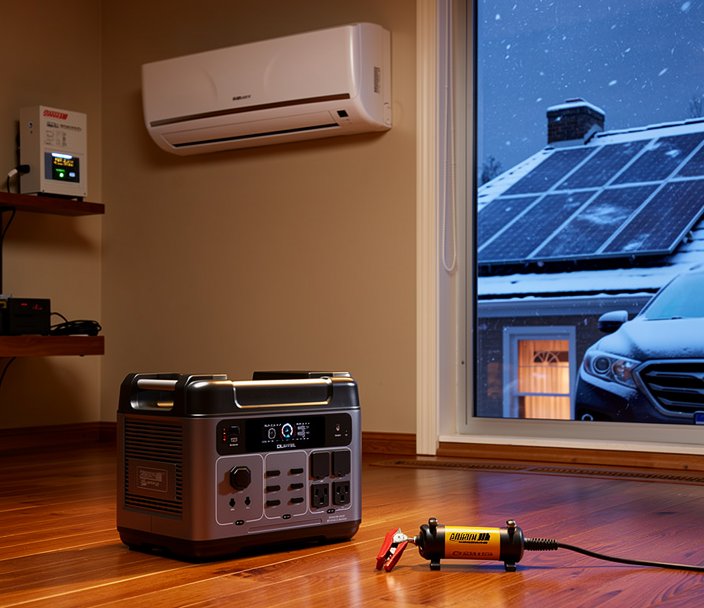
Pour comprendre ce que « silencieux » signifie en pratique, imaginez un propriétaire qui utilise une station d’énergie portable pendant une coupure de courant en soirée. L’appareil est placé dans un coin du salon, alimentant quelques lampes LED et un routeur. Avec une charge d’environ 100 W, les ventilateurs de refroidissement restent éteints. La pièce est totalement calme. Plus tard, lorsque le micro-ondes est allumé et que la charge passe à 1 200 W, les ventilateurs s’activent. Le bruit passe de zéro à un bourdonnement constant de 42 dB, perceptible mais pas envahissant. Dans cet usage réel, la batterie a été silencieuse pendant 90 % de la soirée et n’a été audible que lors des tâches à forte puissance.
Comparez cela avec un scénario de chambre. Une personne installe la même batterie pour faire fonctionner un appareil CPAP toute la nuit. Le CPAP consomme 30 à 60 W, bien dans la plage de faible charge de la batterie. Les ventilateurs restent éteints, le léger bourdonnement électronique de l’onduleur est à peine perceptible, et le dormeur n’entend rien. Cependant, si l’appareil se recharge pendant la journée, le processus de charge rapide peut générer une chaleur importante, provoquant le vrombissement des ventilateurs. Comprendre cette différence, bruit pendant la décharge par rapport à la recharge, est essentiel pour définir les attentes.
Le point clé : une batterie domestique « silencieuse » peut être réellement silencieuse lors d’une décharge à faible puissance, mais son comportement sonore dépend de la charge. Les propriétaires doivent adapter leur utilisation typique à la courbe de ventilation de la batterie, et non pas seulement à un chiffre en dB.
Quand le silence est non négociable : des scénarios qui exigent un bruit quasi nul
Pour certains utilisateurs, même un bref déclenchement du ventilateur peut être rédhibitoire. Pensez au télétravailleur dont le microphone capte un bourdonnement de fond de 35 dB comme un grésillement persistant pendant les appels. Ou au parent d’un nourrisson au sommeil léger ; un ventilateur qui s’allume et s’éteint soudainement peut réveiller le bébé plus qu’un bruit constant. Un autre cas courant est une personne souffrant d’acouphènes ou d’hyperacousie, pour qui tout son inconnu devient une source d’anxiété.
Dans ces situations, vous avez besoin d’une batterie capable de fonctionner sans refroidissement actif pendant de longues périodes. Recherchez des produits dont les spécifications indiquent explicitement un « mode sans ventilateur » ou une « opération à 0 dB » pour des charges allant jusqu’à une certaine puissance. Certains appareils, en particulier les stations d’énergie portables de moins de 1 000 Wh, peuvent dissiper la chaleur uniquement par des dissipateurs passifs, ce qui les rend vraiment silencieux. Mais ils sacrifient la capacité de sortie : vous ne pourrez pas faire fonctionner un radiateur avec eux.
Pour l’OUKITEL P2001 Pro, ses quatre ventilateurs intelligents sont conçus pour rester éteints lors de charges légères comme la recharge de téléphones ou le fonctionnement d’un petit ventilateur, mais ils s’activeront si la température interne augmente. Pour un utilisateur de CPAP dans une chambre, cela signifie qu’il restera probablement silencieux toute la nuit. Mais si vous le rechargez également en même temps (passage CA), la chaleur de la charge peut réveiller les ventilateurs. La solution : séparez les heures de charge des heures calmes, ou choisissez une station d’énergie portable super silencieuse avec un mode bas bruit explicite.
Caractéristiques clés qui rendent une batterie domestique silencieuse (et les compromis que vous acceptez)
Atteindre un fonctionnement quasi silencieux résulte d’une combinaison de choix de conception, chacun ayant ses inconvénients.
Refroidissement passif – Aucun ventilateur. C’est la seule façon de garantir un vrai 0 dB. Mais cela limite sévèrement la puissance de sortie ; sans air forcé, l’onduleur et les cellules de la batterie ne peuvent pas évacuer la chaleur assez rapidement pour des charges élevées soutenues. Un appareil sans ventilateur de 500 W peut convenir pour le camping, mais ne peut pas alimenter un réfrigérateur domestique.
Contrôle intelligent du ventilateur – Des ventilateurs qui restent éteints jusqu’à ce qu’un seuil de température ou de charge soit franchi. Cela vous donne le silence pour la plupart des tâches à faible puissance. Le compromis : lorsque les ventilateurs démarrent, le son peut être plus surprenant car c’est un changement soudain. Certaines marques optimisent les courbes de vitesse des ventilateurs pour une montée en douceur, évitant ainsi un effet « réacteur ».
Conception d’onduleur à faible bruit – Même sans ventilateurs, certains onduleurs produisent un sifflement ou un bourdonnement de bobine sous charge. Un onduleur à onde sinusoïdale pure fonctionne généralement plus proprement, mais la qualité des composants varie. Un appareil commercialisé comme une station d’énergie portable silencieuse peut encore bourdonner à certaines charges si les composants inductifs résonnent.
Isolation du boîtier – Des matériaux amortissants à l’intérieur du boîtier peuvent absorber le bruit du ventilateur et les vibrations. Le compromis est un poids et un coût supplémentaires. Dans un marché où de nombreux acheteurs privilégient la portabilité, le volume supplémentaire pour la réduction du bruit est souvent sacrifié.
En bref, plus vous voulez de silence, plus vous devez accepter soit une puissance inférieure, soit un encombrement plus important, soit un prix plus élevé. Une station d’énergie portable lithium 1000 1045Wh silencieuse sans générateur à essence ne sera jamais aussi puissante qu’une unité de 2000 Wh avec refroidissement actif, mais elle sera le meilleur choix dans une maison aussi calme qu’une bibliothèque.
Erreurs d’installation courantes qui amplifient le bruit inutilement
Même une batterie bien conçue peut devenir bruyante à cause d’erreurs d’installation innocentes. Voici les plus fréquentes et comment les corriger.
- Surfaces dures réfléchissantes – Placer l’appareil directement sur un plancher en bois dur ou du carrelage agit comme une caisse de résonance. Les vibrations basse fréquence se transmettent à la surface et amplifient le bruit perçu. Mettez un tapis en caoutchouc ou un morceau de mousse dense sous la batterie pour la découpler acoustiquement.
- Espaces clos sans circulation d’air – Ranger la batterie dans un placard ou un débarras peut sembler soigné, mais cela emprisonne la chaleur. Les ventilateurs de refroidissement tourneront plus vite et plus longtemps. Laissez toujours au moins 30 cm d’espace libre sur tous les côtés pour la ventilation.
- Surcharge pendant les heures calmes – Faire fonctionner un appareil à forte consommation tout en espérant le silence est contradictoire. Planifiez les charges lourdes (grille-pain, bouilloire) pendant la journée, lorsque le bruit ambiant est plus élevé, et réservez les périodes silencieuses pour la nuit ou les moments de concentration.
- Utiliser des rallonges longues ou enroulées – Dans certains cas, le bruit électrique de l’onduleur voyageant à travers un long câble peut provoquer un léger bourdonnement dans les appareils connectés ou dans le câble lui-même. Utilisez des câbles plus courts et de bonne qualité.
Éviter ces erreurs peut réduire le niveau de bruit perçu de plusieurs décibels sans aucun changement matériel.
Comment vérifier les niveaux de bruit avant d’acheter
Le langage marketing n’est pas réglementé ; n’importe qui peut prétendre être « silencieux ». Pour protéger votre tranquillité, recherchez toujours des données concrètes.
- Mesures en dB(A) à des distances standardisées – Idéalement, les spécifications doivent indiquer les niveaux de bruit à 1 mètre pour le repos, 50 % de charge et 100 % de charge. Si la marque dit seulement « silencieux », demandez ces chiffres.
- Avis audio – Certains testeurs YouTube incluent des extraits sonores de l’appareil sous différentes charges. C’est bien plus révélateur qu’un chiffre. Si vous entendez un sifflement aigu ou un battement rythmique, vous saurez que ce n’est pas pour vous.
- Vérifiez les options de mode ventilateur – L’application ou le panneau de la batterie propose-t-il un réglage « silencieux » ou « quiet » ? C’est un indicateur fort que le fabricant prend le contrôle du bruit au sérieux.
- Lisez les pages de garantie et d’assistance – Une entreprise qui offre une longue garantie (comme la garantie par abonnement 1+2 ans sur les produits OUKITEL) a souvent confiance dans sa conception thermique, car la chaleur tue les batteries. Un système de refroidissement robuste qui fonctionne silencieusement suggère une ingénierie de qualité.
Pour aller plus loin, consultez notre guide complet sur les niveaux de bruit des systèmes de batterie domestique.
Conclusion
« Silencieux » n’est pas une propriété fixe ; c’est une enveloppe de performance. Une batterie domestique peut être silencieuse à faible charge et devenir nettement audible à forte charge. Votre décision doit tourner autour du moment où vous avez le plus besoin de silence. Si l’utilisation nocturne est cruciale, recherchez un appareil avec une zone sans ventilateur éprouvée qui couvre votre consommation typique de nuit. Si vous avez besoin d’une puissance de crête élevée quotidiennement, acceptez qu’un certain bruit de ventilateur soit le prix de la capacité. Dans les deux cas, vérifier le comportement sonore réel, via les spécifications, les avis et une installation correcte, vous évitera une mauvaise surprise au milieu d’une soirée calme.
Questions fréquemment posées
Un niveau de 25 dB est-il vraiment silencieux dans une chambre ?
Dans une chambre parfaitement calme, 25 dB est à peine audible, semblable au bruissement des feuilles devant une fenêtre. La plupart des gens le percevraient comme un très léger sifflement ou bourdonnement. Ce n’est pas un silence absolu, mais il est peu probable qu’il perturbe le sommeil, sauf si vous êtes extrêmement sensible. Cependant, cette valeur s’applique généralement uniquement lorsque les ventilateurs de la batterie sont éteints ; sous toute charge, le bruit est probablement plus élevé.
Une batterie domestique « silencieuse » peut-elle faire fonctionner un appareil CPAP toute la nuit sans perturber le sommeil ?
Oui, si la consommation du CPAP maintient la batterie dans sa plage de fonctionnement sans ventilateur, généralement en dessous de 150 à 200 W. De nombreux appareils CPAP modernes ne consomment que 30 à 60 W, ce qui est bien en dessous de ce seuil. Le principal risque est si vous rechargez également la batterie en même temps ; la chaleur supplémentaire peut activer les ventilateurs. Pour une expérience la plus silencieuse possible, faites fonctionner le CPAP uniquement sur batterie sans charge simultanée.
Les batteries au lithium font-elles du bruit sans ventilateur de refroidissement ?
Les cellules de batterie au lithium (y compris LiFePO4) sont chimiquement silencieuses : elles ne produisent aucun son mécanique pendant la charge ou la décharge. Tout bruit que vous entendez d’une batterie sans ventilateur provient de l’électronique de l’onduleur : un léger sifflement ou bourdonnement de bobine qui est généralement inférieur à 20 dB et souvent inaudible à plus d’un mètre. Le ventilateur est de loin la source de bruit dominante.
Pourquoi ma batterie prétendument silencieuse devient-elle plus bruyante lors de la recharge ?
La recharge, surtout via une charge rapide en CA ou un panneau solaire à haute puissance, génère une chaleur importante à l’intérieur de l’appareil. Pour protéger les composants, le système de gestion de la batterie augmente la vitesse des ventilateurs de refroidissement. Un appareil qui se recharge à 1 800 W peut facilement voir le bruit du ventilateur atteindre 50 dB ou plus. C’est normal, mais si cela vous dérange, envisagez de recharger pendant la journée lorsque le bruit ambiant est plus élevé, ou limitez la vitesse de charge via les réglages si disponibles.
Latest articles
OUKITEL Power Brings Full-Scenario Energy Storage Solutions to Intersolar Middle East 2026 in Dubai
OUKITEL présente ses solutions de stockage d'énergie à Intersolar South America 2026, accélérant son expansion en Amérique latine
Le guide du propriétaire européen pour réduire sa facture de pompe à chaleur grâce au stockage d'énergie et aux tarifs intelligents
Dimensionner le solaire et la batterie pour une pompe à chaleur en hiver : guide pour climats froids en Europe (Allemagne, Suède, Ukraine)
Guide de survie en cas de coupure de courant avec une pompe à chaleur : optimiser votre batterie lors de pannes hivernales de plusieurs jours