C01


OUKITEL Black Friday 2026: Portable Power Station Buying Guide (P800 to BP3000)
Black Friday is the one moment of the year when a serious portable power station becomes genuinely affordable. Whether you are preparing for winter outages, planning next summer’s camping season, or simply want a reliable backup for your home office, the deals that appear during the OUKITEL Black Friday sale are usually the best of the year. This guide walks you through everything you need to know before you buy in Europe — from capacity and output to battery chemistry, charging speed and expandability — and then introduces five OUKITEL models that cover every budget and use case, from the ultra-light P800 to the expandable BP3000.
We have kept the advice practical and region-neutral so it works whether you live in a city apartment, a suburban house, or a rural property. By the end of this guide you will know exactly which watt-hours you need, which output rating matches your appliances, and how to spot a genuinely good Black Friday offer instead of a discount that looks bigger than it is.
Quick summary
- Best all-round: P1000 Plus — 1,800W / 1,024Wh, 12kg, the easiest single-unit choice for most homes and trips.
- Best home backup: P2001 Plus — 2,400W / 2,048Wh for a fridge, router, lights and TV.
- Best for heavy loads: P2001 Pro — 3,200W for tools, larger appliances and a home office.
- Best carry-on: P800 — 6kg and 512Wh for camping and light backup.
- Best for growth: BP3000 — 2,048Wh expandable to 16.38kWh.
Prepared by the OUKITEL EU content team using the manufacturer's official product specifications. Black Friday prices are shown in EUR and reflect the current sale; offers and stock can change, so please confirm the live price on the Black Friday sale page or the relevant product page before ordering.
Why Black Friday is the smartest time to buy a power station
Quality portable power stations typically use lithium iron phosphate (LiFePO4) cells, pure sine wave inverters and a battery management system. Those components are expensive, which is why list prices stay fairly stable for most of the year. Black Friday changes that calculation for three reasons.
First, discounts are deeper and more predictable. Brands plan their biggest promotions of the year around this window, and the savings on higher-capacity models are often the largest in absolute terms. A mid-range 2,000Wh unit that feels out of reach in spring can suddenly sit within a realistic budget.
Second, bundles become attractive. Many offers combine a power station with a matching solar panel, an expansion battery, or a carry bag. If you already know you want solar charging, buying the bundle during Black Friday is usually cheaper than assembling the same kit later at full price.
Third, stock moves fast. The most popular capacities sell out first, and the best bundles are often limited. Shopping early — and knowing exactly what you want before the sale peaks — is the difference between getting the model you need and settling for whatever is left.
You can see the current OUKITEL Black Friday offers, including bundle options and limited-time pricing, on the official OUKITEL Black Friday sale page. Everything below is designed to help you choose intelligently from that lineup.
How to choose a portable power station: the seven numbers that matter
Marketing pages are full of large numbers, but only a handful of specifications actually determine whether a power station will do what you need. Focus on these seven.
1. Capacity (Wh): how much energy you can store
Capacity is measured in watt-hours (Wh). Think of it as the size of the fuel tank. A 512Wh unit can deliver roughly 512 watts for one hour, or 256 watts for two hours, before losses. In practice, inverter efficiency and battery depth-of-discharge mean you should plan for about 80–90% of the rated figure.
As a rough guide: a 500Wh class unit covers phones, laptops, lights, a router and a small fan for a day; a 1,000Wh class unit adds a portable fridge, a projector or a coffee machine for a short burst; a 2,000Wh class unit can keep a fridge, freezer, modem, lights and a TV running through a multi-hour outage. If you want to run heavy appliances for longer, expandability matters more than the base capacity — which is exactly where the BP3000 shines.
2. Rated output (W): what you can run at once
Rated output is the continuous power the inverter can supply. Add up the wattage of everything you intend to run simultaneously and stay comfortably below the rating. A 800W unit is ideal for light devices; 1,800W handles most kitchen small appliances; 2,400–3,200W opens the door to kettles, microwaves, power tools and larger home loads.
3. Surge power: the startup spike
Motors and compressors draw a short burst of extra current when they start. That is why a fridge rated at 150W running may momentarily demand several hundred watts. Surge ratings (often double the continuous rating) tell you how much temporary headroom the inverter has. For anything with a motor — fridges, freezers, pumps, tools — pay attention to surge, not just rated output.
4. Battery chemistry: LiFePO4 is the long-game winner
All five models featured here use LiFePO4, which is the chemistry you want for a long-lived backup system. It offers 4,000+ charge cycles, excellent thermal stability, and a much longer service life than older lithium chemistries. A well-treated LiFePO4 pack can last around a decade, which makes the higher upfront cost far easier to justify.
5. Charging speed: how fast you can refill
Look at both AC charging and solar charging. Fast AC charging (for example, 1,800W on the larger models) means you can top up during a short grid window, while strong solar input lets you recharge off-grid. Combined AC + solar charging is the fastest option of all and is a genuine convenience during unpredictable weather.
6. Ports and outputs: match your devices
Count the AC outlets you realistically need, then check USB-C PD wattage for laptops and phones, and USB-A for accessories. If you plan to run 12V gear — a car fridge, a CPAP machine, camping lights — make sure the unit offers DC or car outlets. More ports mean fewer adapters and less cable juggling.
7. Expandability, EPS and app control
Expandability lets you add battery capacity later instead of buying a bigger unit now. An EPS (emergency power supply) switchover under 10ms keeps sensitive equipment running through a brief outage. App control via Wi-Fi or Bluetooth makes it easy to monitor charge, set charging speed, and manage loads. These features separate a “big battery” from a genuinely useful home backup system.
Prices shown in the product cards are the current Black Friday prices in EUR at the time of writing. Offers and stock can change — always confirm the live price on the Black Friday sale page or the product page.
Meet the lineup: five OUKITEL power stations for every need
The five models below are not simply bigger versions of one another. Each is tuned for a different job, so the right choice depends on how you intend to use it. All of them share the same LiFePO4 foundation and a clean, practical design.


OUKITEL P800 — the featherweight starter
800W output · 512Wh · 6kg. The one you can genuinely carry with one hand.
- 800W AC output (1,600W surge) for laptops, lights, routers and small kitchen tools.
- 500W AC charging refills it in about an hour; 200W solar tops it up in under three.
- Just 6kg with a built-in LED light — ideal for camping, van life and desk backup.
Black Friday is the best moment to pick up an entry-level unit like this, and bundle pricing with a small solar panel is often available.
Check Black Friday price →

OUKITEL P1000 Plus — the all-rounder
1,800W output · 1,024Wh · 12kg. The sweet spot for most households and travellers.
- 1,800W AC output (3,600W surge) powers the vast majority of everyday appliances.
- 1,200W AC charging fills it in about an hour; 500W solar does the job off-grid.
- Wi-Fi and Bluetooth app control, under 29dB operation, four AC outlets.
If you only want to buy one unit for camping, RV trips and occasional home backup, this is usually the most balanced choice during Black Friday.
Check Black Friday price →

OUKITEL P2001 Plus — the home-backup workhorse
2,400W output · 2,048Wh · 22kg. Enough to carry a household through a real outage.
- 2,400W continuous output with 4,800W surge handles fridge and freezer startups.
- 2,048Wh keeps a 50W fridge running for roughly 41 hours — or recharges a phone around 200 times.
- 1,800W AC charging reaches 80% in about an hour; Wi-Fi and Bluetooth app control.
A strong pick for apartments and houses where the priority is keeping essentials alive during winter outages. Watch for bundle offers with solar panels during the sale.
Check Black Friday price →

OUKITEL P2001 Pro — high output, higher ceiling
3,200W output · 2,048Wh · 25kg. When you need to run heavy loads, not just essentials.
- 3,200W continuous (6,400W surge) with a 4-level adjustable output for sensitive devices.
- 1,000W solar input and dual AC + solar charging up to 2,800W — 80% in about 40 minutes.
- EPS switchover under 10ms, splash- and dust-resistant body, four smart cooling fans.
The best fit if your backup plan includes power tools, larger appliances or a home office that cannot afford downtime. Solar bundles are especially worth checking on Black Friday.
Check Black Friday price →

OUKITEL BP3000 — the expandable powerhouse
3,200W output · 2,048Wh · expandable to 16.38kWh. Grows with your needs.
- Start at 2,048Wh and add up to seven B2000L expansion batteries for roughly 16.38kWh.
- 3,200W output, 1,800W AC charging (80% in about 65 minutes), 1,000W solar input.
- 14 ports, EPS under 10ms, six-fan cooling and a robust BMS with multiple protections.
If you expect your energy needs to grow — or you want a scalable whole-home backup — buying the base unit during Black Friday and adding batteries later is a smart, cost-spreading strategy.
Check Black Friday price →Side-by-side comparison
The table below puts the key specifications next to each other. Prices change during the sale, so check the Black Friday sale page for current offers rather than relying on any single figure.
| Model | Output | Capacity | Weight | AC charge | Solar input | Black Friday | Best for |
|---|---|---|---|---|---|---|---|
| P800 | 800W | 512Wh | 6kg | 500W · ~1h | 200W | €399 €259 | Carry-on, camping |
| P1000 Plus | 1,800W | 1,024Wh | 12kg | 1,200W · ~1h | 500W | €699 €459 | All-round / RV |
| P2001 Plus | 2,400W | 2,048Wh | 22kg | 1,800W · 80% ~1h | 500W | €1,199 €809 | Home backup |
| P2001 Pro | 3,200W | 2,048Wh | 25kg | 1,800W · 80% ~1h | 1,000W | €1,499 €849 | Heavy loads / office |
| BP3000 | 3,200W | 2,048Wh (→16.38kWh) | 24kg | 1,800W · 80% ~65min | 1,000W | €1,599 €879 | Scalable home backup |
Which model fits your situation?
Specifications only become meaningful when you match them to a real routine. Here is how the five models map onto common scenarios across Europe.
For apartment and house backup
If your goal is to keep a fridge, freezer, modem, router, lights and a TV running through an outage, start at the 2,000Wh class. The P2001 Plus is the natural entry point: its 2,400W output covers most household essentials, and its 2,048Wh capacity buys hours of runtime rather than minutes. If you also run power tools, a microwave or a larger home office, the P2001 Pro adds 3,200W of continuous output and a higher solar ceiling. For a scalable setup you can grow over several years, the BP3000 is the most future-proof option, because you can add expansion batteries as your needs increase.
For camping, festivals and outdoor weekends
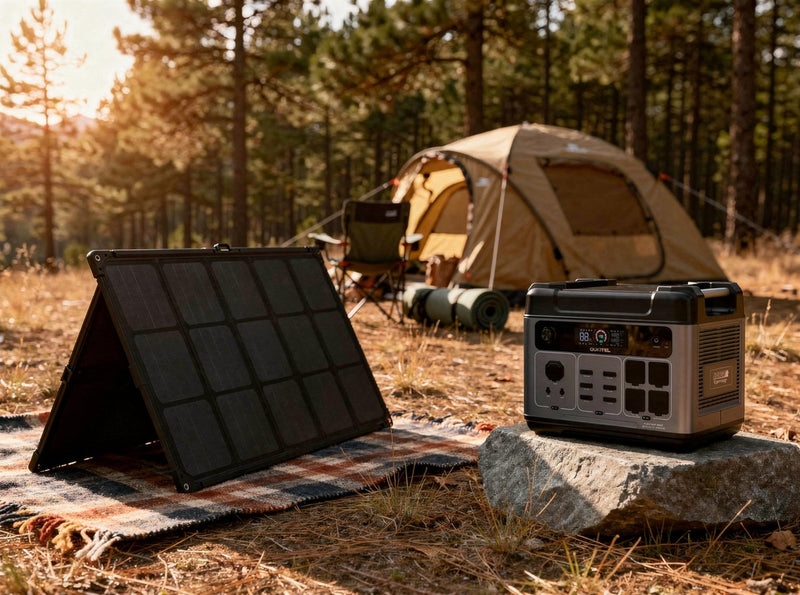
Weight and portability matter far more here than raw capacity. The P800 at 6kg is easy to carry in one hand and is more than enough for phones, cameras, lights, a laptop and a small speaker. If you also want to run a portable fridge or an electric stove briefly, step up to the P1000 Plus — still manageable at 12kg, but with 1,800W of output and 1,024Wh of capacity.
For RV, van life and mobile work
Van and motorhome users tend to run a fridge continuously, charge laptops and cameras, and occasionally use a kettle or induction hob. The P1000 Plus covers light van setups, while the P2001 Plus or P2001 Pro give the headroom needed for a fridge plus daily charging without constantly watching the battery percentage. Pairing any of them with a folding solar panel turns the vehicle into a genuinely self-sufficient base.
For growing or whole-home needs
If you are planning a phased upgrade — a base unit now, more batteries next year — the BP3000 is designed exactly for that. Starting at 2,048Wh and expanding to roughly 16.38kWh with seven B2000L batteries, it lets you spread the cost while building toward serious whole-home backup. Buying the base unit during Black Friday is a sensible first step if you know more capacity is coming later.
Three real-world setups (and what to avoid)
Concrete examples make sizing easier. Here are three common setups, each with a clear match — and a note on what would be a poor choice.
Setup 1: A city apartment during a winter outage
Load: a 150W fridge cycling at roughly 50%, a 15W router, 10W of LED lighting and a 100W TV for four hours — an average draw of roughly 200–250W over an evening. Match: the P2001 Plus keeps the essentials running for many hours and still covers phone and laptop charging. Avoid: a 512Wh unit here — it will handle the router and lights but struggle to keep a fridge going through the night.
Setup 2: A weekend camping trip
Load: two phones, a camera, a laptop, LED lights, a speaker and a small 12V cooler. Match: the P800 for a light kit, or the P1000 Plus if you want a cooler and a coffee machine. Avoid: assuming a 512Wh battery can run an electric kettle — a 1,500–3,000W kettle will drain it in minutes and may exceed the inverter rating.
Setup 3: A van or motorhome with a 24/7 fridge
Load: a 50–60W compressor fridge running continuously, plus laptops and lights — roughly 600–900Wh per day. Match: the P2001 Pro with 200–400W of solar, or the BP3000 if you want room to add batteries later. Avoid: relying on a single 500W panel to fully recharge a 2kWh pack every day in winter — plan the array around real sun hours, not the panel's headline wattage.
How to get the most out of Black Friday
A discount is only valuable if it matches what you actually need. Keep these principles in mind as the sale goes live.
Buy for the load, not the label. It is easy to be tempted by the biggest number on the page, but a smaller unit that matches your devices will be lighter, cheaper and easier to live with. Choose capacity based on the appliances you will realistically run, then add a sensible margin.
Prioritise bundles you will actually use. A power station plus a solar panel is a genuinely useful combination if you camp, travel or want independence from the grid. If you never plan to charge from the sun, a bundle you do not need is not a saving.
Think about total cost over time. LiFePO4 models cost more upfront but last far longer than older chemistries. Over a decade of use, a well-built 4,000-cycle unit is usually the better investment — especially when you buy it at a discount.
Check the current offers, not last week’s price. Black Friday pricing and bundle availability change during the event. Always confirm the live offer on the OUKITEL Black Friday sale page before you decide.
Charging and solar tips for faster refills
Getting the most from a power station is as much about charging strategy as capacity. A few habits make a real difference.
Use combined AC + solar charging when possible. The larger OUKITEL models accept up to 2,800W when AC and solar are combined, which can take a 2,000Wh pack from empty to 80% in well under an hour. During unsettled weather, this flexibility is invaluable.
Match your solar panel to the input limit. Each model lists a maximum solar input: 200W on the P800, 500W on the P1000 Plus and P2001 Plus, and 1,000W on the P2001 Pro and BP3000. Panels above the limit will not charge faster, so choose a panel (or a pair) that matches the unit rather than overspending.
Charge before you need it. A power station is a backup tool, not a generator. Keep it topped up between trips so it is ready the moment the grid goes down, and use the app to check the state of charge without unpacking it.
Battery care and safety
LiFePO4 is one of the safest and most durable battery chemistries available, but a little care goes a long way. Store the unit in a dry, moderate environment, avoid leaving it at very low charge for long periods, and recharge it every few months if it sits unused. All five models include battery management systems with protections against over-current, over-voltage, over-temperature and short circuits, and the larger units add multi-fan cooling for sustained loads.
When running high-draw appliances, keep the unit ventilated and avoid blocking the cooling fans. Use the built-in protections as a safety net rather than a target — staying comfortably within the rated output will always give you the best performance and the longest service life.
Real-world runtime: what each capacity actually powers
Rated capacity is a starting point, not a promise. In practice, inverter losses, battery depth-of-discharge and the way appliances cycle on and off all affect runtime. A useful planning formula is: runtime (hours) ≈ capacity (Wh) × 0.85 ÷ load (W). Treat the result as an estimate and leave yourself a margin.
The table below shows typical wattages for common devices. These are averages — always check the label on your own appliance, and remember that anything with a motor or compressor draws a surge when it starts.
| Device | Typical draw | What to watch |
|---|---|---|
| Smartphone | 10–30W | USB-C PD charges fastest |
| Laptop | 45–100W | Match the USB-C PD wattage |
| LED lights | 5–20W | Very low drain for hours |
| Wi-Fi router / modem | 10–20W | Keep the network alive in outages |
| Fan | 30–60W | Low and steady draw |
| TV | 60–150W | Brightness affects consumption |
| Fridge / freezer | 100–200W | Cycles on/off; needs surge headroom |
| Coffee machine | 600–1,200W | Short, high bursts |
| Electric kettle | 1,500–3,000W | Needs a high-output model |
| Microwave | 700–1,500W | Check continuous rating |
| Power tool | 500–1,800W | Motor surge is significant |
Putting this into practice: a 512Wh unit comfortably covers phones, laptops, lights, a router and a fan for a day; a 1,024Wh unit adds a portable fridge and a projector for an evening; a 2,048Wh unit can keep a fridge, freezer, modem, lights and a TV alive through a long outage and still have reserve. If your plan involves kettles, microwaves or power tools, move up to a 3,200W-class model so the inverter has enough headroom.
Solar panel sizing: how many watts do you actually need
Solar charging is the difference between a power station that is genuinely independent and one that is simply a big battery. The good news is that sizing is straightforward once you know two numbers: your battery capacity and your realistic sun hours.
As a starting rule, divide the battery capacity by roughly three hours of usable sunlight, then add a margin for losses. For a 1,024Wh unit, that points to around 400–500W of panels; for a 2,048Wh unit, around 700–1,000W; for the BP3000 with expansion, plan panels to match your daily consumption rather than the full battery size. Every OUKITEL model lists its maximum solar input, so choose panels that fit within that ceiling — extra panel wattage beyond the limit will not charge faster.
Angle and weather matter as much as raw wattage. A panel pointed directly at the sun in clear conditions can approach its rating; flat on the ground under thin cloud it may deliver a fraction of that. If you rely on solar regularly, consider two smaller panels rather than one large one, so you can angle them independently and keep charging even when one is partly shaded. MPPT controllers, included on these models, squeeze more energy out of variable conditions than older charge controllers.
Common Black Friday buying mistakes to avoid
Black Friday rewards preparation and punishes impulse. Here are the mistakes that most often turn a good deal into a frustrating purchase.
Buying capacity you will never use. A huge unit is heavy, expensive and slow to move. If your real load is a laptop, a router and some lights, a 512–1,024Wh model will serve you better than a 2,000Wh unit that stays in a cupboard.
Ignoring surge requirements. A fridge or a power tool may run at a modest wattage but demand a large burst at startup. Check surge ratings, not just continuous output, or you may find the inverter trips the moment a compressor kicks in.
Forgetting the ports you need. Count your AC outlets, USB-C PD ports and any 12V or car outlets before you buy. Adapters work, but built-in ports are cleaner and more reliable.
Chasing a headline discount without comparing bundles. A slightly higher price that includes a solar panel can be far better value than a cheaper unit sold alone. Compare the total kit, not the sticker price.
Overlooking expandability. If your needs are likely to grow, a scalable model such as the BP3000 can save you from buying a second unit later. Plan for where you want to be in two or three years, not just today.
Not checking the live offer. Prices and stock move during the event. Confirm the current deal on the Black Friday sale page at the moment you are ready to order.
Noise, portability and everyday usability
A power station lives in your home or vehicle, so the experience of using it matters as much as the specification sheet. The P800 is effectively silent in normal use and light enough to move with one hand. The P1000 Plus runs at under 29dB, which is quieter than a whisper in a quiet room. The larger models use smart cooling fans that ramp up only under heavy load, staying unobtrusive during routine backup duty.
Weight is the trade-off for capacity. At 6kg, the P800 is a genuine carry-on companion; at 12kg, the P1000 Plus is still easy for one person to move around a home or van; the 22–25kg units are best treated as semi-permanent installations with a dedicated spot. Handles, a flat top surface and a clean front panel make daily use easier, and app control via Wi-Fi or Bluetooth lets you check charge and manage output without crouching behind furniture.
For home backup, place the unit somewhere dry, ventilated and easy to reach, and keep the charging cable accessible. For travel, a carry bag and a short, thick AC cable are small additions that make a surprising difference. These are simple details, but they are what turn a power station from a gadget into a tool you rely on.
Certifications, warranty and long-term confidence
Because a power station stores a large amount of energy, build quality and certification are not optional extras. The larger OUKITEL models carry CE, RoHS, UN38.3 and related certifications, and all five use LiFePO4 cells with battery management systems that protect against over-current, over-voltage, over-temperature and short circuits. Those protections are the reason you can leave a unit plugged in and trust it to look after itself.
Warranty varies by model: several of the larger units offer a 1+2 year structure when you subscribe, which is worth checking on the product page before you buy. Beyond the paperwork, the 4,000+ cycle rating of these LiFePO4 packs is the real long-term promise — treated well, they are designed to last around a decade, which is why buying a quality unit at a Black Friday discount is such a sensible long-term move.
Your five-minute Black Friday checklist
Before you click buy, run through this quick checklist. It takes a few minutes and prevents most regrets.
- List your devices. Write down the wattage of everything you want to run at the same time, then add a 20–30% margin.
- Pick a capacity class. 512Wh for carry-on essentials, 1,024Wh for all-round use, 2,048Wh for home backup, expandable if you plan to grow.
- Confirm the surge rating for any fridge, freezer, pump or power tool.
- Count your ports: AC outlets, USB-C PD, USB-A and any 12V or car outputs.
- Decide on solar. If you will charge off-grid, check the model’s maximum solar input and choose a compatible panel.
- Compare bundles, not just prices. A slightly higher price with a panel included is often the better deal.
- Check the live offer on the Black Friday sale page and the product page before ordering.
If you follow that sequence, the choice usually becomes obvious: match the load, choose the capacity class, confirm the ports and surge, then pick the bundle that fits how you will actually charge. That is how you turn a Black Friday promotion into a purchase you will still be happy with years from now.
Key takeaways
- Match capacity to load: 512Wh for essentials, 1,024Wh for all-round use, 2,048Wh for home backup.
- Check surge, not just continuous power, for anything with a motor.
- LiFePO4 with 4,000+ cycles is the long-term value play — and a Black Friday discount makes it stronger.
- Plan solar around real sun hours and stay within each model's solar input limit.
- Confirm live prices on the sale page, because Black Friday offers can change.
Final thoughts
A portable power station is one of the few purchases that pays you back in peace of mind. During Black Friday, the combination of deeper discounts and bundle options makes it the right moment to buy — provided you choose based on your real needs rather than the biggest number on the page.
For most people, the P1000 Plus is the safest all-round choice, the P2001 Plus is the best home-backup starting point, and the BP3000 is the smart pick if you want room to grow. Whichever model you choose, confirm the live offer first: explore the full range and current Black Friday pricing on the OUKITEL Black Friday sale page, and check each product page for detailed specifications before you order.
Latest articles
OUKITEL Black Friday 2026: Portable Power Station Buying Guide (P800 to BP3000)
Portable Jump Starter and Power Station Combos: Judging 1200 Peak Amps, Watt-Hours, and '6-in-1' Claims
Battery Charger Buying Guide: How to Match Chargers to Your Batteries and Devices
Solar Charger Buying Guide: How to Match Panel Wattage to Your Portable Power Station
Charging Bank vs Power Bank: How to Tell If You're Getting AC Power or Just USB