C01
C01


Portable Power Station Noise & Thermal Management: What You Need to Know
When shopping for a portable power station, specs like wattage, capacity, and battery type get all the attention. But there's a hidden variable that can make or break your real-world experience: noise and thermal management. The wrong unit in a bedroom, a tent, or a small office can turn from a convenience into a constant irritant — and excessive heat can shorten the battery's life faster than almost anything else.
This guide is designed as your editorial hub for understanding why sound and temperature matter, what the numbers actually mean, and how to match a unit's cooling design to your daily life. Whether you're considering a silent portable power station for sleeping, comparing noise levels across brands, or wondering if a portable power station no cooling fan is a feature or a compromise, you'll find practical, no-hype answers here. Once you're familiar with the fundamentals, we'll direct you to deeper sub-guides that tackle specific use cases — like fixing a loud fan, evaluating fanless systems, and choosing the quietest option for a peaceful bedroom.

Why Noise and Thermal Management Matter for Your Portable Power Station
At first glance, a power station's sound seems trivial. But imagine depending on it during a nighttime power outage while trying to sleep, or using it to power your devices in a quiet campground. A drone of 45 dB suddenly becomes unbearable. Equally important, heat isn't just a comfort issue — it's a longevity issue. Even with durable LiFePO₄ chemistry, sustained high temperatures can accelerate battery aging and force protective shutdowns. When you ignore noise and thermal behavior, you risk disappointment on both fronts.
A practical decision rule: if your usage involves sleeping, working, or any situation where ambient silence matters, treat noise as a primary spec, not an afterthought. If you'll be running the unit hard in hot weather, prioritize tested cooling performance over a spec sheet that claims 'silent' operation.
Understanding Noise Levels: What ‘Silent’ and ‘Quiet’ Really Mean
Decibel ratings on spec sheets can mislead because they're often taken at the lowest load or from a distance that doesn't reflect real placement. In practice, a portable power station silent enough for a bedroom means staying under 30 dB(A) at one meter, measured under the actual load you'll use. Here's a rough field reference:
- Fanless & nearly inaudible: 0–25 dB — you won't hear it unless your ear is against the unit.
- Quiet: 26–35 dB — similar to a whisper or a library; acceptable for most sleepers.
- Noticeable: 36–45 dB — like a quiet refrigerator hum; can disturb light sleepers.
- Loud: 46 dB+ — comparable to normal conversation; too much for a bedroom or tent.
Don't assume a small size guarantees low noise. The inverter itself can produce a faint electronic buzz even in fanless models. Many people mistake this for a faulty unit when it's actually normal PWM modulation. And a loud fan at light load often points to a poorly tuned thermal curve rather than a broken unit — a topic we explore in our guide on why home battery fans get loud and how to fix them.
Common mistake: relying on the manufacturer's “silent operation” claim without checking load-dependent noise curves. A unit that's dead quiet at 50 W may spin up a fan at 200 W, exactly when you need a tranquil environment. Always ask: at what load does the fan start, and how many decibels does it add?
How Cooling Systems Shape Performance, Reliability, and Sound
Portable power stations manage heat in two fundamental ways: active fan cooling and passive (fanless) designs. Each has a distinct impact on what you hear, how long the unit runs, and how it behaves under stress.
Active Fan-Based Cooling
Most mid- and high-capacity units use temperature‑controlled fans. The good news: variable‑speed fans can stay silent or near‑silent at low loads, ramping up only when internal components heat up. The trade-off: a fan that's noisy at full speed can be intrusive, and cheap implementations may cycle on and off annoyingly. However, well‑designed multi‑fan systems — such as the four smart fans found in the OUKITEL P2001 Pro — spread the airflow across several smaller fans, which can reduce per‑fan noise while maintaining robust cooling for high continuous outputs.
For sustained heavy loads or use in warm environments, active cooling is usually the right choice, because it avoids thermal throttling that would limit available power or charging speed.
Passive (Fanless) Cooling
Fanless designs rely entirely on heat sinks and natural convection to dissipate heat. They are truly silent — no moving parts, no fan whirl — making them ideal for bedrooms, recording studios, and noise‑sensitive medical equipment. The constraint is exactly what you'd expect: limited thermal headroom. A fanless station may throttle its output after extended high‑load use, or its maximum operating temperature may be lower. Some smaller, ultra‑light units like the 6‑kg OUKITEL P800 are engineered to stay whisper‑quiet under typical camping loads, precisely because they avoid a fan altogether — but they're not intended to run a 700 W appliance continuously in the sun.
For a balanced evaluation of when fanless makes sense, read our deep‑dive: No Cooling Fan in Battery Systems: Is It a Good Thing?.
Decision rule: if you need quiet above all else and run light to moderate loads, go fanless. If you need to power bigger loads or operate in hotter environments without throttling, choose a smart‑fan design with a proven low‑noise profile at the power levels you'll regularly use.
Real‑World Scenarios Where Noise and Heat Become Dealbreakers
Scenario 1: Bedroom Backup at Night
You're using the power station to run a CPAP machine or charge devices during a nighttime outage. Any fan noise above 35 dB can fragment sleep. Here, both noise level and fan‑start threshold matter. A unit that keeps its fan off up to 150 W AC output is far more valuable than one that spins up at 80 W. Our guide Silent Home Batteries: Noise Levels During Operation breaks down exactly what to measure and how to position the unit for minimal disturbance.
Scenario 2: Tent Camping in Still Wilderness
When you're in a tent under the stars, sound carries. Even a low hum can distract from the natural silence and disturb fellow campers. A portable power station with a silent or ultra‑quiet baseline (< 28 dB) becomes non‑negotiable. But if you're also powering a 12‑V fridge overnight, the unit may need to shed heat. A smart strategy is to use a station with a temperature‑triggered fan that only runs intermittently and to place it outside the tent's sleeping compartment. This is a perfect example of why a portable power station noise level comparison sleeping bedroom checklist matters just as much for camping.
Scenario 3: Office or Work‑from‑Home Setup
The stakes are lower than a bedroom, but a constant 40‑dB hum from under your desk can sap concentration. More importantly, enclosed spaces like under a desk or in a closet can trap heat, causing the fan to run at high speed permanently — a classic negative feedback loop. The solution isn't just a quieter unit; it's proper ventilation. A common failure mode: placing the station in a closed cabinet, triggering repeated over‑temperature shutdowns. Always leave at least 15 cm clearance around the vents, even for fanless models.
Scenario 4: Van Life and Tiny Spaces
In a van, you're living inches away from the power station. Noise and heat directly affect comfort. Many van‑lifers opt for a fanless unit for everything but high‑wattage cooking, relying on a secondary, larger station for those spikes. This two‑unit strategy shows that no single cooling solution fits all needs; it's about matching the tool to the task.
In‑Depth Guides: Explore Every Angle of Noise & Thermal Management
Noise and thermal management isn't a one‑sentence topic. We've created a set of focused guides that take you deeper into the aspects that matter most to your specific situation:
- Silent Home Batteries: Noise Levels During Operation — How to evaluate, measure, and achieve truly silent backup power for your home, with practical dB thresholds for bedrooms.
- Super Quiet Portable Power Stations: What to Look For — The checklist of specs, thermal design features, and real‑world considerations for picking a station that stays unobtrusive.
- Why Is My Home Battery Fan So Loud? Solutions and Tips — Diagnose the real cause of loud fan behavior and learn actionable fixes beyond just lowering the load.
- No Cooling Fan in Battery Systems: Is It a Good Thing? — The pros, cons, and hidden limitations of fanless design, so you can decide when absolute silence is worth the trade‑offs.
If you'd like to browse the full range of options with this framework in mind, our portable power station collection includes models spanning from fanless ultra‑lights to multi‑fan heavy‑duty systems.
Common Questions About Portable Power Station Noise and Heat
Here are the questions most buyers ask — answered briefly to give you a quick starting point. For a detailed, structured answer, see the FAQ section below.
Is a completely silent unit possible? Yes, but only with fanless designs and low power demands. Even then, inverter electronics may emit a faint hum under load.
What noise level is acceptable for a bedroom? Under 30 dB is ideal; up to 35 dB is tolerable for most, provided the fan speed doesn't fluctuate.
Why does the fan get loud even at light load? Often because of poor placement, dust accumulation, or a conservative thermal algorithm. Many solutions don't require replacing the unit.
Does heat really shorten battery life? Yes. LFP batteries are resilient, but sustained operation above 40 °C can accelerate degradation, even if a BMS prevents immediate danger.
Is a fanless power station always the best for quiet use? Not always — it depends on your power needs. A fanless unit may throttle, forcing you to compromise on runtime or simultaneously powered devices.
Conclusion
Choosing a portable power station based on noise and thermal management isn't about chasing a single spec; it's about matching the cooling system to your real environment and load pattern. Start by defining your typical wattage and whether you'll use the unit while sleeping. Then, decide whether absolute silence (fanless) or sustained performance under load (smart fan) is your priority. Don't trust a manufacturer's “silent” label without verifying the decibel figure at the power level you'll actually need, and never underestimate the role of simple ventilation in keeping a unit cool and quiet.
Armed with these principles, you can explore our in‑depth guides above, zero in on the right noise‑versus‑performance balance, and avoid the costly mistake of a station that becomes an intrusive companion rather than a silent helper.
Frequently Asked Questions
What is an acceptable noise level for a portable power station in a bedroom?
For most sleepers, a steady noise level below 30 dB(A) at one meter is unobtrusive. Levels up to 35 dB can be acceptable if the sound is constant and white‑noise‑like, but any fluctuation or “surging” fan noise will disturb rest. It's also critical that the fan doesn't kick in abruptly when load crosses a common threshold like 100 W.
Can a portable power station be completely silent?
A fanless unit with passive cooling produces zero fan noise, making it “silent” from a mechanical standpoint. However, the inverter may still generate a very faint electronic hum under load, typically in the 20–28 dB range. This is rarely noticeable during day‑to‑day use, but it's not absolute acoustic silence. For practical purposes, a well‑designed fanless station is indeed silent in a quiet bedroom.
Why does the fan get loud even when the load is light?
A loud fan at low load often points to one of these: the unit's thermal trigger point is set too low, the ambient temperature is high, dust or lint has partially blocked the airflow path, or the station is placed in a confined space with poor ventilation. In many cases, repositioning the unit or cleaning the intake grille resolves it. If the behavior is software‑driven, a firmware update or replacement may be necessary.
How does high temperature affect battery lifespan and performance?
Lithium iron phosphate (LiFePO₄) batteries tolerate heat better than other lithium‑ion chemistries, but sustained operation above 40 °C still accelerates chemical aging. High temperature also triggers the BMS to limit charging speed or shut down to prevent damage. Over months, this can reduce the effective cycle count and slightly lower the battery's usable capacity before it reaches the 80% health threshold.
Is a fanless power station always the best choice for quiet operation?
Not always. Fanless units are indeed the quietest option, but they have lower thermal dissipation limits. If your load regularly exceeds 70% of the unit's rated output, it may throttle or become warm enough to reduce long‑term reliability. A smart‑fan design with a low‑noise curve at your typical load can be a better all‑rounder, especially in hot climates. The best choice depends on whether your priority is absolute acoustic silence or sustained high‑power delivery.
Latest articles
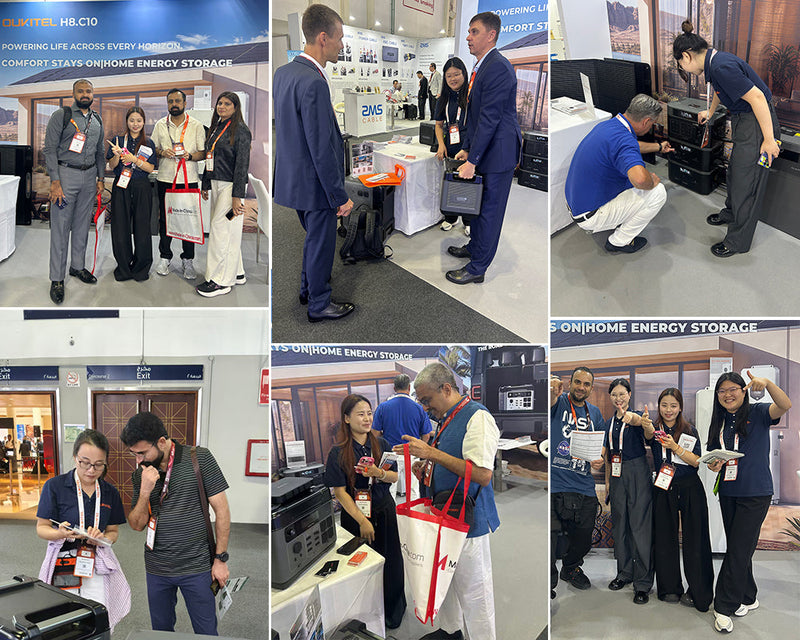
OUKITEL Power Brings Full-Scenario Energy Storage Solutions to Intersolar Middle East 2026 in Dubai

OUKITEL Showcases Energy Storage Solutions at Intersolar South America 2026, Accelerating Expansion into Latin America
The European Homeowner’s Blueprint to Slashing Heat Pump Bills with Battery Storage and Smart Tariffs
Sizing Solar and Battery for a Winter Heat Pump: A Cold‑Climate Guide for Europe (Germany, Sweden, Ukraine)
Heat Pump Power Outage Survival Guide: Stretching Your Battery Through Multi-Day Winter Outages