C01
C01


No Cooling Fan in Portable Power Stations: The Pros and Cons of Silent Design
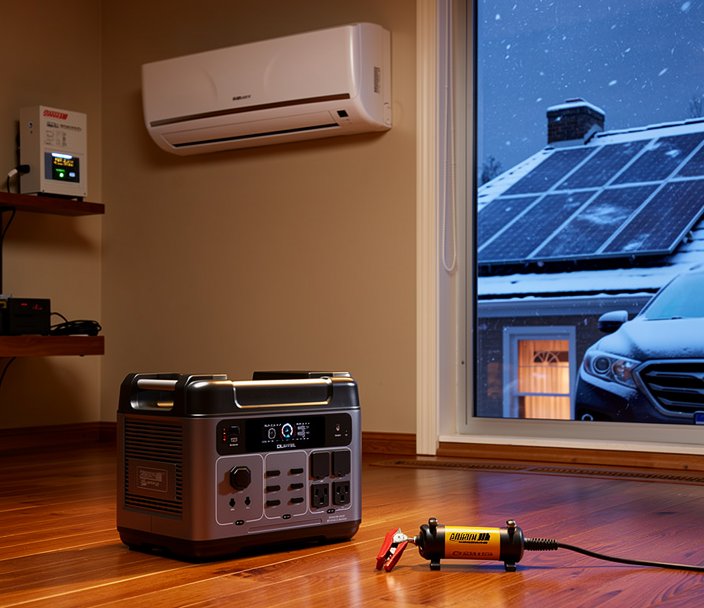
The quiet hum of a drone, the soft whisper of a breeze — these are sounds that blend into the background. But if you’ve ever been jolted awake by the sudden whir of a cooling fan inside a portable power station, you know how disruptive even a modest noise can be. As portable power stations become the backbone of off-grid life, emergency preparedness, and mobile work setups, a growing number of buyers are asking one question: do I really need a cooling fan, or can I get away with a fanless design?
A portable power station with no cooling fan isn’t a gimmick. It’s a deliberate engineering choice that prioritizes acoustic serenity, but it comes with meaningful trade-offs in sustained output, size, and how you’ll use the unit day after day. This guide breaks down exactly what you’re signing up for when you choose a fanless power station, how passive cooling works, and where silent design shines — or falls short.

Why Fanless? The Appeal of Silent Power Stations
At first glance, the benefit is obvious: silence. A fanless power station produces zero mechanical noise. There’s no bearing whine, no air turbulence, no high-pitched motor startup. For a camper sleeping three feet from their battery, a digital nomad recording audio inside a van, or a homeowner using backup power overnight in a bedroom, that silence isn’t a luxury — it’s a requirement.
But the real appeal goes deeper than decibels. A fan is a moving part, and every moving part introduces a point of failure. Dust, debris, and fine sand can clog fan blades or bearings, especially in outdoor environments. A fanless design eliminates that vulnerability, potentially reducing long-term maintenance and extending the life of the unit itself. Some users also report that fanless power stations feel more confidence-inspiring near sensitive electronics: there’s no airflow pushing potentially damp or dusty air across delicate circuit boards.
In practice, the decision to go fanless often reflects a shift in priorities. Rather than chasing maximum wattage or the fastest possible recharge, buyers are starting to value a different kind of reliability — one that doesn’t intrude on their environment. As we explored in our article on what to look for in a super quiet portable power station, the market is now responding with designs that trade brute power for refinement.
How Fanless Designs Keep Cool: Passive Cooling Explained
Without a fan, heat must escape the battery and inverter through passive cooling — a combination of conduction, natural convection, and thermal radiation. The chassis becomes a heat sink. Manufacturers use materials like aluminum alloy housings, finned enclosures, and strategically placed air vents to maximize surface area and encourage air movement without any moving parts.
Passive cooling relies heavily on physics: hot air rises. Many fanless units are designed with vertical channels or elevated bases that allow cool air to enter from the bottom and warm air to exit from the top. This chimney effect works best when the unit is placed in an open space — not tucked inside a cabinet or buried under a sleeping bag. Real-world scenario: a camper placing a fanless power station under a picnic table in still air may see higher internal temperatures than if it were standing upright on the tabletop, simply because the natural convection path is obstructed.
A critical limitation often overlooked is that passive cooling is ambient-temperature-dependent. In a 30°C (86°F) environment, a fanless unit’s ability to shed heat is reduced compared to a cooler 20°C setting. The battery management system (BMS) inside will derate output or pause charging if internal sensors detect excessive temperature. So while the unit may be rated for a certain continuous wattage, that rating assumes a specific ambient temperature range — often around 25°C. Outside that comfort zone, performance drops.
One common failure mode: using a fanless power station in a hot car or enclosed tent on a sunny day. The external heat soak can bring the unit to its temperature ceiling before any load is applied, forcing an early shutdown even for small devices. This is a real constraint that active cooling would mitigate with forced airflow.
Trade-Offs: When No Fan Means Lower Performance
The biggest trade-off is sustained power output under load. A fan-cooled unit can pull heat away from inverter MOSFETs and battery cells aggressively, allowing it to sustain near-peak output for longer periods. A fanless design, by contrast, must limit average power over time to keep component temperatures within safe margins. You’ll often see this in the fine print: a fanless model marketed as “800W continuous” may only hold that level for 20-30 minutes on a warm day before the BMS throttles it down to 500W or even 300W.
This doesn’t mean fanless is weak; it means it’s optimized for bursty, moderate loads rather than sustained high draw. For example, running a 600W coffee maker for five minutes is fine; running a 700W electric grill for 45 minutes may not be. The inverter will protect itself by gracefully reducing output or shutting down temporarily — which can be frustrating if you’re depending on that power.
Charging speed is another area affected. Fast AC charging generates significant heat inside the power electronics. A fanless unit might cap its charging rate at 300W internally even if the design could accept 500W, solely to stay within passive cooling limits. The result: longer recharge times, especially if you’re relying on a generator or wall outlet for a quick top-up during a brief window. This is a hidden cost of silence that many spec sheets gloss over.
Weight can also become a proxy for performance. To get enough passive cooling surface area for a 1000Wh+ battery, manufacturers sometimes increase the aluminum mass, making the unit heavier than a comparable fan-cooled model. That can be a problem for backpackers or anyone who counts every kilogram. A 6 kg fanless unit might feel nimble, but a 12 kg fanless design with the same capacity but a larger heatsink might feel less portable than an equivalent fan-cooled alternative that shaved off a couple of kilos.
Real-world scenario: a van-lifer running a 12V compressor fridge 24/7. The fridge’s compressor cycles on and off, drawing 40-60W in bursts. A fanless station can handle this indefinitely because the average power is low and the load is intermittent. But if the same person also runs a 1500W induction cooktop for 20 minutes, they’ll reach the thermal ceiling quickly. That’s where a unit with a fan — like many higher-wattage power stations — would keep chugging along.
When a Fanless Portable Power Station Makes Sense (And When It Doesn’t)
Ideal scenarios for fanless:
- Bedroom CPAP use overnight. A CPAP machine draws 30-60W and runs continuously. Silence is paramount, and the load is well within passive cooling capabilities for an appropriately sized unit. This is arguably the strongest use case for a fanless design.
- Office backup in a quiet workspace. Keeping a router, laptop, and monitor powered during a blackout without adding fan noise to an already stressful situation.
- Audio/video recording setups. Location sound recordists, podcasters, and live streamers need zero mechanical noise in the signal chain.
- Nighttime camping in a tent. Lights, phone charging, and a small fan (battery-powered) can be powered without disturbing sleep.
Scenarios where a fan is better:
- Powering high-wattage tools repeatedly. Circular saws, angle grinders, or large air pumps demand bursts that active cooling handles more gracefully.
- Home backup for a refrigerator and sump pump. These loads can cycle on simultaneously and demand sustained inverter capability that fanless designs typically can’t sustain in warm basements.
- Fast recharging in a short window. If you have only an hour to recharge from AC before the next outage, a fan-cooled unit will accept higher charge rates without thermal throttling.
- Very hot environments. Using a power station outdoors in direct sun at 35°C+ heavily penalizes passive cooling. A fan helps push hot air out and keeps temperatures manageable.
Practical decision rule: If your daily power use averages under 200-300W and you value silence above all else, a fanless unit is a strong candidate. If you anticipate loads above 500W for more than 10-15 minutes at a time, or you’ll be operating in warm conditions without shade, invest in a unit with a well-designed variable-speed fan system. Many modern fan-cooled units are remarkably quiet at low loads, often inaudible from a meter away — the fan only spins up under heavy load, and even then, some models keep noise below 40 dB, similar to a library whisper. As we detail in our guide on noise levels during operation, not all fans are intrusive.
Key Considerations Before Buying a No-Fan Battery System
Before you click “buy,” there are four practical checks to apply that go beyond the spec sheet hype.
1. Load profiling: measure, don’t guess. Use a plug-in power meter to log the actual wattage and duration of the devices you’ll power. A fanless unit might struggle with a “700W microwave” not because of the power level but because the microwave cycles the magnetron on and off, creating repeated thermal spikes. Test your rig for at least an hour in the same ambient conditions you’ll use it in. If you see sustained draws above the unit’s “continuous” rating for more than a few minutes, look elsewhere.
2. Ambient temperature envelope. Check the operating temperature range in the manual. Most LiFePO4-based units list 0°C-40°C, but that’s for all modes; often the upper limit for fast charging or inverter output is lower — sometimes 35°C. If you plan to charge in a sun-baked vehicle, you’re likely to hit that ceiling. A workaround: pre-cool the environment or only charge at night. But that reduces flexibility.
3. Passive cooling design integrity. Not all fanless units are created equal. Look for large, finned aluminum enclosures, plenty of bottom-to-top airflow pathways, and a BMS that communicates thermal status via an app or display. A small, tightly packed plastic housing with no visible vents is a red flag — it may look sleek but will trap heat and trigger early throttling.
4. Warranty and cycle life reality. Some fanless models might run hotter internally, which can accelerate battery aging over hundreds of cycles. While LiFePO4 chemistry is inherently stable, consistently operating at the upper end of its temperature range can reduce total cycle life by 5-15% compared to a well-cooled counterpart. Look for manufacturers that are transparent about expected cycle counts under real-world thermal conditions, not just ideal lab conditions.
A common mistake to avoid: assuming that a fanless power station can handle any load within its rated wattage “as long as it’s within the specs.” The rating is for a short burst under specific lab conditions; the real world includes cumulative heat soak, voltage sag, and ambient heat that drastically reduce usable continuous power. Treat a fanless unit as a “moderate-duty” tool and plan your loads conservatively.
Frequently Asked Questions
Can a fanless power station safely run a CPAP machine all night?
Yes, for most CPAP machines (30-60W continuous), a properly sized fanless unit can run 8 hours without overheating, provided the ambient temperature is moderate and the unit has adequate passive cooling surface area. However, if you use a heated humidifier and heated tubing, the draw can exceed 80W — measure your device’s actual consumption and ensure the station’s continuous output rating comfortably covers it at your expected overnight temperatures.
Do fanless batteries degrade faster due to heat?
Not necessarily, but there is a subtle risk. LiFePO4 cells can tolerate higher temperatures than standard lithium-ion, but chronic exposure to near-limit temperatures (40-45°C internal) can trim total cycle life by a small percentage. A well-designed passive cooling system that keeps cells under 35°C in normal use will have negligible impact. The key is to avoid sustained high loads in hot environments; doing so repeatedly can accelerate degradation compared to a fan-cooled unit that maintains lower internal temps.
Are there passive cooling technologies that actually work well in stationary battery systems?
Yes. Effective passive cooling in portable power stations uses large metal heatsinks, aluminum enclosures with finned ridges, and vertical convection channels that promote chimney-effect airflow. Some designs incorporate phase-change materials that absorb heat during peak loads and release it slowly. These technologies work well for intermittent, moderate loads (under 300W average) and in environments with reasonable ambient temperatures, but they cannot match the thermal headroom of active fan cooling for sustained high-power output.
How can I tell if a fanless unit will overheat before I buy it?
Read independent reviews that test sustained loads at elevated ambient temperatures (25-30°C). Look for mention of thermal throttling, reduced output, or automatic shutdowns during extended use. A reliable indicator is a manufacturer that publishes continuous power ratings with an ambient temperature condition (e.g., “800W continuous at 25°C”). If only a peak wattage is listed without temperature context, the unit is likely to throttle earlier than you’d expect.
The decision to go fanless is ultimately a decision about priorities. Silence has real value — especially in small spaces, at night, or when recording — but it comes at the expense of thermal headroom. Before you choose, think not about peak power, but about your typical power: how many watts you’ll draw for how many minutes, in what ambient temperature, and whether a brief fan noise is an acceptable trade for more consistent high-output performance. If you need absolute quiet with moderate loads and can manage a few constraints, a fanless portable power station will earn its place. If you’re running a jobsite or powering a fridge in a hot garage, look for a unit with a smart, variable-speed fan that stays silent when you need it and spins up only when you push the limits.
Latest articles
OUKITEL Power Brings Full-Scenario Energy Storage Solutions to Intersolar Middle East 2026 in Dubai

OUKITEL Showcases Energy Storage Solutions at Intersolar South America 2026, Accelerating Expansion into Latin America
The European Homeowner’s Blueprint to Slashing Heat Pump Bills with Battery Storage and Smart Tariffs
Sizing Solar and Battery for a Winter Heat Pump: A Cold‑Climate Guide for Europe (Germany, Sweden, Ukraine)
Heat Pump Power Outage Survival Guide: Stretching Your Battery Through Multi-Day Winter Outages